
Key Takeaways
- Trader Joe’s carries 7–9 olive oil options depending on season and region — quality varies dramatically, and two of the most commonly grabbed bottles ranked at the bottom of Consumer Reports’ blind taste testing.
- Consumer Reports’ top picks from the TJ’s lineup are the Sicilian Selezione EVOO (praised for “pungent, grassy-green fruit flavor with a bit of a kick”) and the 100% Italian Organic EVOO — both verified as genuinely fresh and high-quality in blind testing.
- The standard Trader Giotto’s EVOO (the most commonly purchased bottle) ranked poorly in Consumer Reports testing for having “hardly any fruit flavor” and tasting stale — it’s the bottle most people default to, and it’s not the best choice.
- Trader Joe’s olive oil prices range from $0.27/oz to $0.59/oz — the cheapest option is also one of the worst-performing in quality tests. Value and cheapness are not the same thing here.
- The California EVOO benefits from a 2022 California state law requiring that oil labeled as California-grown actually contains 100% California olives — making it one of the most origin-transparent options in the entire TJ’s lineup.
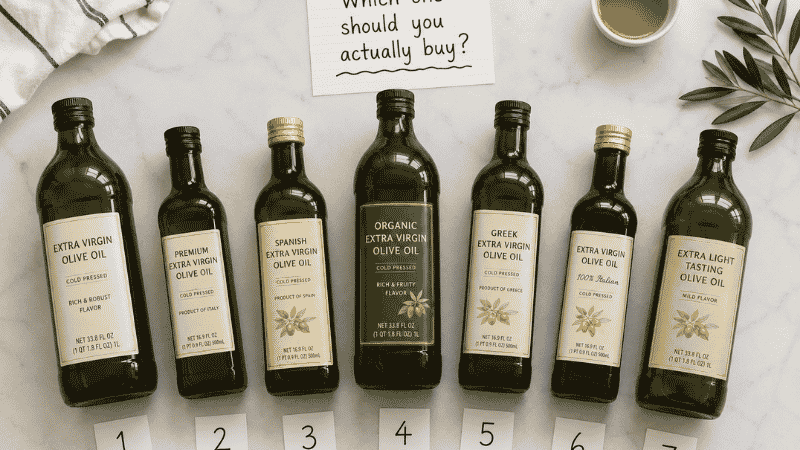
You know the feeling. You’re in the Trader Joe’s olive oil section, staring at seven different bottles that look roughly similar, priced within a few dollars of each other, and you grab the standard green bottle because it’s what you always get. It seems fine. It’s probably fine.
Here’s what most people don’t know: Consumer Reports conducted a professional blind taste test of seven Trader Joe’s olive oils — tasted by expert panelists from blue glasses, the industry standard for unbiased evaluation. The standard Trader Giotto’s EVOO, the bottle most people reach for by default, “had hardly any fruit flavor and tasted stale.” Two other commonly purchased options — the Spanish EVOO and the Spanish Organic — also tested poorly for staleness and lack of character.
The good news is that some Trader Joe’s olive oils genuinely pass professional quality tests, and they’re not dramatically more expensive. The better news is that this guide gives you all of that research in one place — with real price-per-ounce data, Consumer Reports results, use-case recommendations, and a clear answer to the question nobody else is answering: which of these should you actually put in your cart?
The Full Trader Joe’s Olive Oil Lineup — What You’re Actually Choosing Between
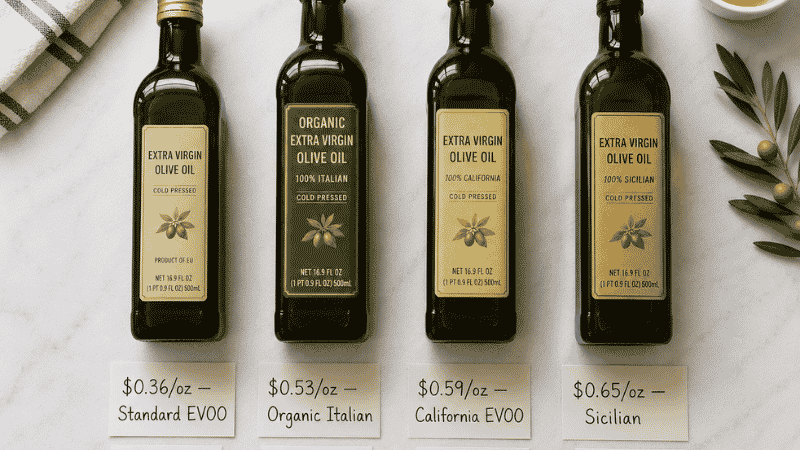
Trader Joe’s olive oil selection varies by season and region, but the core lineup as of 2026 includes:
| Product | Size | Approx. Price | Price/oz | Type |
|---|---|---|---|---|
| Trader Giotto’s Imported Olive Oil | 33.8 oz | $11 | $0.33 | Refined blend (NOT all EVOO) |
| Trader Giotto’s Extra Virgin Olive Oil | 33.8 oz | $12 | $0.36 | Extra Virgin |
| Trader Joe’s Spanish Organic EVOO | 16.9 oz | $9 | $0.53 | Extra Virgin, Organic |
| Trader Giotto’s 100% Italian Organic EVOO | 16.9 oz | $9 | $0.53 | Extra Virgin, Organic |
| Trader Giotto’s Italian President’s Reserve EVOO | 33.8 oz | $13 | $0.38 | Extra Virgin |
| Trader Joe’s California Extra Virgin Olive Oil | 16.9 oz | $8–$10 | $0.47–$0.59 | Extra Virgin, CA-certified |
| Trader Joe’s Sicilian Selezione EVOO | 16.9 oz | $10–$11 | $0.59–$0.65 | Extra Virgin, seasonal |
Important note: The Sicilian Selezione is a seasonal/limited item and may not be available year-round. The California EVOO availability also varies. The most consistently stocked items are the Trader Giotto’s line.
Every Trader Joe’s Olive Oil Ranked: Quality, Value, and Best Use
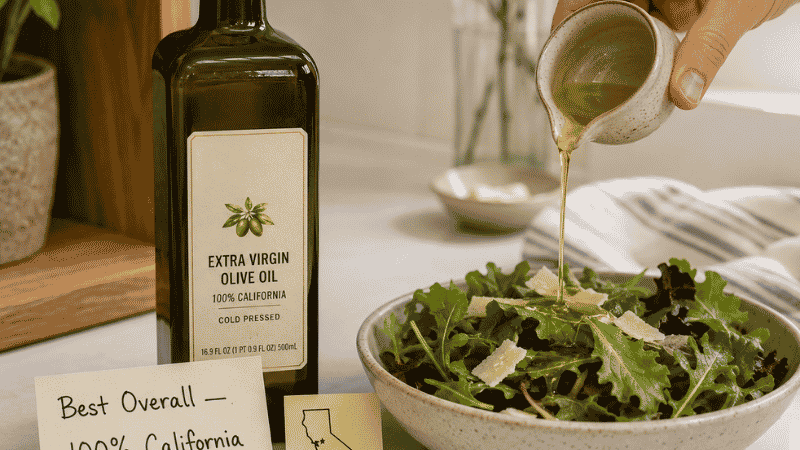
#1: Trader Joe’s California Extra Virgin Olive Oil — Best Overall Pick
Price/oz: ~$0.47–$0.59 | Consumer Reports: Not directly tested, but Tasting Table’s #1 pick | Availability: Seasonal/regional
This is the consensus best choice across multiple independent taste tests. Tasting Table ranked it #1 in their 9-oil comparison, describing it as “mellow, fresh, fruity, and clean-tasting — without being particularly bold or pronounced.” Food Republic and Sporked independently praised it for its clean flavor and versatility.
What makes the California EVOO particularly trustworthy is a 2022 California state law protecting olive oil integrity: any oil labeled as California-grown must contain 100% California olives, with no blending from other origins allowed. This legal protection means you’re getting genuine single-origin transparency that multi-country blended oils can’t offer.
The flavor profile is mild enough for everyday cooking but fresh and genuine enough for raw finishing — which makes it the most versatile bottle in the lineup. If you find it in stock, this is the one to buy.
Best for: Everything — cooking, salad dressings, finishing, drizzling. The most versatile bottle in the TJ’s lineup.
Watch out for: Availability — this is not always in stock. If you find it, buy two.
#2: Trader Joe’s Sicilian Selezione Extra Virgin Olive Oil — Best Flavor
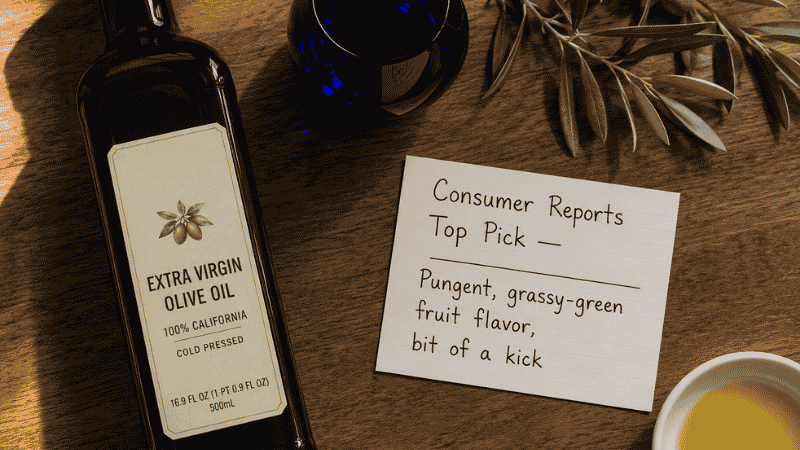
Price/oz: ~$0.59–$0.65 | Consumer Reports: Top pick — “pungent and grassy-green fruit flavor, slightly nutty, bit of a kick” | Availability: Seasonal
This is the bottle with the most enthusiastic reviews across every taste test — and it’s the only TJ’s olive oil that Consumer Reports specifically called out as a top recommendation. Their description: “Pungent and grassy-green fruit flavor, with a slightly nutty taste and a bit of a kick.” Food Republic ranked it #1 in their 6-oil comparison for flavor, quality, and versatility.
The Sicilian Selezione has genuine Italian single-origin character — the peppery finish that indicates oleocanthal content, the grassy fruitiness that signals freshness. It’s a noticeably better olive oil in a blind taste setting than most of the other bottles in the TJ’s lineup.
The caveat is availability. This is a seasonal and sometimes limited item at Trader Joe’s. It’s not always on shelves, and when it appears, it tends to go quickly. If you see it, buy it. If you don’t, the California EVOO is the next best choice.
Best for: Raw finishing applications — drizzling over salads, finished pasta, bread dipping, any dish where olive oil flavor is prominent. Also excellent for cooking when you want more olive character in the dish.
Not ideal for: High-heat cooking where the nuanced flavor will cook off — save it for raw or low-heat applications where you’ll taste it.
#3: Trader Giotto’s 100% Italian Organic Extra Virgin Olive Oil — Solid Mid-Range
Price/oz: ~$0.53 | Consumer Reports: Second-tier recommendation — “complex and balanced, with both ripe and green fruit notes, but one sample was less fresh” | Availability: Regular stock
Consumer Reports found this one “complex and balanced” in their blind testing, though they noted inconsistency between samples — one was notably less fresh than the other. This variability is a mild concern for a bottle at $0.53/oz, but the better samples were genuinely good quality.
The organic certification adds traceability credibility beyond what the standard Trader Giotto’s EVOO offers. If the California EVOO and Sicilian Selezione aren’t available, this is the next best regularly-stocked option.
Best for: Everyday cooking and simple salad dressings. Not as impressive for raw finishing as the California or Sicilian options, but a solid functional choice.
#4: Trader Giotto’s Italian President’s Reserve Extra Virgin Olive Oil — Value for Quality
Price/oz: ~$0.38 | Consumer Reports: Top recommendation — “complex with good balance of fruit, bitterness, and pungency, spicy and herbal” | Availability: Regular stock
Despite its slightly pretentious name (“President’s Reserve” means nothing in terms of quality certification), this bottle performed well in Consumer Reports testing: “complex with a good balance of fruit, bitterness, and pungency, and a spicy, herbal flavor.” At $0.38/oz for a 33.8-oz bottle, it’s the best value among the bottles that Consumer Reports actually recommended.
The catch: some independent tasters found it heavy and slightly greasy compared to lighter options. Chowhound’s Italian-resident reviewer noted it was “the sharpest, most spicy and peppery” of the lineup — which some people will love and others will find aggressive.
Best for: Cooking applications, sautéing, roasting — the bold flavor works better in cooked applications than as a raw finisher. Also good for those who specifically prefer assertive, peppery olive oil.
Not ideal for: Delicate raw applications where a heavy or aggressive oil could overpower the dish.
#5: Trader Giotto’s Extra Virgin Olive Oil (Standard) — Functional, But Not the Best Choice
Price/oz: ~$0.36 | Consumer Reports: NOT recommended — “had hardly any fruit flavor and tasted stale” | Availability: Always in stock
This is the bottle most TJ’s shoppers grab by default. It’s always there, the price is reasonable, and the familiar green bottle is easy to find. The problem: Consumer Reports’ blind testing found it distinctly subpar — “had hardly any fruit flavor and tasted stale.” This is the kind of oil that tastes like nothing and smells like nothing, which is a strong signal of either oxidation, poor quality olives, or significant age.
The practical implication: at $0.36/oz, you’re paying more per ounce than some of TJ’s genuinely good options in larger bottles, and getting a product that multiple independent tests found underwhelming. The President’s Reserve at $0.38/oz — just $0.02/oz more — was Consumer Reports’ recommended pick. The marginal price difference makes the standard EVOO hard to justify.
Best for: High-volume, high-heat cooking where olive oil is purely a cooking medium and flavor doesn’t matter. This and only this.
Not ideal for: Any application where you’ll actually taste the oil — dressings, finishing, drizzling, dipping.
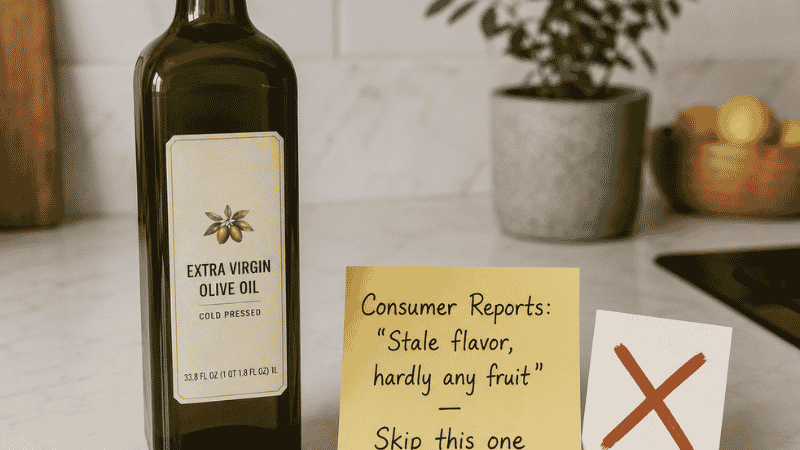
#6: Trader Joe’s Spanish Organic Extra Virgin Olive Oil — Skip It
Price/oz: ~$0.53 | Consumer Reports: NOT recommended — “stale, with a taste of overripe olives” | Availability: Regular stock
At $0.53/oz — one of the more expensive options in the TJ’s lineup — the Spanish Organic performed the worst in Consumer Reports’ testing among the extra virgin options: “stale, with a taste of overripe olives.” This is particularly disappointing for an organic-certified option at a premium price.
There’s no reason to choose this over the Italian Organic, which costs the same price per ounce and tested significantly better.
Skip entirely. If you want an organic TJ’s EVOO, buy the Italian Organic instead.
#7: Trader Giotto’s Imported Olive Oil — Not Extra Virgin, Don’t Buy It for Quality
Price/oz: ~$0.33 | Availability: Regular stock
This is the only bottle in the TJ’s lineup that is NOT fully extra virgin — it’s a blend of extra virgin and refined olive oil. Tasting Table ranked it last in their 9-oil test, noting it “had the flavor of a standard olive oil, not a high-quality EVOO.” The texture is thin and translucent.
At $0.33/oz, it’s the cheapest. But it’s a fundamentally different (and lesser) product than extra virgin olive oil. The health benefits associated with extra virgin olive oil research — polyphenols, antioxidants, anti-inflammatory oleocanthal — are largely absent from refined oil blends.
The only case for buying it: You need a large quantity of neutral cooking oil at a low price and don’t care about olive oil’s health properties. Otherwise, skip it.
The TJ’s Olive Oil Decision Matrix
Here’s the fastest guide to the right bottle for each situation:
You want the best overall: California EVOO (if in stock) → Sicilian Selezione (if in stock) → Italian Organic
You want the best for cooking daily: Italian President’s Reserve ($0.38/oz, Consumer Reports recommended, large bottle)
You want the best for finishing and drizzling: California EVOO or Sicilian Selezione — whichever is available
You want organic: Italian Organic (not Spanish Organic — the Spanish Organic tested poorly)
You want to skip: Standard Trader Giotto’s EVOO, Spanish EVOO, Imported Olive Oil
Is Trader Joe’s Olive Oil Actually Good Value vs. Costco and Aldi?
This is the comparison most TJ’s-specific guides avoid, and it’s worth answering honestly.
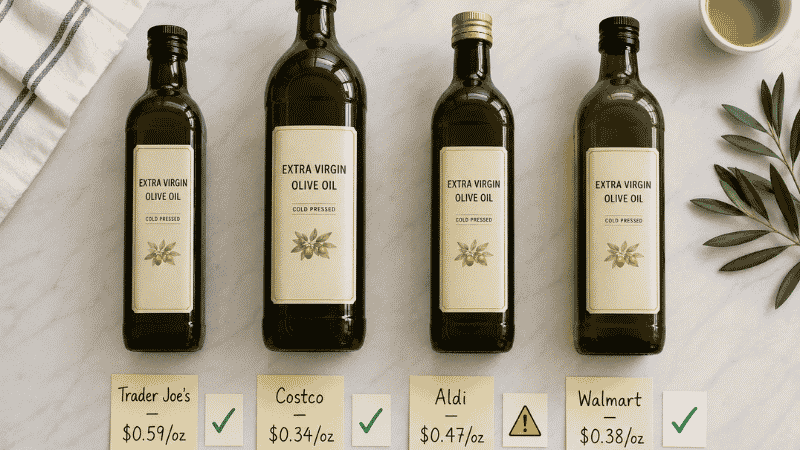
| Retailer | Best Option | Price/oz | Quality Verification |
|---|---|---|---|
| Trader Joe’s | Sicilian Selezione or California EVOO | $0.47–$0.65 | Consumer Reports tested ✅ |
| Costco | Kirkland Organic EVOO | $0.32–$0.36 | Bureau Veritas certified ✅ |
| Aldi | Specially Selected EVOO | $0.45–$0.50 | Consumer Reports Smart Buy ✅ |
| Walmart | Great Value EVOO | $0.35–$0.40 | Limited verification ⚠️ |
The honest verdict:
Trader Joe’s best options (California, Sicilian Selezione) are genuinely good olive oils, but they’re among the more expensive options on this cross-retailer list. The advantage of Trader Joe’s is that their best bottles are readily available without a warehouse membership, come in smaller bottles (better for freshness if you use oil slowly), and have been independently tested by Consumer Reports.
For families who use olive oil in moderate quantities and prioritize freshness over bulk savings: Trader Joe’s California EVOO or Sicilian Selezione are excellent choices. For families who use olive oil daily in large quantities: Costco’s Kirkland Organic is cheaper per ounce and equally well-verified.
The TJ’s Availability Problem: How to Handle Rotating Stock
This is the Trader Joe’s shopping reality that most olive oil guides don’t acknowledge: the best TJ’s olive oils are often not consistently available.
The Sicilian Selezione is seasonal and sometimes sells out mid-season. The California EVOO availability varies by region and time of year. The consistently stocked bottles — the standard Trader Giotto’s EVOO, the Imported Olive Oil — are ironically among the worst performers in quality tests.
How to handle this practically:
If the California EVOO or Sicilian Selezione is in stock: buy two bottles. The Sicilian in particular tends to disappear from shelves for extended periods.
If neither is available: buy the Italian Organic or Italian President’s Reserve instead — both are Consumer Reports recommended and regularly stocked.
If you’re tired of the availability gamble: keep Aldi Specially Selected or Kirkland Organic as your pantry staple and use TJ’s special bottles as an upgrade when you find them.
How to Store Trader Joe’s Olive Oil
Trader Joe’s oils come in smaller bottles than Costco, which is actually a freshness advantage — less time for the oil to oxidize between first use and finishing the bottle. That said, proper storage still matters.
Keep it in a dark location. TJ’s olive oil bottles vary in packaging — some are dark glass, some are lighter. Regardless of bottle color, store in a cool cabinet away from the stove and away from direct light.
Use within 3–4 months of opening. At the bottle sizes TJ’s sells (typically 16.9 oz or 33.8 oz), most households will finish a bottle within this window naturally. If you use very little olive oil, buy the 16.9 oz size rather than the larger bottles.
Smell it before using for raw applications. Fresh EVOO smells grassy, slightly fruity, and mildly peppery. If it smells waxy, flat, or like cardboard — it’s past its prime regardless of the “best by” date. Given that Consumer Reports found some TJ’s oils already tasting stale from the shelf, checking freshness before using is not a paranoid habit.
FAQ
Q: What is the best olive oil at Trader Joe’s?
Based on Consumer Reports blind testing and multiple independent taste tests, the Sicilian Selezione EVOO is the highest-quality bottle in the lineup — praised for genuine fruitiness, peppery finish, and balanced flavor. The California Extra Virgin Olive Oil is the most consistently praised bottle across all taste tests and benefits from California’s strict labeling laws. If you can find either of these, choose them over the standard Trader Giotto’s bottles.
Q: Is Trader Giotto’s extra virgin olive oil good?
The standard Trader Giotto’s EVOO (the 33.8 oz green bottle that most people default to) tested poorly in Consumer Reports’ blind evaluation: “had hardly any fruit flavor and tasted stale.” For a similar or lower price per ounce, the Italian President’s Reserve is Consumer Reports’ recommended pick and a significantly better choice.
Q: Is Trader Joe’s olive oil real extra virgin?
Most bottles in the TJ’s lineup are labeled extra virgin, but quality varies. Consumer Reports tested seven TJ’s olive oils and found that the standard Trader Giotto’s EVOO and the Spanish options tasted stale or had minimal olive character — markers of either poor quality or significant age. The Sicilian Selezione and Italian options tested as genuinely fresh and high-quality extra virgin.
Q: Is Trader Joe’s olive oil better than Costco Kirkland?
For flavor at the top end: TJ’s Sicilian Selezione is arguably more complex than Kirkland. For value and verified quality: Kirkland Organic EVOO at $0.32–$0.36/oz is cheaper per ounce and Bureau Veritas certified. For smaller-quantity buyers who prioritize freshness: TJ’s smaller bottles are a practical advantage. Neither is strictly better — it depends on how much you use and what matters most to you.
Q: What happened to Trader Joe’s Sicilian olive oil?
The Sicilian Selezione is a seasonal item at Trader Joe’s and may not be available year-round. When it disappears from shelves, it’s typically due to seasonal inventory rotation rather than a permanent discontinuation. TJ’s products come and go — the best strategy is to buy multiple bottles when you find it in stock.
Q: Which Trader Joe’s olive oil should I use for cooking vs. finishing?
For cooking (sautéing, roasting, everyday use): Italian President’s Reserve or Italian Organic — both are regularly stocked, Consumer Reports recommended, and priced reasonably for regular use. For finishing (drizzling, dressings, bread dipping): California EVOO or Sicilian Selezione — their fresher, more complex flavor is worth preserving for raw applications where you’ll actually taste the oil.
The Honest Bottom Line
Trader Joe’s has some genuinely good olive oils — and some that, based on independent testing, you’d be better off avoiding despite their prominent shelf placement. The standard Trader Giotto’s EVOO is the most-purchased bottle and the least-impressive in quality tests. The California EVOO and Sicilian Selezione are excellent, and Consumer Reports separately verified the Sicilian and Italian options as worth buying.
The Trader Joe’s olive oil aisle rewards the shopper who knows what to look for. Use this guide, check whether the California or Sicilian bottles are in stock before defaulting to the standard green bottle, and don’t assume the most familiar bottle is the best one.
For a broader look at how Trader Joe’s compares to Costco for olive oil — including the head-to-head price and quality comparison — our Costco olive oil guide covers the complete picture. And for the label-reading skills that help you evaluate any olive oil, at any store, our extra virgin olive oil buying guide is the reference to bookmark.
References
- Consumer Reports. Best Extra Virgin Olive Oils at Trader Joe’s — Blind Taste Test Results. consumerreports.org
- UC Davis Olive Center. Olive Oil Quality and Authenticity Research. olivecenter.ucdavis.edu
- California Department of Food and Agriculture. California Olive Oil Labeling Law — AB 535 (2022). cdfa.ca.gov
- North American Olive Oil Association. Olive Oil Standards and Quality Grades. aboutoliveoil.org
- American Heart Association. Healthy Cooking Oils — Olive Oil Recommendations. heart.org