
Key Takeaways
- Extra virgin olive oil is safe and appropriate for the vast majority of home cooking — including sautéing, roasting, and pan-frying at normal temperatures. A landmark 2018 study published in ACTA Scientific Nutritional Health found that EVOO produced fewer harmful oxidative compounds when heated than canola oil, sunflower oil, and other commonly recommended “high-heat” oils.
- The smoke point myth — that you can’t cook with extra virgin olive oil because it smokes too early — is based on outdated science. EVOO’s smoke point ranges from 375–405°F, which covers sautéing, roasting at standard temperatures, and pan-frying. The stability of an oil under heat depends more on its antioxidant content than its smoke point number alone.
- For everyday family cooking, the best olive oil for cooking is Kirkland Signature Organic EVOO (Costco, ~$0.32–$0.36/oz) or Aldi Specially Selected EVOO (~$0.45–$0.50/oz) — both independently verified as genuine extra virgin and priced for daily use without restraint.
- You don’t need two different bottles for cooking and finishing — but you may want two. An affordable EVOO for daily cooking and a slightly better bottle for raw finishing gives you the best of both without overspending.
- The single most important quality indicator when buying olive oil for cooking is a visible harvest date — not the smoke point on the label, not the country of origin, and not the price.
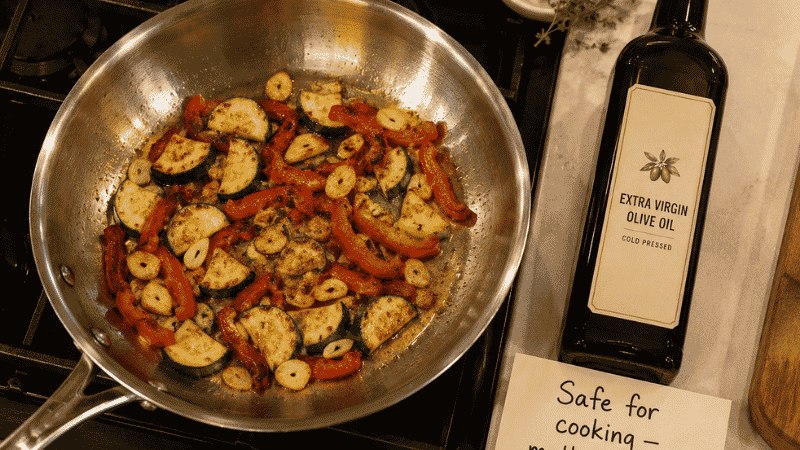
There’s a version of cooking anxiety that lives specifically in the olive oil decision. You’re standing at the stove, you add your good olive oil to the pan, and it starts smoking slightly — and you immediately think: did I just ruin $12 worth of oil? Should I have used vegetable oil? Is the “extra virgin” now regular? Will this taste wrong?
The short answer is: probably not, and almost certainly you’re fine. The longer answer — the one that actually changes how you shop for and use olive oil — is worth understanding, because it will save you money and eliminate a decision you’re currently getting wrong at the grocery store.
Most of the guidance home cooks have received about olive oil and cooking is based on a smoke point number that turns out to be less predictive of cooking safety than we thought. The more meaningful measure is oxidative stability — how well the oil resists breaking down and forming harmful compounds when heated — and extra virgin olive oil performs exceptionally well on that measure.
This guide tells you exactly which olive oil to use for each cooking method, which brands are actually worth buying for daily family cooking, and how to stop wasting money on the wrong approach.
The Smoke Point Myth: What Every Home Cook Gets Wrong About Cooking Olive Oil
The standard advice has been: extra virgin olive oil has a low smoke point, so use it only for finishing, and use a higher-smoke-point oil for cooking. This advice sounds scientific. It’s also largely wrong, or at least significantly misleading.
What Smoke Point Actually Measures
Smoke point is the temperature at which an oil visibly smokes. When an oil smokes, it’s breaking down — releasing free fatty acids and potentially forming compounds like aldehydes that can affect flavor and, at high enough levels, health.
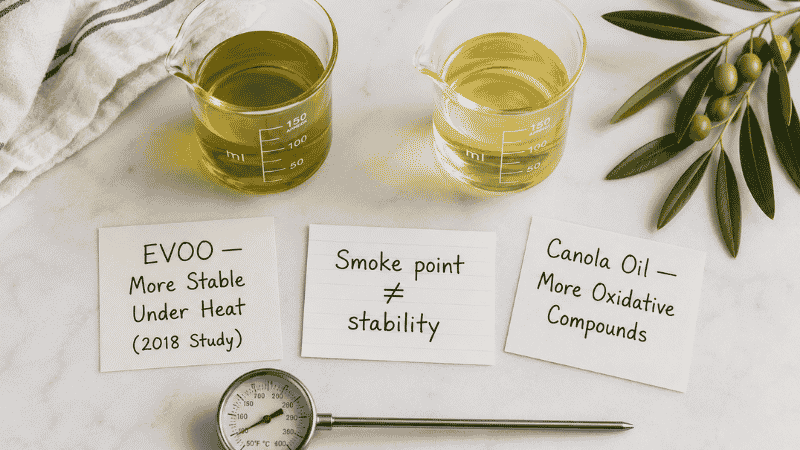
Here’s the problem: smoke point doesn’t reliably predict how quickly an oil breaks down or how much harmful chemistry is happening. An oil can smoke at a higher temperature but still degrade faster than a lower-smoke-point oil because it lacks the antioxidants to resist oxidation.
A 2018 study from the ACTA Scientific Nutritional Health journal — one of the most comprehensive analyses of cooking oil stability conducted to date — tested 10 different oils at cooking temperatures ranging from 180°C (356°F) to 240°C (464°F). The results were striking: extra virgin olive oil was the most stable oil tested, producing the least oxidative degradation and fewest harmful polar compounds, despite having a lower smoke point than canola oil, sunflower oil, and corn oil — all of which performed worse.
The reason is EVOO’s polyphenol content. These antioxidant compounds act as a natural defense against oxidation under heat. The more polyphenols an oil contains (which correlates directly with freshness and genuine extra virgin quality), the more resistant it is to heat degradation even if its smoke point number is lower than refined oils.
The Practical Implication
You can cook with extra virgin olive oil for:
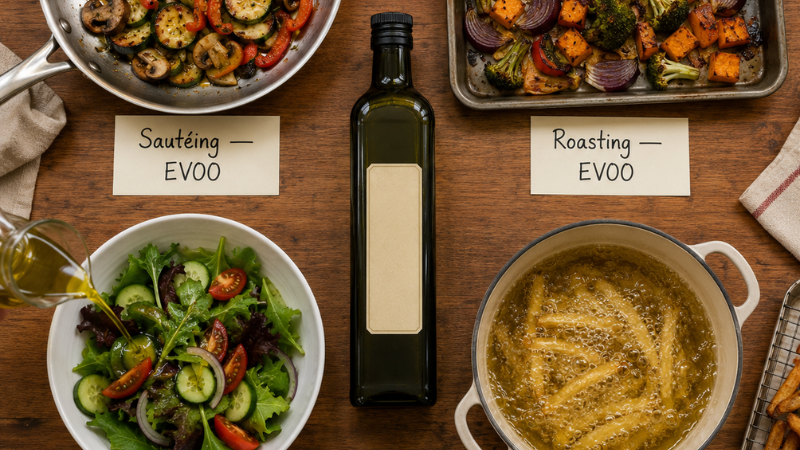
- Sautéing vegetables, proteins, and aromatics at medium to medium-high heat ✅
- Roasting at standard temperatures (350–425°F) ✅
- Pan-frying at moderate heat ✅
- Baking where olive oil flavor is appropriate ✅
- Making pasta sauce ✅
Where refined olive oil or other high-smoke-point oils are more appropriate:
- Deep frying at sustained temperatures above 400°F for extended periods ⚠️
- Very high-heat searing where you’re pushing the pan temperature as high as possible ⚠️
For the vast majority of what families actually cook on a weeknight — sautéed vegetables, chicken thighs, roasted potatoes, pasta — extra virgin olive oil is not only acceptable but better than most alternatives.
Best Olive Oil for Cooking: Matched to Every Method
For Everyday Sautéing (Medium to Medium-High Heat, 300–375°F)
Use: Affordable everyday extra virgin olive oil
This covers the most common weeknight cooking scenario: onions, garlic, vegetables, ground meat, chicken pieces, eggs. At these temperatures — which represent the majority of stovetop cooking — extra virgin olive oil is stable, appropriate, and adds flavor rather than just being a cooking medium.
Best choices:
- Kirkland Signature Organic EVOO (Costco, ~$0.32–$0.36/oz) — Best value, Bureau Veritas certified
- Aldi Specially Selected EVOO (~$0.45–$0.50/oz) — Consumer Reports Smart Buy
- Carapelli Original EVOO (~$0.65–$0.75/oz) — America’s Test Kitchen top pick among supermarket brands
The key for everyday sautéing: use enough oil to actually coat the pan. Underoiling causes sticking and makes you compensate by raising the heat — which is where real smoking and degradation happens.
For Roasting (350–425°F Oven Temperatures)
Use: Same everyday EVOO, used generously
Roasting vegetables, chicken thighs, potatoes, and sheet pan meals at 375–425°F is well within EVOO’s stable cooking range. The oil you use here doesn’t need to be expensive — it needs to be genuine extra virgin (for oxidative stability) and applied generously enough to coat the food.
The approach: Toss vegetables or protein in 2–3 tablespoons of olive oil per pound before roasting. This is one of the highest-usage cooking applications in most family kitchens, which is exactly why having an affordable, reliable EVOO in large quantity (the Costco 2-liter or Aldi bottle) makes economic sense.
What happens if you see some smoke in the oven: The oil drips from the food onto the pan surface and can smoke slightly. This is normal and doesn’t mean the oil has been ruined or the food is compromised. If it’s excessive, your pan is too hot or you’ve used too little oil and it’s burning the stuck bits.
For Pan-Frying and Shallow Frying (350–400°F)
Use: Everyday EVOO or, if you prefer, regular olive oil for cost efficiency
Pan-frying chicken cutlets, fish fillets, or croquettes at 350–375°F is safely within EVOO’s stable range. The food is in contact with the oil, which keeps the oil temperature modulated and reduces degradation.
If you’re frying in volume — a large batch of chicken, or anything where you’re using a cup or more of oil — regular olive oil (the refined blend) makes sense purely for cost efficiency. You’re using too much oil for the premium to be justified.
For High-Heat Searing (Very High Heat, 400°F+)
Use: Regular olive oil or avocado oil
For getting a hard sear on a steak, achieving deep caramelization on meat, or any application where maximum heat is the goal, a refined oil with a higher smoke point is more appropriate. This represents a small fraction of most families’ cooking but is worth knowing.
Regular olive oil (labeled “olive oil” or “pure olive oil”) has a smoke point of approximately 465°F, which handles high-heat searing well. Avocado oil (smoke point ~520°F) is the premium option.
For Deep Frying (Sustained Very High Heat)
Use: Regular olive oil or a neutral oil like vegetable oil
Sustained deep frying above 400°F for extended periods is the one application where EVOO is genuinely not the right choice — both because of temperature and cost. Use regular olive oil or vegetable oil for deep frying.
For Baking (325–375°F)
Use: EVOO for olive-flavor applications; neutral oil for flavor-neutral baking
Olive oil cakes, focaccia, Mediterranean-style breads, and other recipes that call specifically for olive oil should use a decent EVOO — the flavor contributes to the recipe. Regular chocolate cakes, muffins, or any recipe where you want a neutral fat should use a lighter oil (vegetable, canola, or regular olive oil) so the olive flavor doesn’t compete.
For Salad Dressings, Finishing, and Raw Applications
Use: Your best EVOO — this is where quality matters most
Raw applications are where the full flavor profile, freshness, and polyphenol content of a high-quality extra virgin olive oil are most perceptible and most preserved. For a simple vinaigrette, a drizzle over finished pasta, a finishing touch on roasted vegetables, or bread dipping — use the better bottle.
This doesn’t mean spending $20 on a specialty oil for every salad. It means the $8 Trader Joe’s California EVOO or the slightly better Kirkland Italian EVOO are excellent for raw finishing without the premium price of specialty boutique oils.
How to Choose the Best Olive Oil for Cooking at the Grocery Store
All the cooking technique knowledge in the world doesn’t help if you’re starting with a mislabeled or degraded oil. Here’s what to look for when buying olive oil specifically for cooking.
The #1 Signal: A Harvest Date
A specific harvest date (e.g., “Harvest: October 2024”) indicates both that the producer stands behind their freshness and that you can calculate approximately how old the oil is. Olive oil peaks in quality within 12–18 months of harvest. Oil used for cooking should be fresh enough that its polyphenol content is still intact — because that’s what makes it stable under heat.
Without a harvest date, you have no way to know if the oil is 4 months old or 2 years old. This matters more for cooking than people realize: old or degraded EVOO has fewer polyphenols, which means less heat stability, which means it performs more like the refined oils you were probably told to use instead.
Packaging That Protects the Oil
Dark glass or tin are the appropriate packaging choices for a cooking oil you want to remain stable. Light degrades polyphenol content — the very compounds that make EVOO heat-stable. An oil in clear plastic that’s been sitting under fluorescent grocery store lights has likely already lost meaningful polyphenol content before you even open it.
Grade: Extra Virgin, Not Refined Blends
For everyday cooking where you want both flavor and the heat-stability benefits that come from polyphenol content, always use genuine extra virgin olive oil. Regular “olive oil” or “pure olive oil” blends have minimal polyphenols and behave more like neutral refined oils under heat.
Price Point as a Quality Signal
Genuine extra virgin olive oil has production cost floors. A 33-oz bottle at $4.99 is almost certainly a mislabeled or very old product. Expect to pay at least $0.30–$0.40/oz for a budget but verified EVOO.
Best Olive Oil for Cooking: Top Budget Picks at Major Retailers
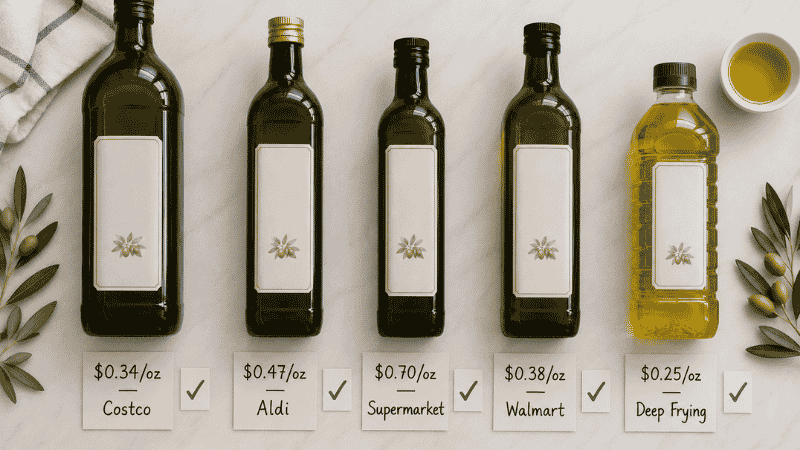
| Brand | Retailer | Price/oz | Best For | Quality Verification |
|---|---|---|---|---|
| Kirkland Signature Organic EVOO | Costco | $0.32–$0.36 | Daily cooking in volume | Bureau Veritas ✅ |
| Aldi Specially Selected EVOO | Aldi | $0.45–$0.50 | Daily cooking, smaller quantity | Consumer Reports Smart Buy ✅ |
| Carapelli Original EVOO | Walmart/Target | $0.65–$0.75 | Everyday cooking + finishing | ATK top pick ✅ |
| California Olive Ranch EVOO | Most grocery chains | $0.70–$0.85 | Cooking + finishing | COOC certified ✅ |
| Kirkland Signature Italian EVOO | Costco | $0.36–$0.41 | Cooking + better finishing | Traceable Italian origin ✅ |
For deep frying and high-volume high-heat cooking:
| Brand | Retailer | Price/oz | Notes |
|---|---|---|---|
| Kirkland Pure Olive Oil | Costco | $0.21–$0.25 | Refined blend, neutral, high smoke point |
| Great Value Olive Oil | Walmart | $0.25–$0.35 | Refined blend for budget high-heat cooking |
The Two-Bottle System for Family Cooking
Most families don’t need one premium bottle for everything. They need a system.
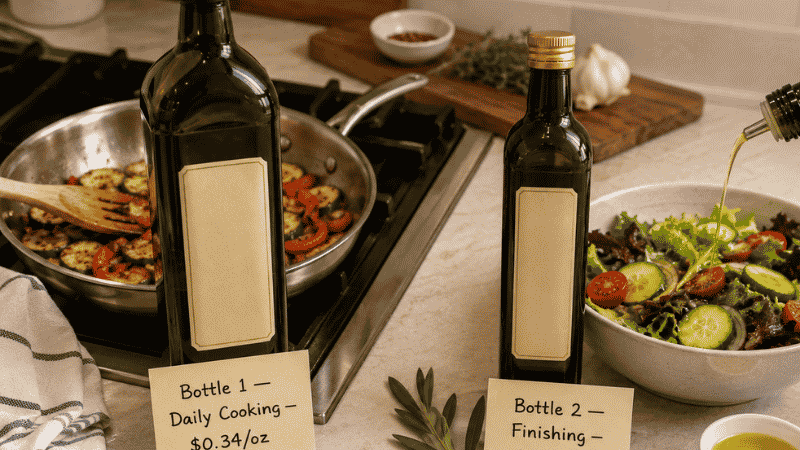
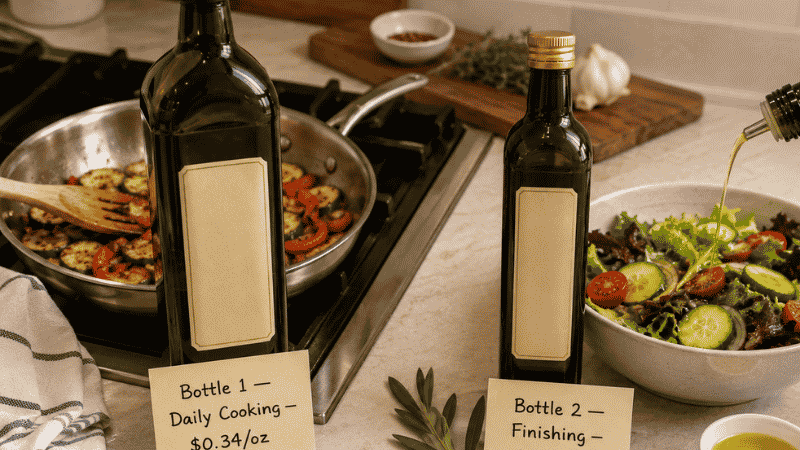
Bottle 1 — Daily Cooking: Kirkland Organic or Aldi Specially Selected for sautéing, roasting, pan-frying, and everyday use. At $0.32–$0.50/oz, you can use it generously without watching every drop. This is the bottle that lives near the stove and gets used daily.
Bottle 2 — Finishing: A mid-range EVOO like Carapelli, California Olive Ranch, or Trader Joe’s California EVOO for raw applications — dressings, drizzling, bread dipping. A 16-oz bottle used only for these purposes lasts 6–8 weeks and costs $10–$15. Replace it when it’s done, buy fresh.
The economics: This system costs approximately $25–$30 per quarter for both bottles combined — less than buying mid-priced grocery store EVOO for everything, and with better freshness management for each use.
Common Cooking Mistakes With Olive Oil (and How to Fix Them)
Mistake 1: The Pan Is Too Hot When You Add the Oil
The most common source of smoking and degradation. Preheat the pan on medium heat, add the oil, then give it 30–60 seconds to warm before adding food. Adding oil to an already very hot pan accelerates degradation and can cause food to stick.
Fix: Add oil to a warm (not hot) pan, let it heat briefly, then add food.
Mistake 2: Using Too Little Oil
Under-oiling causes food to stick, which makes you compensate by raising the temperature — which causes the oil to smoke. Two tablespoons in a 10-inch pan is the minimum for sautéing; three tablespoons is better.
Fix: Use more oil than you think you need. A proper coating protects both the food and the oil’s stability.
Mistake 3: Storing the Cooking Bottle Next to the Stove
The ambient heat from the stovetop is the fastest way to degrade an olive oil between uses. Even if you cook at appropriate temperatures, the oil sitting next to a warm stove for weeks is continuously oxidizing.
Fix: Keep the main bottle in a cool cabinet, decant a week’s worth into a small counter bottle if needed.
Mistake 4: Buying for Smoke Point Rather Than Freshness
A high smoke point number on a bottle of old, degraded, or mislabeled oil doesn’t make it a better cooking oil than a fresh, genuine EVOO with a slightly lower smoke point. Freshness and polyphenol content — not the smoke point number — determine real cooking performance.
Fix: Look for harvest dates. Choose verified brands. Don’t be fooled by smoke point marketing.
What to Do When Your Olive Oil Smokes
If your olive oil starts smoking during cooking:
- Reduce the heat. This is usually the entire solution.
- Add food immediately. Food in the pan regulates temperature by absorbing heat.
- Don’t panic. Light smoke briefly doesn’t ruin the oil or the food.
- If it’s smoking heavily and continuously: remove the pan from heat, let it cool slightly, then continue. Heavy sustained smoking indicates the temperature is too high for any oil.
What you don’t need to do: pour the oil out, switch to a different oil, or conclude that EVOO is wrong for cooking. Reduce the heat and continue.
FAQ
Q: Can you cook with extra virgin olive oil at high heat?
Yes, for the vast majority of home cooking. EVOO’s smoke point (375–405°F) covers sautéing, roasting, and most pan-frying. More importantly, a 2018 study published in ACTA Scientific Nutritional Health found EVOO was the most stable cooking oil tested, producing fewer harmful compounds than canola and sunflower oil despite having a lower smoke point. The antioxidants in genuine EVOO protect it under heat better than the smoke point number alone suggests.
Q: What is the best olive oil for sautéing?
Any genuine extra virgin olive oil works well for sautéing at normal temperatures (300–375°F). For daily family cooking, Kirkland Signature Organic EVOO (Costco) and Aldi Specially Selected EVOO offer the best price-per-ounce among independently verified options. The most important thing is that the oil is genuinely fresh — look for a harvest date on the label.
Q: Should I use regular olive oil or extra virgin for cooking?
Extra virgin for most cooking. Regular olive oil (refined blend) has fewer polyphenols, which means less heat stability and significantly fewer health benefits. The price difference between a budget EVOO and regular olive oil is small — about $0.10–$0.15/oz at major retailers — and the quality gap is significant. Regular olive oil is appropriate for deep frying at very high temperatures or when you need a completely neutral flavor.
Q: Does olive oil lose its health benefits when cooked?
Some polyphenols are reduced at cooking temperatures, but genuinely significant loss requires sustained very high heat that exceeds typical home cooking. Research shows that EVOO retains the majority of its beneficial compounds after moderate heating (sautéing, roasting at normal temperatures). Starting with a fresh, high-polyphenol EVOO means you’re finishing with more antioxidant content than most standard oils have even unheated.
Q: What oil do professional chefs use for cooking?
Professional kitchens typically use refined olive oil or neutral oils for high-volume, high-heat cooking for cost efficiency — not because these oils perform better, but because the volumes involved make premium EVOO impractical financially. For home cooking where you’re using 1–3 tablespoons at a time, the cost difference is trivial and the quality difference from fresh EVOO is meaningful.
Q: How do I know if my olive oil is good quality for cooking?
Look for: a visible harvest date (ideally within the past 14 months), a certification seal (NAOOA or COOC), dark glass or tin packaging, and a price above $0.30/oz. Smell it before using — fresh EVOO smells grassy, slightly fruity, and mildly peppery. Oil that smells waxy, flat, or like cardboard has oxidized and has lost the polyphenols that make it a good cooking oil.
The Honest Bottom Line
The best olive oil for cooking is fresh extra virgin olive oil — not the expensive specialty bottle you’re saving for salads, and not the cheap refined blend you think you’re supposed to use for cooking. A budget EVOO with a harvest date, from a verified source, used generously and stored properly, is the correct tool for the vast majority of what families cook.
Stop worrying about whether your oil is smoking slightly. Reduce the heat. Use more oil. Buy a verified bottle with a harvest date. These three things matter far more than the smoke point number on the label.
For the specific brand recommendations and where to find them at the best price, our extra virgin olive oil buying guide covers every retailer with real price data. And for the complete comparison of the best Costco and Trader Joe’s options, our Costco olive oil guide and Trader Joe’s olive oil guide give you the direct answers.
References
- Guillaume C, et al. (2018). Evaluation of Chemical and Physical Changes in Different Commercial Oils during Heating. ACTA Scientific Nutritional Health. actascientific.com
- American Heart Association. Healthy Cooking Oils — Monounsaturated Fats and Heart Health. heart.org
- North American Olive Oil Association. EVOO Stability Under Heat — Polyphenol Content and Cooking Performance. aboutoliveoil.org
- UC Davis Olive Center. Olive Oil Quality Testing — Polyphenol Content and Freshness Research. olivecenter.ucdavis.edu
- Kathy McManus, RD. The Nutrition Source: Choosing Cooking Oils. Brigham and Women’s Hospital / Harvard T.H. Chan School of Public Health. hsph.harvard.edu