
Key Takeaways
- Kirkland Signature carries 5 distinct olive oil products at Costco — ranging from a $19.99 refined blend to a $27.99 single-origin Italian extra virgin. They are fundamentally different products, not just different bottles of the same thing.
- Kirkland Signature Organic Extra Virgin Olive Oil is the best all-purpose recommendation for most families: Bureau Veritas certified as genuine extra virgin, USDA Organic certified, independently tested by ConsumerLab, and priced at approximately $0.32–$0.36/oz — the best-value verified EVOO at any major U.S. retailer.
- The Kirkland Signature Pure Olive Oil (the cheapest option at ~$0.21/oz) is a refined blend — not extra virgin — and appropriate only for high-heat cooking or applications where flavor doesn’t matter. It’s a different product category from the EVOO options.
- The Kirkland 100% Italian EVOO ranked last in Tasting Table’s taste test due to an overly assertive, bitter, and peppery profile — not a flaw for olive oil connoisseurs, but a poor fit for everyday family cooking.
- The 2-liter storage system matters. The biggest mistake Costco shoppers make is buying a Kirkland olive oil and letting it sit exposed to light, heat, and air. This guide tells you exactly how to manage the large-format bottle without wasting quality.
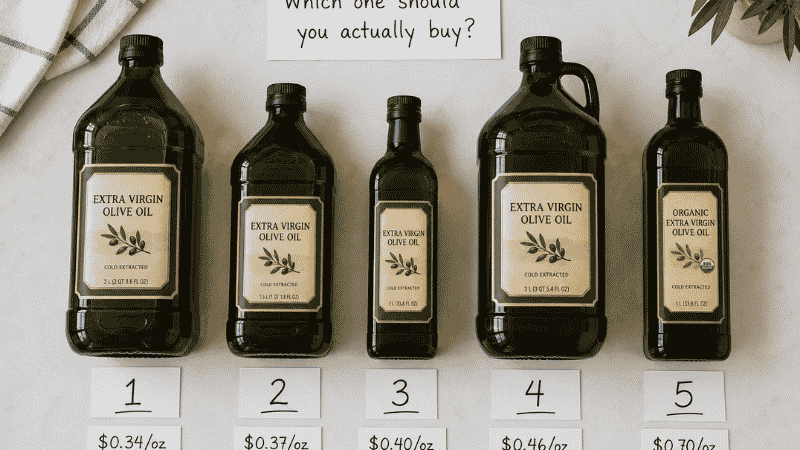
You’ve made the right decision going to Costco for olive oil. The Kirkland Signature lineup genuinely offers the best price-per-quality at any major U.S. retailer. The problem is standing in front of five bottles that look similar, carry the same brand name, range in price by about $10, and come with no straightforward explanation of what’s actually different between them.
The Organic and the Italian look almost identical. The Pure Olive Oil is cheaper — but why? Is it a better deal or a worse product? The California version has completely different sourcing. And somewhere in the back of your mind, you wonder whether Costco’s “generic” brand can actually be good olive oil, or whether you’re buying volume disguised as quality.
This guide answers all of it. Five Kirkland olive oils, ranked and explained with actual price-per-ounce data, third-party quality certification information, and a clear recommendation for which bottle belongs in which family’s cart — not based on flavor snobbery, but based on how your family actually cooks.
The Complete Kirkland Olive Oil Lineup: What You’re Actually Choosing Between
Before the rankings, the facts. Here’s what each bottle actually is:
| Product | Size | Approx. Price | Price/oz | Grade |
|---|---|---|---|---|
| Kirkland Signature Pure Olive Oil | 3 liters (101 oz) | $19.99 | $0.20 | Refined blend (NOT EVOO) |
| Kirkland Signature Organic EVOO | 2 liters (67.6 oz) | $21–$24 | $0.31–$0.36 | Extra Virgin, USDA Organic |
| Kirkland Signature 100% Italian EVOO | 2 liters (67.6 oz) | $24–$28 | $0.36–$0.41 | Extra Virgin, Single Origin |
| Kirkland Signature California EVOO | ~33.8 oz | $14–$17 | $0.41–$0.50 | Extra Virgin, CA-certified |
| Kirkland Signature Spanish EVOO | 2 liters (67.6 oz) | $22–$25 | $0.33–$0.37 | Extra Virgin, Single Origin |
The most important thing to understand before ranking: The Pure Olive Oil is in a different product category than the other four. It’s a refined blend — heat-processed to remove flavor defects — with 15% extra virgin olive oil blended back in for minimal flavor. Comparing it to the EVOO options on taste is like comparing skim milk to whole milk and calling the result surprising. They’re different products for different purposes.
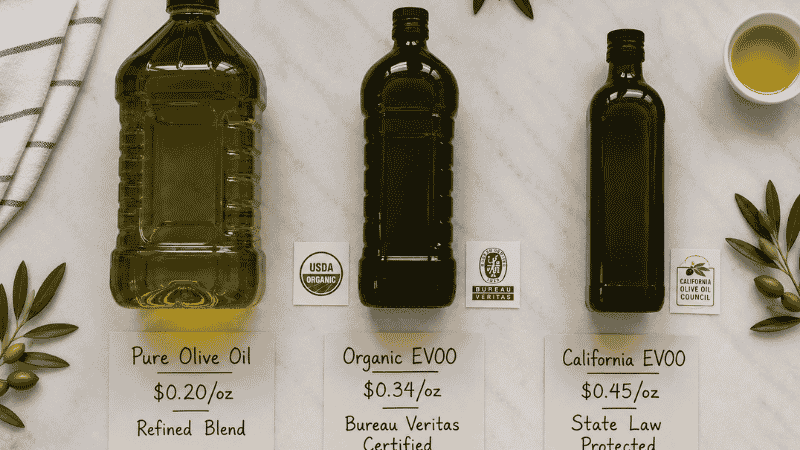
All 5 Kirkland Olive Oils Ranked for Everyday Family Use
#1: Kirkland Signature Organic Extra Virgin Olive Oil — Best Overall
Price/oz: ~$0.31–$0.36 | Grade: Extra Virgin + USDA Organic | Certification: Bureau Veritas, ConsumerLab tested
This is the clearest recommendation in the entire Kirkland lineup — and arguably the best-value genuinely verified extra virgin olive oil at any major U.S. retailer. Full stop.
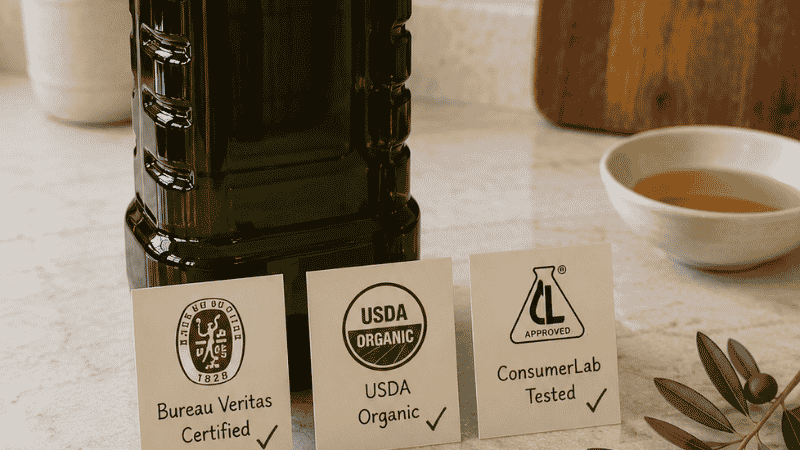
The Bureau Veritas certification means an independent third party has verified the oil meets extra virgin standards. ConsumerLab’s expanded olive oil testing included this specific product, and it passed as authentic extra virgin. These aren’t marketing claims — they’re third-party verifications that most olive oils on grocery store shelves don’t have.
The flavor profile is mild and clean — genuinely pleasant grassy notes with a light peppery finish that doesn’t overpower. This is precisely what you want in a daily cooking and finishing oil: enough character to add value to a dish, mild enough not to fight with other flavors. Tasting Table ranked it third in their five-oil comparison, but from a value and certification standpoint, it’s the clear winner.
The USDA Organic certification adds an additional layer: the olives were grown without synthetic pesticides or fertilizers. For families who use olive oil daily — in dressings, finishing dishes, cooking for children — the organic aspect is a meaningful extra benefit at a price that doesn’t require choosing between organic and budget.
At $0.31–$0.36/oz for 2 liters, you’re getting:
- Bureau Veritas certified genuine extra virgin
- USDA Organic certification
- ConsumerLab verified quality
- Mild, versatile flavor profile
- Best-in-class value among verified EVOOs
Best for: Everything — daily sautéing, roasting, pasta sauce, salad dressings, finishing dishes. The universal choice for families who want genuine quality at a reasonable price.
Not ideal for: Olive oil enthusiasts who specifically want bold, assertive Italian or Spanish character for premium finishing applications. For that, the Italian or California versions offer more personality.
#2: Kirkland Signature California Extra Virgin Olive Oil — Best for Freshness and Transparency
Price/oz: ~$0.41–$0.50 | Grade: Extra Virgin | Certification: California state law protections
The California EVOO is the most origin-transparent bottle in the Kirkland lineup. A 2022 California state law requires that any oil labeled as California-grown contains 100% California olives — no blending from other origins permitted. This legal protection provides origin accountability that multi-country import blends can’t offer.
The flavor is clean, buttery, and mellow — distinctly Californian in character. It’s fresh-tasting in a way that’s immediately noticeable, with a smooth finish that works as well for drizzling as for cooking.
The primary trade-off is the smaller bottle size (typically ~33.8 oz rather than the 2-liter jugs) and slightly higher per-ounce cost. For families who use olive oil quickly and prioritize freshness over volume, this is the right choice. For high-volume daily users, the cost difference adds up and the Organic version is the better value.
Best for: Raw finishing, salad dressings, dishes where clean olive flavor matters. Ideal for lighter-use families who value freshness and origin transparency.
Not ideal for: High-volume daily cooking where the per-ounce premium becomes significant.
#3: Kirkland Signature Spanish Extra Virgin Olive Oil — Solid Value, Mild Profile
Price/oz: ~$0.33–$0.37 | Grade: Extra Virgin | Certification: Spanish single-origin
The Spanish EVOO sits in interesting value territory — priced similarly to the Organic but without organic certification or the same depth of third-party quality verification. The flavor is gentler and fruitier than the Italian, with less bitterness and a rounder mouthfeel that makes it approachable for daily cooking.
Spain is the world’s largest olive oil producer, and Spanish EVOOs are generally consistent and reliable for everyday cooking. The single-origin sourcing adds traceability beyond what a multi-country blend provides.
This is a reasonable choice if the Organic isn’t available or you specifically want Spanish character, but given the Organic’s Bureau Veritas certification at a similar or sometimes lower price point, the Organic edges it out on verification grounds.
Best for: Everyday cooking, sautéing, roasting. A versatile middle-ground option with a mild, pleasant profile.
Not ideal for: Raw finishing applications where more complex flavor is desired, or when the Organic is available at comparable pricing.
#4: Kirkland Signature 100% Italian Extra Virgin Olive Oil — Best for Bold Flavor, Worst for Versatility
Price/oz: ~$0.36–$0.41 | Grade: Extra Virgin | Certification: Traceable Chain of Italian Origin
The Italian EVOO earned last place in Tasting Table’s taste test, but that ranking was based on flavor evaluation criteria that don’t necessarily apply to every use case. What they described as a weakness — intense bitterness, strong peppery finish, sharp assertive character — is actually a quality marker in olive oil evaluation, indicating high polyphenol content from early-harvest olives.
The Traceable Chain of Italian Origin certification means every stage of production (cultivation, pressing, bottling) happened in Italy — a meaningful quality signal in an industry where “Product of Italy” often just means bottled there.
The practical problem for everyday family cooking: this oil’s bold intensity can overpower delicate dishes. It works beautifully drizzled over hearty soups, grilled meats, and bean dishes where its strength is an asset. It’s wrong for baking, lighter dishes, or as a neutral cooking medium.
Best for: Robust finishing applications — drizzling over stews, grilled meats, bean soups, or any dish where you want pronounced olive oil flavor as a condiment.
Not ideal for: Everyday cooking medium, baking, or families with children who prefer milder flavors. The most expensive per-liter option in the EVOO lineup.
#5: Kirkland Signature Pure Olive Oil — For High-Heat Only, Not a Quality Comparison
Price/oz: ~$0.20 | Grade: Refined blend (85% refined + 15% EVOO) | No EVOO certification
This bottle is last not because it’s bad at what it does, but because what it does is fundamentally different from the four EVOO options. As a refined olive oil blend, it has undergone heat processing to remove flavor defects — losing most polyphenols, antioxidants, and olive character in the process. A 15% EVOO addition provides minimal flavor restoration.
What it does well: neutral flavor, high smoke point (~465°F), large volume (3 liters) at very low cost-per-ounce ($0.20). For deep frying, high-heat searing, or any application where you need volume and neutrality rather than olive oil’s health properties and flavor, this is the most economical Kirkland option.
At $19.99 for 3 liters, it costs approximately $6.66/liter — far cheaper than any of the EVOO options. If your household does a lot of deep frying or uses oil in large quantities for applications where flavor and health properties are secondary, this makes sense.
Best for: Deep frying, high-heat searing, applications requiring a neutral high-volume cooking fat.
Never use for: Raw applications like salad dressings or finishing — the flavor is nearly nonexistent and the health properties of EVOO are absent.
Which Kirkland Olive Oil Is Right for Your Family?
Different families have different cooking patterns. Here’s the straightforward match:
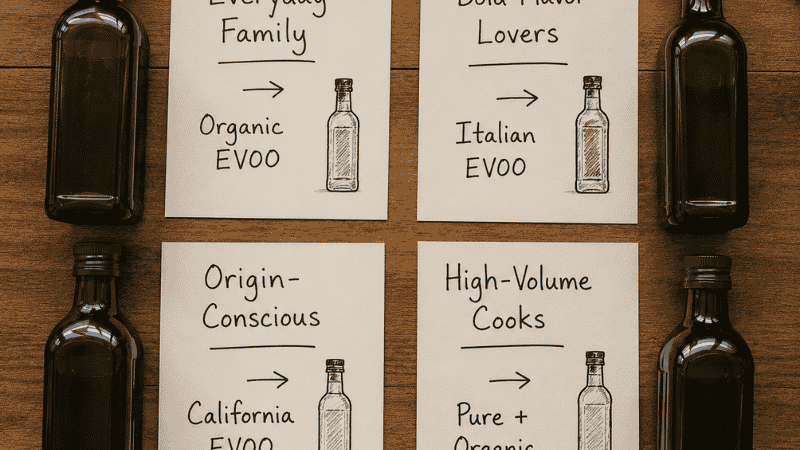
The Everyday Family (Cooks Most Nights, Budget-Conscious)
→ Kirkland Signature Organic EVOO
You cook 5–6 nights a week, use olive oil for everything from sautéing vegetables to finishing pasta, and you want quality you can feel good about without paying a premium. The Organic is verified, mild enough for any application, and at $0.31–$0.36/oz it’s the best quality-per-dollar in the entire Costco olive oil section.
The Family That Wants Bold Italian Character
→ Kirkland 100% Italian EVOO (for finishing) + Organic (for cooking)
You appreciate assertive, complex olive oil on finished dishes but need a milder oil for everyday cooking. The two-bottle approach costs marginally more but gives you the best of both worlds.
The Family That Prioritizes Origin Transparency
→ Kirkland California EVOO
You want to know exactly where your olives came from, and California’s strict labeling law gives you that guarantee. The smaller bottle format also means faster turnover, which means fresher oil in your kitchen.
The High-Volume Cooking Family
→ Kirkland Pure Olive Oil (for frying) + Organic (for everything else)
You deep fry regularly, or you cook for a large family and go through significant oil volume for high-heat applications. Use the refined blend for high-heat cooking and reserve the Organic EVOO for cooking and finishing where quality matters.
The Single Person or Light User
→ Kirkland California EVOO (smaller bottle) or skip Costco entirely
A 2-liter jug of EVOO takes a light user 6–12 months to finish — well past the 3–6 month post-opening quality window. Consider Aldi Specially Selected or Trader Joe’s California EVOO in 16-oz bottles instead, replacing them every 6–8 weeks.
Is Kirkland Olive Oil Actually Good? What the Third-Party Tests Show
The honest answer, supported by independent testing:
Kirkland Signature Organic EVOO: Yes — genuinely verified as authentic extra virgin by Bureau Veritas, and included in ConsumerLab’s expanded testing where it passed as authentic. This is one of the most tested and verified budget EVOOs available in the U.S. market.
Kirkland 100% Italian EVOO: Yes, with verification — the Traceable Chain of Italian Origin certification provides meaningful quality accountability. Single-origin Italian sourcing reduces the blending and adulteration risks associated with multi-country import oils.
Kirkland California EVOO: Yes — California state law provides legal backing for the “100% California” label, which is more meaningful than most origin claims on olive oil labels.
Kirkland Spanish EVOO: Likely yes, but less independently verified than the Organic. Reliable for everyday cooking without the same depth of third-party testing documentation.
Kirkland Pure Olive Oil: It’s a refined blend, which is what it claims to be. It’s not adulterated or misrepresented — it’s simply a different (lesser) product than EVOO.
The Costco 2-Liter System: Using Kirkland Olive Oil Without Wasting Quality
The Kirkland EVOO options all come in 2-liter jugs. This is the format most associated with Costco savings — and most associated with quality degradation when handled incorrectly.
How Long Does Kirkland Olive Oil Last?
At peak quality: 3–6 months after opening, stored properly. A 2-liter jug contains approximately 135 tablespoons of oil.
Usage rate check:
- Family using 2–4 tbsp daily → finishes in 5–9 weeks ✅ Perfect format
- Couple using 1–2 tbsp daily → finishes in 9–18 weeks ✅ Fine with good storage
- Single person using 1 tbsp daily or less → 19+ weeks ❌ Quality degrades before finishing
The Correct Storage System
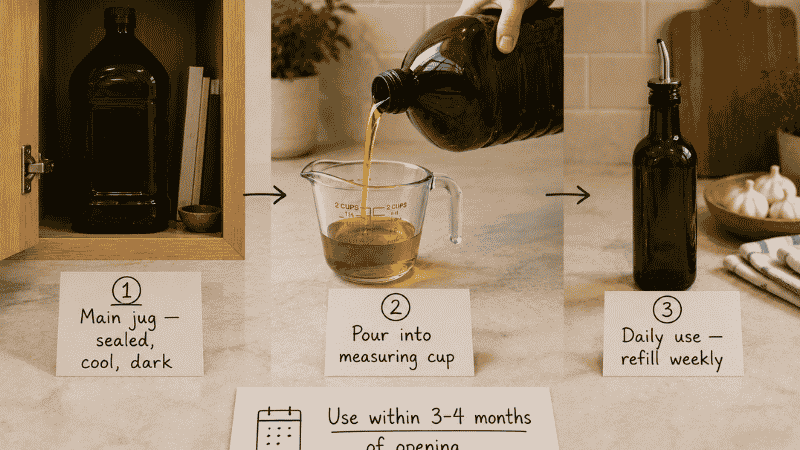
Step 1: When you get home from Costco, decant 1–2 cups into a small dark glass cruet or bottle for counter use. Keep the rest of the jug sealed and stored.
Step 2: Store the main jug in a cool, dark cabinet — not on the counter near the stove, not in a pantry that gets warm. The kitchen cabinet farthest from heat sources is ideal. Optimal temperature is 57–70°F.
Step 3: Seal the jug tightly after every use. Oxygen exposure between uses is cumulative.
Step 4: Smell the oil occasionally. Fresh Kirkland Organic EVOO smells clean, grassy, and mildly peppery. If it smells waxy, cardboard-like, or flat — it has oxidized and the beneficial polyphenols are gone.
What If You’re a Slower User?
If the math above suggests you’re a slower user, consider buying Kirkland California EVOO in the smaller bottle format, or supplementing with Aldi or Trader Joe’s EVOO in 16-oz bottles that turn over more quickly.
Kirkland Olive Oil vs. Aldi and Trader Joe’s: Is Costco Actually the Best Deal?
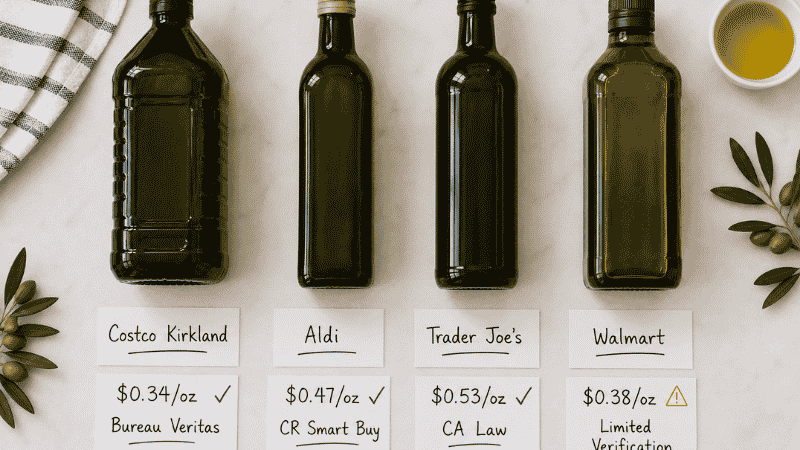
| Retailer | Best Option | Price/oz | Membership Required | Quality Verification |
|---|---|---|---|---|
| Costco | Kirkland Organic EVOO | $0.31–$0.36 | Yes ($65/yr) | Bureau Veritas ✅ |
| Aldi | Specially Selected EVOO | $0.45–$0.50 | No | CR Smart Buy ✅ |
| Trader Joe’s | California EVOO | $0.47–$0.59 | No | CA law protected ✅ |
| Walmart | Great Value EVOO | $0.35–$0.40 | No | Limited ⚠️ |
The verdict: Costco’s Kirkland Organic wins on cost-per-ounce for verified EVOO — but requires a $65 membership and the discipline to use a 2-liter jug within 3–4 months of opening. For families who meet both conditions, Costco is the clear winner. For lighter users or those without membership, Aldi or Trader Joe’s in smaller bottles is the better practical choice.
FAQ
Q: Is Kirkland olive oil real extra virgin?
The Kirkland Signature Organic EVOO and Italian EVOO are verified as genuine extra virgin by independent certification. The Organic has Bureau Veritas certification and was tested by ConsumerLab. The Italian has Traceable Chain of Italian Origin certification. The Pure Olive Oil is explicitly a refined blend and does not claim to be extra virgin.
Q: Which Kirkland olive oil is the best?
For most families: Kirkland Signature Organic EVOO — best value, best-verified quality, most versatile flavor profile. For bold-flavor enthusiasts: Kirkland Italian EVOO for finishing applications. For origin transparency: Kirkland California EVOO.
Q: Is Kirkland organic olive oil worth it?
Yes — at $0.31–$0.36/oz, it’s the cheapest Bureau Veritas-certified genuine extra virgin olive oil with USDA Organic certification at any major U.S. retailer. The value proposition is exceptional. The only caveat is managing the 2-liter format to maintain freshness.
Q: What is the difference between Kirkland olive oil and Kirkland extra virgin olive oil?
Kirkland Signature Pure Olive Oil is a refined blend (85% refined + 15% EVOO) — lower price, neutral flavor, high smoke point, minimal health benefits. The Kirkland EVOO options (Organic, Italian, California, Spanish) are genuine extra virgin — mechanically extracted, no heat processing, full polyphenol content. They are fundamentally different products.
Q: Does the Costco Kirkland olive oil 2-liter bottle go bad?
It can, if used too slowly or stored improperly. Extra virgin olive oil at peak quality lasts 3–6 months after opening. Families using 2–4 tablespoons daily will finish a 2-liter jug in 5–9 weeks — no problem. Lighter users should consider smaller-format alternatives. Proper storage (cool, dark, sealed) extends peak quality significantly.
Q: Is Kirkland Italian olive oil good?
It’s genuine and well-certified (Traceable Chain of Italian Origin), but its flavor profile — strong bitterness, assertive peppery finish — is polarizing. Olive oil experts consider these characteristics quality markers; most American home cooks find them intense for everyday use. It’s excellent for specific applications (hearty stews, grilled meat finishing, bean dishes) but not the best all-purpose family cooking oil.
The Honest Bottom Line
Kirkland olive oil is genuinely good — but knowing which bottle to buy makes a meaningful difference in whether you’re getting the quality you’re paying for. The Organic EVOO is the standout choice for most families: independently verified, organically certified, mild enough for any use, and priced better than any comparable product at other retailers.
The 2-liter format rewards families who actually go through olive oil quickly. If that’s you, Costco is the best deal on verified EVOO available anywhere. If it’s not, the smaller bottles at Aldi or Trader Joe’s serve you better.
For the complete picture on how Kirkland compares to all other Costco olive oil options — including non-Kirkland brands like Terra Delyssa and Cobram Estate — our Costco olive oil guide covers the full lineup. And for how olive oil storage and quality applies to your pantry as a whole, our pantry staples guide is the next step.
References
- ConsumerLab. Extra Virgin Olive Oil Review — Kirkland Signature Organic EVOO Testing Results. consumerlab.com
- UC Davis Olive Center. Olive Oil Quality and Third-Party Certification Research. olivecenter.ucdavis.edu
- California Department of Food and Agriculture. California Olive Oil Integrity Labeling Law — AB 535 (2022). cdfa.ca.gov
- North American Olive Oil Association. Bureau Veritas Certification and EVOO Standards. aboutoliveoil.org
- American Heart Association. Monounsaturated Fats and Heart-Healthy Cooking Oils. heart.org