
Key Takeaways
- Not all olive oil is the same product. “Extra virgin,” “virgin,” “pure,” and “light” are four distinct grades with fundamentally different production methods, nutritional profiles, and appropriate uses. Most families are buying the wrong one for at least one of their kitchen applications.
- A UC Davis Olive Center study found that 69% of imported olive oils labeled “extra virgin” in the U.S. failed to meet the official standard — making label literacy one of the highest-value grocery shopping skills a family can develop.
- The best olive oil for most families is Kirkland Signature Organic EVOO at Costco (~$0.32–$0.36/oz) — Bureau Veritas certified, USDA Organic, and the best-value verified extra virgin olive oil at any major U.S. retailer.
- Extra virgin olive oil is safe and appropriate for the vast majority of home cooking, including sautéing, roasting, and pan-frying. A 2018 study published in ACTA Scientific Nutritional Health found EVOO was more heat-stable than canola oil, sunflower oil, and other commonly recommended cooking oils.
- The single most important thing you can do when buying olive oil is look for a harvest date on the label — not the price, not the country of origin, not the marketing language.
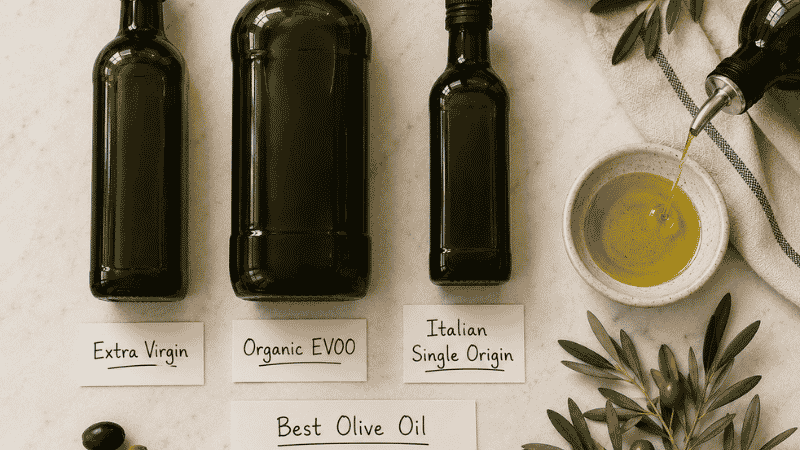
You’ve been buying olive oil your whole adult life. Probably the same bottle, from the same spot on the shelf, without reading much beyond the price. Then someone tells you that most of what’s labeled “extra virgin” isn’t actually extra virgin, that the smoke point advice you’ve been following is largely wrong, and that the $12 bottle you’ve been saving for salads can actually go in the pan. And suddenly a simple grocery decision feels a lot more complicated than it should be.
It isn’t, once you know the framework. Choosing the best olive oil for your family comes down to four decisions: which grade to buy, what to look for on the label, which retailer and brand gives you the best value, and how to use and store it correctly once you get it home. This guide covers all four — completely, without the food-world jargon — and connects you to deeper information on each topic when you need it.
Why Olive Oil Is Worth Getting Right
Olive oil isn’t just a cooking fat. It’s one of the most researched foods in nutritional science, and the evidence behind it is unusually strong.
The landmark PREDIMED trial — published in the New England Journal of Medicine and one of the most comprehensive dietary studies ever conducted — followed over 7,000 adults at high cardiovascular risk for nearly five years. Participants who supplemented with extra virgin olive oil had a 30% lower rate of major cardiovascular events compared to the control group. The American Heart Association classifies EVOO as a heart-healthy fat and recommends it as a replacement for saturated fats like butter and lard.
The operative word is extra virgin. The benefits documented in research come from the polyphenols, oleocanthal, and antioxidants that are preserved only in genuine, unrefined extra virgin olive oil — not in the heat-refined blends sold as “pure olive oil” or “light olive oil.” Knowing which bottle actually contains what the label promises is the foundation of getting olive oil right.
For most families, olive oil is a daily purchase that adds up to real money over a year. Getting the grade, the brand, and the usage right means more nutritional value per dollar — not more spending.
The Four Grades of Olive Oil: What You’re Actually Choosing Between
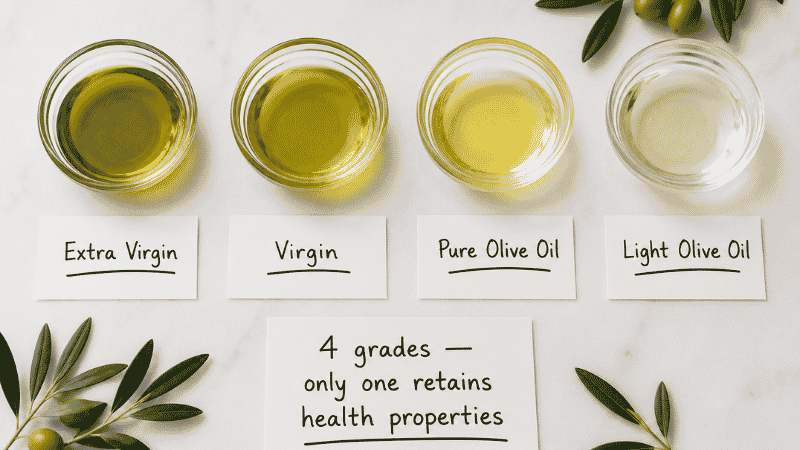
This is the most important thing to understand before buying. The four grades sold in U.S. grocery stores are fundamentally different products:
Extra virgin olive oil (EVOO) is extracted from olives purely by mechanical means — crushing and pressing without heat or chemical solvents. It must pass both chemical testing (free acidity at or below 0.8%) and sensory testing (no flavor defects, positive fruity character). This is the least processed form of olive oil and the grade that retains the health-protective polyphenols and antioxidants.
Virgin olive oil is made the same way but allows minor flavor imperfections and acidity up to 2.0%. Rarely sold in U.S. stores — if you see it, it’s a legitimate option for cooking.
Regular olive oil (sold as “pure olive oil,” “classic olive oil,” or “light olive oil”) is a blend of heat-refined olive oil and a small amount of virgin or extra virgin oil added back for flavor. The refining process removes most polyphenols and antioxidants. It’s a fundamentally different product from EVOO — appropriate for specific applications, not as a health-conscious default.
Olive pomace oil is extracted from the leftover olive pulp using chemical solvents. Not typically found in regular grocery stores.
The shopping rule: For any application where you want olive oil’s health properties or flavor — which includes most cooking and all finishing — buy genuine extra virgin olive oil. Use regular olive oil only for high-volume, high-heat cooking where neutrality and cost matter more than quality.
→ For a complete breakdown of every grade and what each label actually means at the grocery store, see our guide to virgin vs. extra virgin olive oil.
How to Buy the Best Olive Oil at the Grocery Store
Knowing the grade is the first step. Knowing which bottle within that grade is actually what it claims to be is the second — and it requires label literacy, because the U.S. olive oil market has a documented authenticity problem.
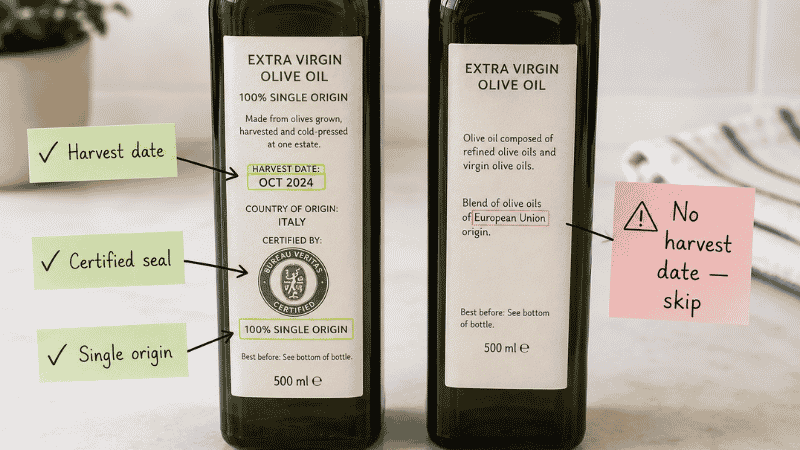
The Labels That Actually Mean Something
Harvest date — The most underused label element. Olive oil peaks in quality within 12–18 months of harvest and degrades meaningfully after that. A bottle with a visible harvest date (e.g., “Harvest: October 2024”) is a signal that the producer stands behind their freshness. Without a harvest date and only a vague “best by” date three years out, you have no way to know if the oil is 3 months old or 2 years old.
Third-party certification seals — The North American Olive Oil Association (NAOOA) seal and the California Olive Oil Council (COOC) seal both indicate independent quality verification. These matter because the extra virgin label alone has a significant authenticity gap.
“100% [Country] Olives” — Specific single-origin language is more meaningful than “Product of Italy” or “Imported from Spain,” which can simply mean the oil was bottled there from olives grown elsewhere.
Dark glass or tin packaging — Light degrades polyphenol content. Genuine extra virgin oil that a producer cares about is packaged in dark glass or tin. Clear plastic on a shelf under fluorescent lights is degrading the oil continuously before you buy it.
Labels That Are Mostly Marketing
“Cold pressed,” “first pressed,” “natural,” “artisanal,” and “premium” have no regulatory definition in the U.S. They can appear on any bottle regardless of quality.
“Product of Italy” — means the oil may have been bottled in Italy from olives grown in Spain, Greece, Tunisia, or Turkey. Not a quality indicator.
→ For the complete label-reading guide with every term explained, see our extra virgin olive oil buying guide.
Is Organic Olive Oil Worth the Premium?
This is one of the most common questions families have, and the answer is nuanced.
USDA Organic certification on olive oil means the olives were grown without synthetic pesticides, herbicides, or fertilizers, and the processing facility meets National Organic Program standards. This is a real and verifiable certification.
What organic doesn’t mean: higher polyphenol content, better flavor, or superior heat stability compared to a non-organic EVOO of the same freshness and variety. Research published in the Journal of Agricultural and Food Chemistry found that organic status did not consistently predict higher polyphenol levels — freshness, olive variety, and harvest timing were more predictive than farming method.
When organic is worth it:
- Cooking daily for young children (proportionally higher exposure concerns)
- Regular raw consumption where residues aren’t heat-degraded
- When the organic option is priced similarly to non-organic (Kirkland Organic EVOO, for example, costs nearly the same per ounce as many non-organic options)
When it may not justify the premium:
- The organic option has an older harvest date than the non-organic alternative
- The organic bottle is in worse packaging (clear plastic vs. dark glass)
- The price difference is $5+ per bottle and budget is tight
→ For the complete organic EVOO analysis with brand recommendations and price comparisons, see our organic extra virgin olive oil guide.
The Best Olive Oil for Cooking: What the Science Actually Says
Most home cooks have been told not to cook with extra virgin olive oil because its smoke point is too low. This advice is based on outdated science and has caused a generation of cooks to either waste good oil by avoiding the pan or spend money on inferior refined oils they didn’t need.
The 2018 study published in ACTA Scientific Nutritional Health — the most comprehensive cooking oil stability analysis conducted to date — tested 10 different oils at cooking temperatures from 180°C to 240°C. Extra virgin olive oil was the most stable oil tested, producing fewer harmful oxidation compounds than canola, sunflower, and corn oil despite having a lower smoke point.
The reason is polyphenol content. These antioxidant compounds protect the oil against heat degradation in a way that smoke point numbers don’t capture. An oil can have a high smoke point but low antioxidant content and break down faster than EVOO under real cooking conditions.
Extra virgin olive oil is appropriate for:
- Sautéing at medium to medium-high heat ✅
- Roasting at 350–425°F ✅
- Pan-frying at moderate temperatures ✅
- Baking where olive flavor is welcome ✅
- All finishing and raw applications ✅
Where refined oils are more appropriate:
- Sustained deep frying above 400°F for extended periods ⚠️
- Very high-heat searing where maximum temperature is the goal ⚠️
For the vast majority of what families cook on a weeknight, extra virgin olive oil is the right choice — not a compromise.
→ For the complete cooking guide matched to every method, with brand recommendations and the two-bottle system that works for most family kitchens, see our best olive oil for cooking guide.
The Best Olive Oil Brands: Where to Buy and What to Buy
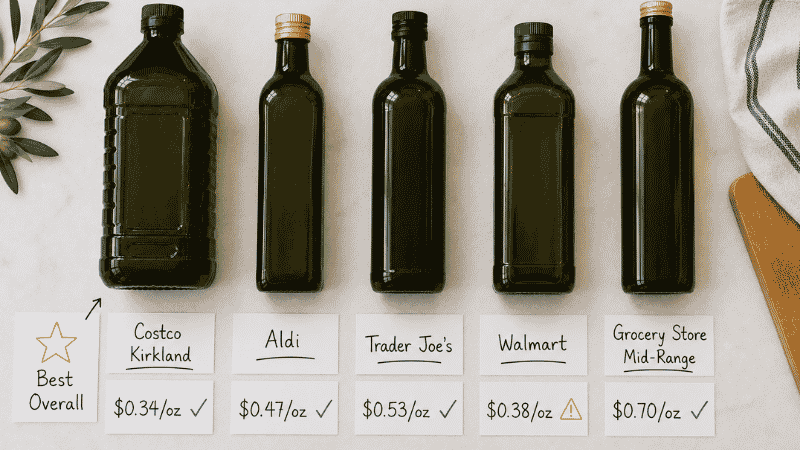
Best Value Overall: Costco (Kirkland Signature)
Costco’s Kirkland Signature Organic EVOO is the best-value genuinely verified extra virgin olive oil at any major U.S. retailer. At approximately $0.32–$0.36/oz for a 2-liter bottle, it carries Bureau Veritas certification (independent third-party quality verification), USDA Organic certification, and was included in ConsumerLab’s expanded olive oil testing — passing as authentic extra virgin.
The Kirkland lineup includes five distinct olive oil products ranging from a refined blend to single-origin Italian EVOO. Understanding which Kirkland bottle to buy — and how to use the 2-liter format without wasting quality — makes the difference between genuine value and expensive waste.
→ For the complete Costco olive oil lineup ranked with price-per-ounce data, see our Costco olive oil guide and Kirkland olive oil guide.
Best for Smaller Quantities: Aldi
Aldi’s Specially Selected EVOO was named a Smart Buy by Consumer Reports in blind tasting. At approximately $0.45–$0.50/oz in a 16–17 oz bottle, it’s independently verified quality without requiring a warehouse club membership. The smaller format is actually an advantage for households that use oil slowly — you finish the bottle while it’s still fresh.
Best for Freshness and Origin Transparency: Trader Joe’s
Trader Joe’s California Extra Virgin Olive Oil benefits from California’s 2022 labeling law requiring 100% California olives in any California-labeled oil. The Sicilian Selezione — when in stock — was Consumer Reports’ top-rated pick in their blind testing of TJ’s olive oils. The TJ’s lineup is more varied than most shoppers realize, and some options (the standard Trader Giotto’s EVOO) tested poorly while others tested excellently.
→ For the complete Trader Joe’s olive oil ranking with Consumer Reports data, see our Trader Joe’s olive oil guide.
Best Mid-Range at Regular Grocery Stores
Carapelli Original EVOO — America’s Test Kitchen top-scorer among supermarket brands. Widely available at Walmart, Target, and most grocery chains at $0.65–$0.75/oz.
California Olive Ranch EVOO — COOC certified, California-grown, buttery clean flavor. Available at most major grocery chains at $0.70–$0.85/oz.
Filippo Berio EVOO — Consistent quality, widely distributed, passes third-party authenticity tests regularly. Reliable mid-range option.
Brand Comparison by Price Per Ounce
| Brand / Retailer | Price/oz | Quality Verification | Membership Required |
|---|---|---|---|
| Kirkland Organic EVOO (Costco) | $0.32–$0.36 | Bureau Veritas ✅ | Yes ($65/yr) |
| Kirkland Italian EVOO (Costco) | $0.36–$0.41 | Italian origin certified ✅ | Yes |
| Aldi Specially Selected EVOO | $0.45–$0.50 | CR Smart Buy ✅ | No |
| Walmart Great Value EVOO | $0.35–$0.40 | Limited ⚠️ | No |
| TJ’s California EVOO | $0.47–$0.59 | CA law protected ✅ | No |
| Carapelli EVOO | $0.65–$0.75 | ATK top pick ✅ | No |
| California Olive Ranch | $0.70–$0.85 | COOC certified ✅ | No |
How to Store Olive Oil and How to Tell When It’s Gone Bad
This section is where most olive oil guides stop short — and where most family kitchens quietly waste money.
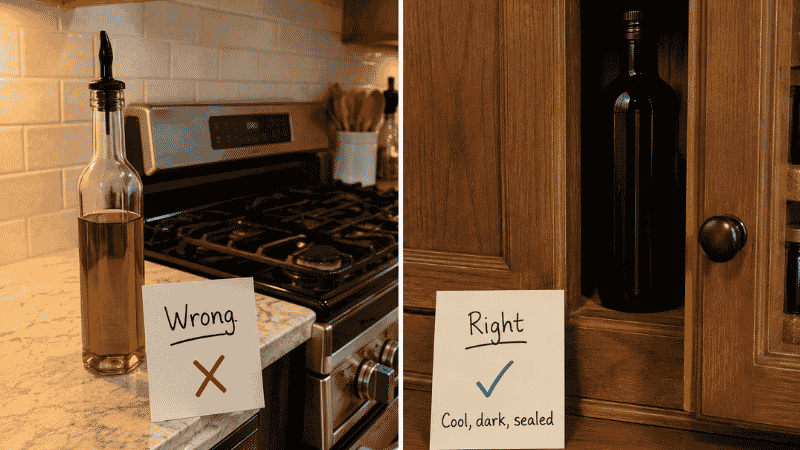
The Three Enemies of Olive Oil
Heat, light, and oxygen degrade olive oil continuously after the bottle is opened. The polyphenols that make EVOO nutritious and heat-stable are the compounds most vulnerable to these three factors.
The most expensive storage mistake: keeping olive oil on the counter next to the stove. The ambient heat from cooking accelerates oxidation dramatically. A bottle that would last 5 months in a cool cabinet might last 6–8 weeks next to a warm range.
The Correct Storage System
For everyday bottles (16–34 oz): Store in a sealed, cool cabinet away from heat and light. Keep the cap tight after every use.
For the Costco 2-liter jug: Decant 1–2 weeks’ worth (about 1–2 cups) into a small dark glass cruet for counter access. Store the main jug sealed in a cool, dark location. This limits air exposure of the bulk supply while keeping daily access convenient.
How long does it last?
- Unopened, properly stored: 12–18 months from harvest date
- Opened, properly stored: 3–6 months at peak quality
After the peak window, flavor degrades even if the oil isn’t rancid. You’re losing both the flavor and the polyphenol content that made it worth buying.
How to Tell If Olive Oil Has Gone Bad
Fresh extra virgin olive oil smells grassy, slightly fruity, and mildly peppery. Rancid olive oil smells like wax, old crayons, or cardboard — distinctly different from the fresh olive character. Flat, tasteless oil has oxidized and lost its nutritional profile even if it doesn’t smell actively unpleasant.
If you’re not sure: smell it before using it for a raw application. Your nose is the most reliable quality indicator you have.
The Two-Bottle System Most Families Should Use
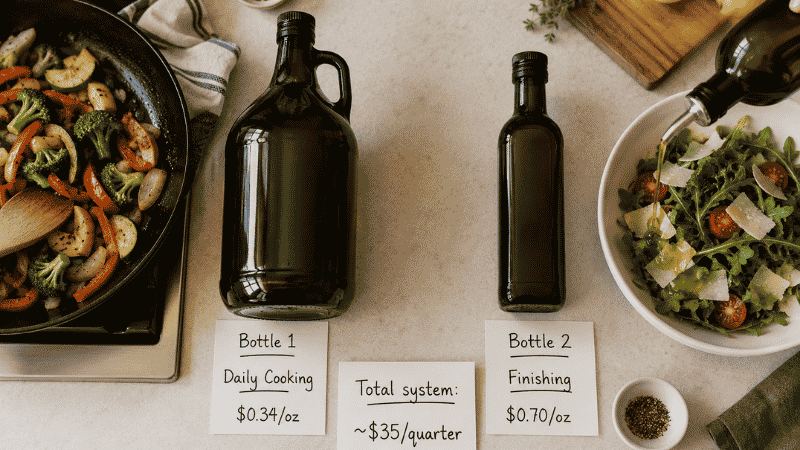
Most households don’t need one premium bottle for everything and one cheap bottle for cooking. They need a deliberate system.
Bottle 1 — Daily Cooking: An affordable verified EVOO (Kirkland Organic, Aldi Specially Selected, or Walmart Great Value EVOO) for sautéing, roasting, making sauces, and everything that involves heat. Use it generously — this is not the oil to ration. At $0.32–$0.40/oz, there’s no reason to be stingy with it.
Bottle 2 — Finishing: A mid-range EVOO (Carapelli, California Olive Ranch, TJ’s California, or Kirkland Italian) for salad dressings, drizzling over finished dishes, bread dipping, and any application where the oil’s flavor is tasted directly. A 16-oz bottle used only for these purposes lasts 6–8 weeks and costs $10–$14.
The economics: Two-bottle system cost per quarter: approximately $22–$30 (Costco Kirkland for cooking) + $10–$14 (mid-range for finishing) = $32–$44 total. This is comparable to or cheaper than buying one mid-priced grocery store EVOO for everything — with better freshness management, better quality for each use case, and no compromise on either end.
Quick Decision Guide: Which Olive Oil to Buy in 60 Seconds
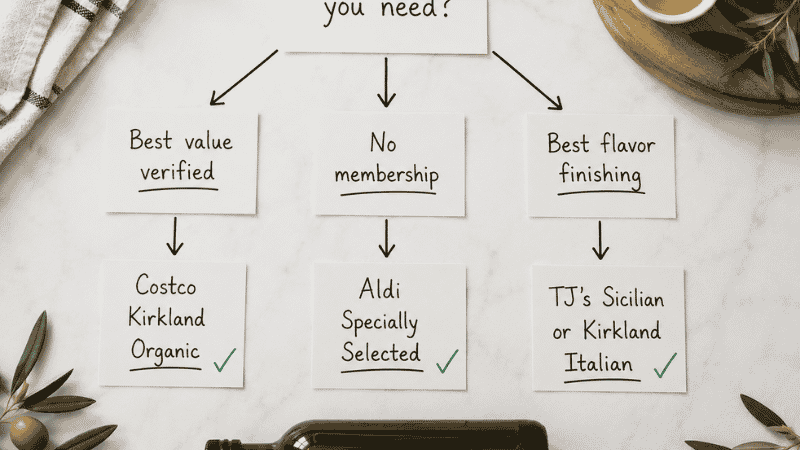
You want the best overall value with verified quality: Kirkland Signature Organic EVOO (Costco). Stop here.
You don’t have a Costco membership: Aldi Specially Selected EVOO or California Olive Ranch at your nearest grocery store.
You want the best flavor for finishing and drizzling: Kirkland Italian EVOO (Costco) or TJ’s Sicilian Selezione (when in stock).
You want organic certification: Kirkland Organic EVOO (Costco) — same price range as many non-organic options, better verified.
You need a high-volume neutral oil for deep frying: Kirkland Pure Olive Oil (Costco, $0.20/oz) or any refined olive oil blend.
You want to avoid Costco AND you use oil quickly: Trader Joe’s California EVOO or Aldi Specially Selected in 16-oz bottles, replaced every 6–8 weeks.
Always skip: Any bottle with no harvest date priced significantly below surrounding bottles, any bottle in clear plastic on a brightly lit shelf, anything labeled only “olive oil” or “light olive oil” if you want health benefits.
FAQ
Q: What is the best olive oil to buy?
For most families: Kirkland Signature Organic Extra Virgin Olive Oil at Costco. It’s Bureau Veritas certified as genuine extra virgin, USDA Organic, and priced at $0.32–$0.36/oz — the best value among independently verified options at any major U.S. retailer. Without a Costco membership, Aldi Specially Selected EVOO (Consumer Reports Smart Buy) is the next best value.
Q: Is extra virgin olive oil really the best?
For cooking and finishing where olive oil’s health properties matter: yes. Extra virgin is the only grade that retains the polyphenols, antioxidants, and oleocanthal that research associates with cardiovascular protection, anti-inflammatory effects, and antioxidant activity. Regular “olive oil” or “pure olive oil” is a refined blend with a fraction of these compounds.
Q: Can you cook with extra virgin olive oil?
Yes — for the vast majority of home cooking. EVOO’s smoke point (375–405°F) covers sautéing, roasting, and pan-frying at normal temperatures. A 2018 study found EVOO was actually more stable under heat than canola, sunflower, and corn oil. The advice to avoid cooking with EVOO is based on outdated smoke point thinking that doesn’t reflect how oil actually behaves under heat.
Q: How do you know if olive oil is good quality?
Look for: a specific harvest date (not just a “best by” date), a certification seal (NAOOA or COOC), dark glass or tin packaging, and specific origin language (“100% Italian Olives,” not just “bottled in Italy”). At home: smell it — fresh EVOO smells grassy and slightly peppery. Rancid oil smells waxy or cardboard-like.
Q: Is expensive olive oil worth it?
Not always. Price correlates loosely with quality at the very low end (anything under $0.25/oz for “extra virgin” is a red flag), but above a threshold, price doesn’t reliably predict polyphenol content or freshness. Kirkland Organic EVOO at $0.34/oz has been more extensively third-party verified than many specialty oils at $1.50/oz. Focus on certification and harvest date, not price.
Q: What’s the difference between olive oil and extra virgin olive oil?
They are fundamentally different products. Extra virgin is mechanically extracted without heat or chemicals, retaining all polyphenols and health properties. “Olive oil” or “pure olive oil” is a refined blend — heat-processed to remove defects, with a small amount of EVOO added back for flavor. It has a fraction of the nutritional value and is a different product category entirely.
Q: How long does olive oil last?
Unopened and properly stored (cool, dark, sealed): 12–18 months from harvest date. After opening: 3–6 months at peak quality. After this window, flavor and polyphenol content decline even if the oil isn’t rancid. Buying in quantities appropriate to your usage rate — rather than the largest bottle available — preserves quality and reduces waste.
Q: Is Kirkland olive oil good?
Yes — the Kirkland Signature Organic EVOO is one of the most extensively verified budget extra virgin olive oils available in the U.S. Bureau Veritas certification, USDA Organic, and ConsumerLab testing all confirm it meets extra virgin standards. The 100% Italian EVOO also carries Traceable Chain of Italian Origin certification. The only Kirkland olive oil that isn’t genuine EVOO is the Kirkland Pure Olive Oil — which is a refined blend and explicitly labeled as such.
The Honest Bottom Line
Buying the best olive oil for your family isn’t complicated once you know what you’re looking for. The grade matters — extra virgin, not refined blends. The label matters — harvest date and certification, not marketing language. The brand matters — but not in the way you might expect, since some of the best-verified options are also among the most affordable.
Kirkland Organic EVOO at Costco is the clearest recommendation for most families. It checks every box: verified quality, organic certification, mild versatile flavor, and the lowest price-per-ounce among genuinely certified options at any major retailer. Store it properly, use it generously, and replace it before it degrades.
From there, every specific question about olive oil has a deeper answer. Use the guides below as your reference library:
- Grades explained: Virgin vs. Extra Virgin Olive Oil
- Complete label-reading guide: Extra Virgin Olive Oil Buying Guide
- Is organic worth it: Organic Extra Virgin Olive Oil Guide
- Cooking with olive oil: Best Olive Oil for Cooking Guide
- All Costco options ranked: Costco Olive Oil Guide
- All Kirkland options ranked: Kirkland Olive Oil Guide
- All Trader Joe’s options ranked: Trader Joe’s Olive Oil Guide
- Pantry staples that work with olive oil: Pantry Staples List
References
- Estruch R, et al. (2013). Primary prevention of cardiovascular disease with a Mediterranean diet. New England Journal of Medicine. doi:10.1056/NEJMoa1200303
- UC Davis Olive Center. Imported Olive Oil Quality Testing Results. olivecenter.ucdavis.edu
- Guillaume C, et al. (2018). Evaluation of Chemical and Physical Changes in Different Commercial Oils during Heating. ACTA Scientific Nutritional Health. actascientific.com
- American Heart Association. Monounsaturated Fats and Heart Health. heart.org
- Peralbo-Molina A, et al. (2014). Organic vs. conventional olive oil polyphenol content. Journal of Agricultural and Food Chemistry. doi:10.1021/jf500148h
- ConsumerLab. Extra Virgin Olive Oil Review and Testing. consumerlab.com
- North American Olive Oil Association. Olive Oil Quality Standards and Certification. aboutoliveoil.org