
Key Takeaways
- “Organic” and “extra virgin” are two separate certifications — a bottle can be one without the other, both, or neither. Understanding what each label actually guarantees helps you decide whether the premium is worth paying.
- USDA Organic certification for olive oil means the olives were grown without synthetic pesticides, herbicides, or fertilizers, and the oil was processed without synthetic additives. It does not automatically mean higher quality, better flavor, or more polyphenols than a non-organic EVOO.
- Research published in the Journal of Agricultural and Food Chemistry found that organic olive oils do not consistently contain higher polyphenol levels than non-organic oils of the same variety and harvest timing — freshness and olive variety matter more than organic status for nutritional content.
- The price premium for organic extra virgin olive oil typically runs 30–60% above comparable non-organic EVOO at major U.S. retailers. For most families, that premium buys pesticide-reduction peace of mind more than measurable nutritional gain.
- Kirkland Signature Organic EVOO (Costco) is the best-value genuine organic extra virgin olive oil at a major U.S. retailer — independently certified, third-party tested, and priced at roughly $0.32–$0.38/oz, significantly undercutting most grocery store organic options.
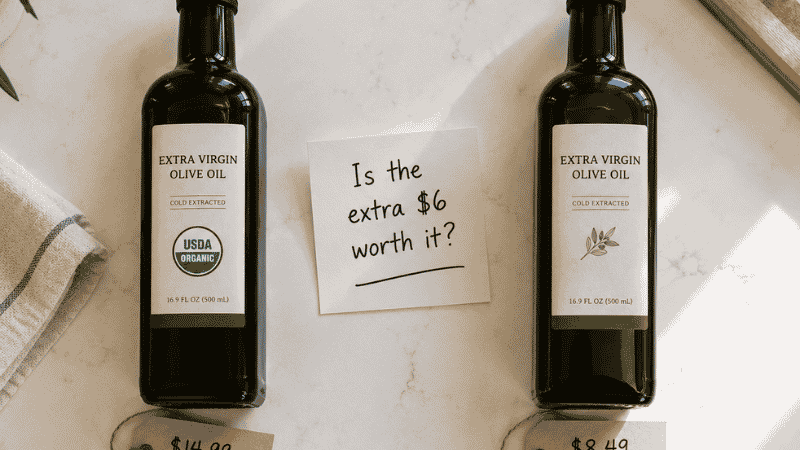
You pick up the bottle of organic extra virgin olive oil. It’s $14.99 for 16.9 ounces. Right next to it sits a non-organic extra virgin olive oil for $8.49 for the same size. Both say “extra virgin.” Both have similar labels. The organic one costs 77% more. You put it in the cart — because organic is better, right? — but you’re not entirely sure what you just paid $6.50 extra for.
This question is worth answering properly, because the answer is more complicated than most people expect. “Organic” means something specific and verifiable. “Extra virgin” means something separate and specific. The combination of both is not automatically the highest quality olive oil you can buy, and for a family that goes through olive oil regularly, the decision has real budget implications.
This guide is for the shopper who wants an honest answer rather than a marketing pitch. What does organic actually mean on an olive oil label? Does it translate to better health outcomes or better flavor? Which organic extra virgin options are genuinely worth buying at a reasonable price — and when is the regular extra virgin just as good?
What “Organic” Actually Means on an Olive Oil Label
The word “organic” on food packaging in the United States is regulated by the USDA National Organic Program (NOP). It’s one of the more meaningful label terms in the grocery store — unlike “natural,” “pure,” or “artisanal,” which have no regulatory definition.
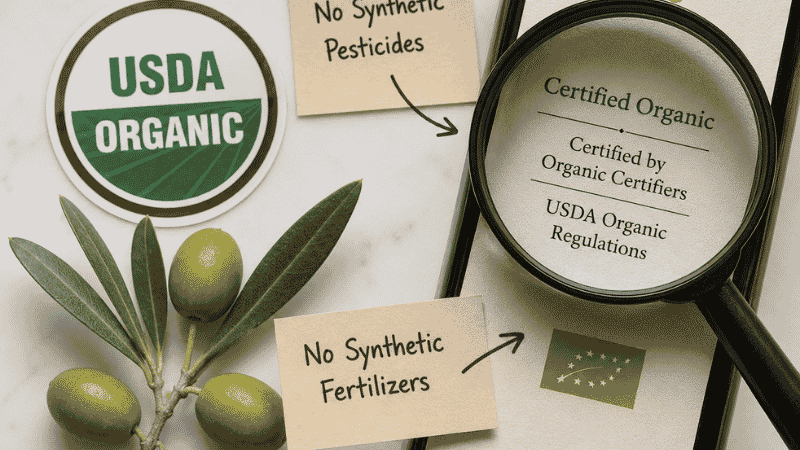
For olive oil to carry the USDA Organic seal, the following must be true:
At the farm level:
- Olives must be grown without synthetic pesticides or herbicides
- No synthetic fertilizers may be used on the olive trees or soil
- The land must have been managed organically for at least 3 years before certification
- GMO olives (not currently a real-world concern since commercial GMO olive trees don’t exist, but required by standard) are prohibited
At the processing level:
- No synthetic additives or processing aids may be used during extraction or bottling
- The facility must maintain segregation between organic and non-organic products
- Annual inspections and certification renewal are required
What organic does NOT mean:
- It does not guarantee a specific quality grade (an organic olive oil can still be refined, mislabeled as extra virgin, or rancid)
- It does not mean the oil contains more polyphenols, antioxidants, or nutrients than a comparable non-organic oil
- It does not mean the oil was grown in Italy, Greece, or Spain — organic olives are grown worldwide, including in regions with less transparent quality oversight
- It does not mean pesticide-free in absolute terms — organic farming permits the use of approved natural-source pesticides, some of which have their own environmental and health considerations
The practical implication: “organic” addresses farming and processing methods. “Extra virgin” addresses oil quality and purity. A bottle that has both certifications has met two separate sets of standards. A bottle that has only “extra virgin” has met the quality standard but not the farming standard. Whether that farming standard matters to your family is a legitimate personal decision — but it’s a different decision from choosing a higher-quality olive oil.
Does Organic Extra Virgin Olive Oil Have More Health Benefits?
This is the question most people are implicitly asking when they reach for the organic bottle, and the answer from current research is: not reliably.
What the Research Shows
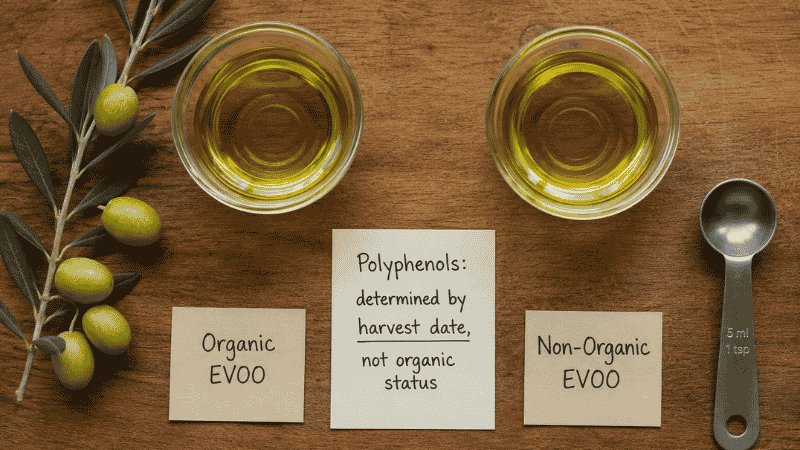
A 2014 study published in the Journal of Agricultural and Food Chemistry analyzed polyphenol content across multiple organic and conventional olive oils of the same variety grown under comparable conditions. The finding: organic status did not consistently predict higher polyphenol levels. The factors that actually drove polyphenol content were olive variety, harvest timing (earlier harvest = more polyphenols), and post-harvest handling speed — not whether the olives were grown organically.
The National Institutes of Health’s Office of Dietary Supplements notes that olive oil’s documented health benefits — cardiovascular protection, anti-inflammatory properties, antioxidant activity — are associated with the polyphenol and oleic acid content of genuine extra virgin olive oil. These compounds are determined by variety, harvest, and processing quality, not by organic certification.
What organic farming does reduce: Pesticide residue levels on the finished oil. A 2021 study in Food Chemistry found that conventionally produced olive oils do sometimes contain trace levels of pesticide residues, though these levels were generally within or below regulatory safety limits. For families who want to minimize pesticide exposure as a precautionary measure, organic is a meaningful choice. For families prioritizing polyphenol content and nutritional value above all, freshness and variety matter more.
The Honest Assessment
Organic extra virgin olive oil is worth the premium if:
- Reducing pesticide residue exposure is important to your family
- You’re buying for young children or someone with specific health sensitivities
- The price difference is within your budget without meaningful sacrifice elsewhere
It may not be worth the premium if:
- The organic option available at your store has an older harvest date than the non-organic alternative
- The organic bottle is in clear plastic while the non-organic is in dark glass (storage conditions override farming method for freshness)
- The budget difference matters to your household
How to Read an Organic Extra Virgin Olive Oil Label at the Grocery Store
The organic EVOO aisle has its own set of label traps. Here’s what to look for beyond the organic seal itself.
The USDA Organic Seal — and What It Doesn’t Tell You
The green and white USDA Organic seal is the baseline verification. Without it, any use of the word “organic” is unverified marketing language. With it, you have genuine third-party certification.
However, the seal tells you nothing about:
- Freshness — An organically certified oil sitting in a warehouse for 18 months is less nutritious than a fresh non-organic oil harvested 3 months ago
- Country of origin — Organic certification applies globally; Italian, Spanish, Californian, and Tunisian farms all produce USDA-certified organic olive oil
- Polyphenol content — Not measured or regulated by organic certification
Additional Label Elements That Matter
Harvest date — More important for organic oil than for regular EVOO, because you’re paying more and deserve to know what you’re getting. A harvest date within the past 12–14 months is the target.
Third-party quality certification — The NAOOA (North American Olive Oil Association) seal or COOC (California Olive Oil Council) seal verifies extra virgin quality independently of organic certification. An oil with both USDA Organic AND a quality certification seal is the most verified option available.
Specific origin — “Organic certified from [specific region]” is more trustworthy than vague multi-country origin language. Single-origin organic oils are more traceable.
Dark glass or tin — Same rule as all olive oil. Organic oil in clear plastic packaging is losing quality on the shelf regardless of its farming credentials.
The “Made With Organic” Label Trap
Some olive oils carry “made with organic olive oil” or “contains organic ingredients” rather than the full USDA Organic seal. These designations mean the product contains some organic content (at least 70%) but does not meet the full certification standard. The full USDA Organic seal requires 95%+ organic content.
Best Organic Extra Virgin Olive Oil Brands at Major U.S. Retailers
Based on third-party testing data, certification verification, and price-per-ounce analysis:
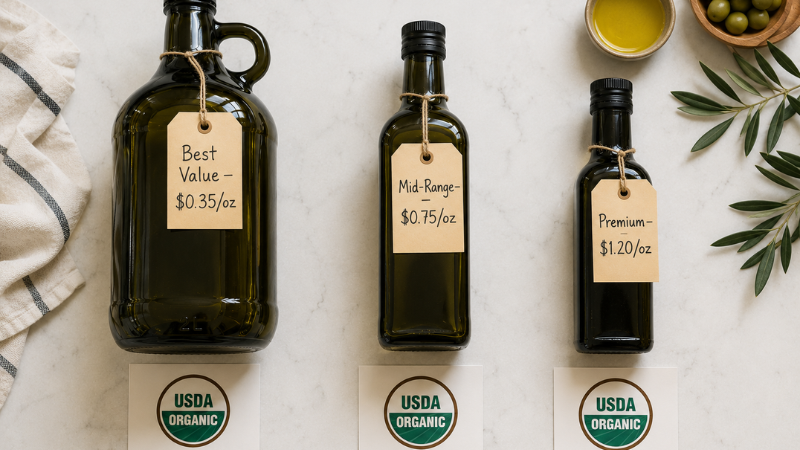
Best Value Organic EVOO (Under $0.50/oz)
Kirkland Signature Organic Extra Virgin Olive Oil (Costco) This is the clearest best-value recommendation in the organic EVOO category. At approximately $0.32–$0.38/oz for a 2-liter bottle, it carries USDA Organic certification and has been Bureau Veritas verified as genuine extra virgin. The Kirkland Organic EVOO was specifically noted in UC Davis Olive Center research as one of the certified products that passed authenticity testing. For a family that wants organic EVOO without paying specialty store prices, this is the starting and ending point of the search.
Decanting note: The 2-liter jug is excellent value but requires proper storage management. Decant weekly portions into a small dark glass cruet, keep the main jug sealed and cool. This preserves freshness across the entire jug rather than exposing the full volume to air repeatedly.
Mid-Range Organic EVOO ($0.60–$1.00/oz)
California Olive Ranch 100% California EVOO (Organic) California Olive Ranch produces both organic and conventional lines. The organic version carries USDA Organic certification and is made from California-grown olives, meaning stricter state labeling requirements and more transparent origin traceability. Priced around $0.70–$0.85/oz at most grocery chains and Target. Buttery, clean flavor profile; works well for both cooking and raw finishing.
Bragg Organic Extra Virgin Olive Oil Widely available at Walmart, Target, and natural food stores. USDA Organic certified, Greek origin, dark glass packaging. Priced at approximately $0.70–$0.90/oz. Bragg has consistent brand standards and reasonable freshness track record. A reliable mid-range organic option for families who can’t access Costco.
365 by Whole Foods Market Organic EVOO Whole Foods’ house brand organic EVOO has improved significantly in quality consistency. Priced at approximately $0.65–$0.80/oz (somewhat lower if you have Whole Foods Prime discounts). USDA Organic certified, typically stocked with reasonable freshness rotation.
Premium Organic EVOO ($1.00+/oz)
At this price point, you’re buying for flavor complexity and specific origin character rather than additional health benefits. Single-estate organic oils from California, Tuscany, or Greece with recent harvest dates and quality certification seals are appropriate here for finishing applications — drizzling over finished dishes, high-quality salad dressings, bread dipping. This category includes brands like Kosterina (Greek), Brightland (California), and various direct-import options.
For everyday family cooking, the cost difference between this tier and Kirkland Organic is not justified nutritionally. Reserve these for the finishing bottle in your two-bottle system.
Organic vs Non-Organic Extra Virgin Olive Oil: When Does the Difference Actually Matter?
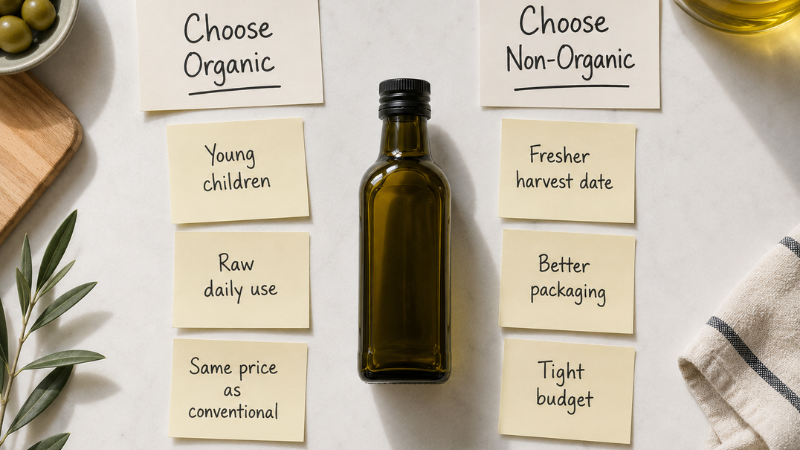
Here’s the practical decision framework for families:
When Organic Is the Right Choice
Cooking for young children regularly. Children have lower body weight relative to food intake, meaning pesticide residues represent a proportionally higher exposure. If olive oil is a daily staple in your family’s cooking and you have young children, the organic premium is a reasonable precautionary investment.
Someone in your household has chemical sensitivities or is immunocompromised. The marginal pesticide reduction from organic is more meaningful in these contexts.
You’re using it as a finishing oil where it’s consumed raw. Raw consumption means no heat-based degradation of any residues. If you’re regularly drizzling EVOO over food and eating it uncooked, organic makes more sense than for high-heat cooking applications.
The price difference is minimal at your preferred retailer. At Costco, Kirkland Organic and Kirkland conventional EVOO are similarly priced per ounce. When the organic option costs nearly the same, there’s no reason not to choose it.
When Non-Organic EVOO Is the Better Choice
The organic option has an older harvest date. A fresher non-organic EVOO provides more polyphenols and better flavor than an older organic one. Freshness wins.
The organic option is in worse packaging. If the organic bottle is clear plastic and the non-organic is dark glass, choose the dark glass. Light degradation is faster than pesticide residue accumulation in terms of quality impact.
The budget difference is meaningful to your household. A family spending $6–$8 extra per bottle every 6–8 weeks is spending $50–$70 more per year on olive oil. That’s a real number. If that money is better allocated elsewhere in the grocery budget, the non-organic Kirkland or Aldi EVOO is a sound choice.
How to Store Organic Extra Virgin Olive Oil
Organic EVOO follows the same storage rules as all extra virgin olive oil — in some ways it’s even more important to store correctly, since you paid a premium for the quality you’re protecting.
The three enemies: heat, light, and oxygen.
Ideal storage: Cool cabinet (57–70°F), dark location, sealed bottle. The pantry across the kitchen from the stove is the target — not next to the range where ambient heat accelerates oxidation.
The Costco jug system: Decant 1–2 weeks’ worth into a small dark glass cruet for counter use. Keep the main jug sealed and stored in a cool, dark location. This limits how often the bulk of the oil is exposed to air while keeping daily access convenient.
How long it lasts:
- Unopened, properly stored: 12–18 months from harvest date
- Opened, properly stored: 3–6 months at peak quality
How to tell if it’s gone off: Rancid olive oil — organic or not — smells like wax, old crayons, or cardboard. Fresh organic EVOO smells grassy, slightly fruity, and mildly peppery. If you open a bottle and smell nothing interesting, the oil has either oxidized or was never genuinely extra virgin to begin with.
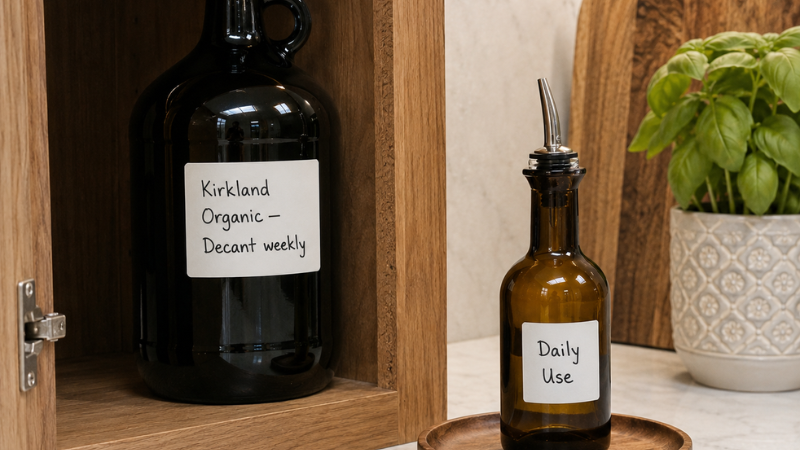
Quick Decision Guide: Organic or Non-Organic EVOO?
If you have five minutes in the grocery store and want a fast, reliable answer:
Choose organic if:
- Kirkland Organic at Costco is accessible — same price range as conventional, verified quality ✅
- You’re buying for young children and it’s a daily kitchen staple ✅
- The organic option has a harvest date and the non-organic doesn’t ✅
Choose non-organic if:
- The non-organic bottle has a more recent harvest date ✅
- The non-organic bottle is in better packaging (dark glass vs. clear plastic) ✅
- The price difference is $5+ per bottle and your budget is tight ✅
- You’re using it exclusively for high-heat cooking ✅
Either way, skip any bottle that:
- Has no harvest date and no certification seal ❌
- Is in clear plastic sitting under bright store lighting ❌
- Is priced significantly below all surrounding bottles ❌
- Says only “olive oil,” “pure olive oil,” or “light olive oil” ❌
FAQ
Q: Is organic extra virgin olive oil better for you than regular extra virgin olive oil?
Not consistently, based on current research. The health benefits associated with extra virgin olive oil — cardiovascular protection, anti-inflammatory polyphenols, antioxidant activity — are driven by the oil’s polyphenol content, which is determined by olive variety, harvest timing, and freshness. Organic certification addresses farming methods (no synthetic pesticides), not polyphenol content. A fresh, recently harvested non-organic EVOO may contain more beneficial compounds than an older organic bottle.
Q: What does USDA Organic mean on olive oil?
It means the olives were grown without synthetic pesticides, herbicides, or fertilizers, and the processing facility meets USDA National Organic Program standards. The certification requires annual inspection and renewal. It does not address oil quality grade, freshness, polyphenol content, or country of origin quality.
Q: Is Kirkland organic olive oil worth buying?
Yes — it’s the best-value genuine organic EVOO at a major U.S. retailer. The Kirkland Signature Organic EVOO has been Bureau Veritas certified as genuine extra virgin and noted in UC Davis testing. At approximately $0.32–$0.38/oz for a 2-liter jug, it costs significantly less per ounce than most grocery store organic options while meeting the same certification standards.
Q: Does organic olive oil taste different from regular olive oil?
Not predictably — and not because of the organic certification itself. Flavor differences between olive oils are driven by olive variety, harvest timing, terroir, and freshness. Two oils of the same variety and harvest timing, one organic and one conventional, should taste nearly identical. Taste differences you notice between organic and non-organic bottles are more likely due to these other variables than the farming method.
Q: Can you cook with organic extra virgin olive oil at high heat?
Yes, for normal home cooking. Organic EVOO has the same smoke point characteristics as non-organic EVOO (approximately 375–405°F), covering sautéing, roasting, pan-frying, and most baking. The organic certification doesn’t change the oil’s chemical behavior at heat. For sustained deep frying above 400°F, a refined oil with a higher smoke point is more appropriate regardless of organic status.
Q: How do I know if my organic olive oil is actually organic?
Look for the USDA Organic seal — the green and white circular badge. Without this seal, any use of “organic” on the label is unverified. Also look for a certification code or certifying agency name on the label (usually on the back), which indicates which USDA-accredited certifier verified the product. If neither is present, the “organic” claim is marketing language only.
Q: Is organic olive oil worth it for cooking or only for eating raw?
The pesticide residue argument is stronger for raw consumption (where residues aren’t heat-degraded) than for high-heat cooking. If you’re primarily using olive oil for sautéing and roasting, the conventional EVOO with a good harvest date is likely a better allocation of your grocery budget. If you use olive oil heavily for dressings, finishing, and drizzling — where it’s consumed raw — organic is a more meaningful choice.
The Honest Bottom Line
Organic extra virgin olive oil is a legitimate product category with real, verifiable meaning behind the certification. If reducing pesticide residue exposure is a priority for your family — particularly with young children or regular raw consumption — the organic premium is a reasonable choice.
But organic status doesn’t automatically mean better flavor, more polyphenols, or superior health benefits compared to a fresh, well-sourced conventional extra virgin olive oil. The factors that most determine quality — harvest date, olive variety, processing speed, and storage — operate independently of the organic certification.
The clearest recommendation for most families: if you want organic EVOO, start with Kirkland Signature Organic at Costco. It’s the point where organic certification and genuine quality verification overlap at a price that makes sense for a family budget. If Costco isn’t accessible, California Olive Ranch Organic or Bragg Organic are reliable mid-range alternatives at most major grocery chains.
For the complete picture on extra virgin olive oil — including how to read labels, which non-organic brands are genuinely good value, and the two-bottle system that works for most family kitchens — our extra virgin olive oil buying guide covers everything. And for a direct brand comparison of the top affordable EVOO options at Costco and Trader Joe’s, our Costco vs. Trader Joe’s olive oil guide gives you the head-to-head numbers.
References
- Peralbo-Molina A, et al. (2014). Metabolomics analysis of organic and conventional olive oils. Journal of Agricultural and Food Chemistry. doi:10.1021/jf500148h
- Muñoz-Tebar N, et al. (2021). Pesticide residues in virgin olive oils from organic and conventional farming. Food Chemistry. doi:10.1016/j.foodchem.2020.128172
- National Institutes of Health, Office of Dietary Supplements. Olive Oil and Health: What the Evidence Shows. ods.od.nih.gov
- USDA National Organic Program. Organic Regulations and Certification Requirements. ams.usda.gov
- UC Davis Olive Center. Olive Oil Quality Testing and Certification Results. olivecenter.ucdavis.edu