
Key Takeaways
- Extra virgin olive oil (EVOO) is the highest grade — mechanically extracted, no heat or chemicals, no flavor defects allowed, free acidity at or below 0.8%. It’s the one worth buying for both health and flavor.
- Virgin olive oil is made the same way but allows minor flavor imperfections and slightly higher acidity (up to 2%). It’s rarely sold in U.S. stores — if you can’t find it, that’s normal.
- The third type most people overlook is regular “olive oil” (also labeled “pure” or “light”) — a blend of heat-refined oil and a small amount of virgin or extra virgin. It has significantly fewer health benefits and is not the same product as the other two.
- According to a UC Davis Olive Center study, 69% of imported olive oils sold as extra virgin in the U.S. did not meet the official standard. Knowing what to look for on the label protects you from paying extra virgin prices for a refined product.
- For a family budget, the practical answer is simple: always choose extra virgin for cooking and finishing, and use the label tips in this guide to make sure you’re getting real EVOO rather than a mislabeled substitute.
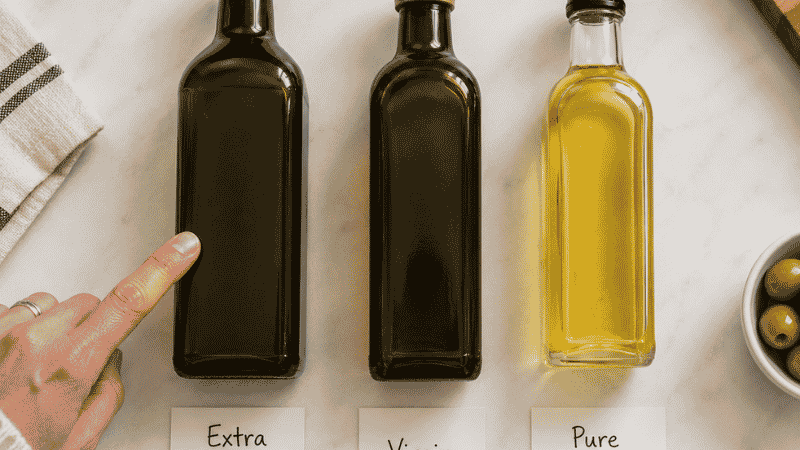
There are three olive oil bottles on the shelf. One says “extra virgin” and costs $8.99. One says “virgin” and costs $6.49. One just says “olive oil” and costs $4.99. They’re all the same size. You pick up the middle one — “virgin” sounds almost as premium as “extra virgin,” and it’s cheaper. Makes sense, right?
Here’s the thing: that choice might not be wrong, but it probably won’t be what you expected either. Virgin olive oil — the actual certified grade — is rarely available in North American grocery stores. Most bottles labeled “olive oil” or “pure olive oil” are something completely different from either virgin or extra virgin. And the “extra virgin” bottle you passed on? It might be worth the extra $2 — or it might be a mislabeled product that doesn’t actually meet the standard.
This guide cuts through the terminology so that the olive oil aisle takes 30 seconds to navigate instead of 3 minutes of confused label-reading. You’ll know exactly what each grade means, which one to buy and why, what the grocery store labels are actually telling you, and which types are marketing language versus meaningful quality indicators.
Virgin vs Extra Virgin Olive Oil — The Actual Difference That Matters for Shoppers
Both virgin and extra virgin olive oil are made the same way: olives are crushed and pressed mechanically, with no heat or chemical solvents involved. This “mechanical extraction only” requirement is what separates both of these grades from refined olive oils. So far, they’re identical.
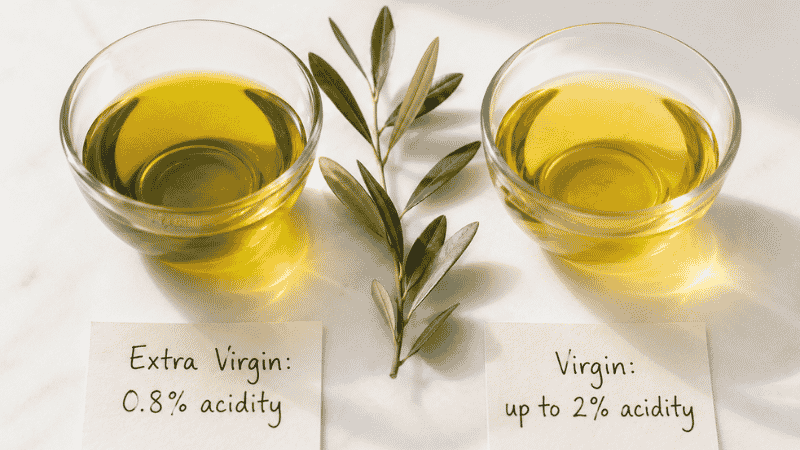
The separation happens at the quality testing stage. After extraction, olive oils are graded based on two criteria: chemical analysis (measuring free acidity and other markers) and sensory evaluation (professional tasters assessing flavor, aroma, and defects).
Extra virgin olive oil must pass both tests at the strictest level:
- Free acidity at or below 0.8% (a measure of how much the olive’s cell structure has broken down — lower is fresher and better)
- Zero flavor defects — no mustiness, no rancidity, no fermented notes
- Positive fruity olive character — the oil must actually taste and smell like olives
Virgin olive oil passes the same basic tests but at more lenient thresholds:
- Free acidity between 0.8% and 2.0%
- Minor flavor defects are allowed — slight mustiness or minor off-notes that don’t rise to the level of rejecting the oil
In practice, the flavor difference between a borderline extra virgin and a good virgin olive oil may be subtle. But the threshold matters because it’s the only formal quality guarantee the label provides. An extra virgin that just barely passed the test is still better than a virgin that barely passed its (lower) test.
The key shopping insight: For most families, this distinction is largely theoretical because virgin olive oil is almost never sold in U.S. grocery stores. The market essentially operates with two practical options — extra virgin and regular olive oil — with the “virgin” label appearing occasionally at specialty stores or online.
What About Regular “Olive Oil”? The Third Type Most Guides Ignore
This is the category that causes the most confusion, and it’s the one most guides skip over quickly. “Regular” olive oil — sold under labels including “olive oil,” “pure olive oil,” “classic olive oil,” and “light olive oil” — is fundamentally different from both virgin and extra virgin.
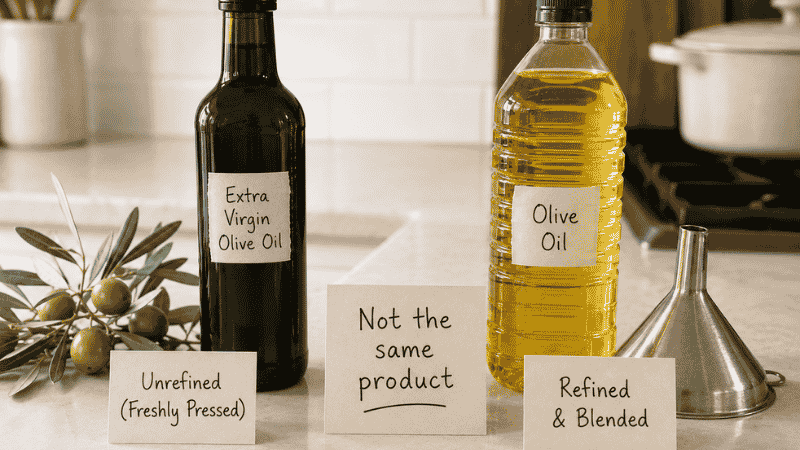
Regular olive oil is refined. After the initial mechanical extraction, the oil that doesn’t meet virgin standards (too acidic, too many flavor defects) goes through a refining process that uses heat and sometimes chemical solvents to neutralize the defects and produce a neutral, shelf-stable oil. A small amount of virgin or extra virgin oil is then blended back in to restore some flavor.
The refining process strips out most of what makes unrefined olive oil valuable:
- Polyphenols and antioxidants are largely destroyed by heat processing
- Vitamin E content is reduced
- Flavor becomes neutral — the characteristic olive taste is mostly gone
- Health benefits are significantly diminished compared to genuine extra virgin
What “light olive oil” actually means: Not lower calories. All olive oil has approximately the same calorie count per tablespoon (about 119 calories). “Light” refers to light flavor — a neutral, almost tasteless oil suited for baking or cooking where you don’t want olive oil flavor. It’s a marketing term with no regulatory definition of “light” for fat content.
When regular olive oil makes sense: For high-volume, high-heat cooking where you want a neutral flavor (frying, baking applications where olive flavor would be intrusive), regular olive oil is cheaper and adequate. For any application where the oil’s flavor or health properties matter, extra virgin is the right choice.
Which Olive Oil Should You Buy at the Grocery Store?
Now that you understand what the grades mean, here’s the direct purchasing guidance.
The Default Recommendation: Extra Virgin, Every Time
For a family buying olive oil for everyday cooking, dressings, and finishing, extra virgin olive oil is the only grade worth buying as a default choice. Here’s why:
It’s the only grade that guarantees both mechanical extraction (no chemical processing) and a minimum quality standard for freshness and flavor. The polyphenols that give olive oil its anti-inflammatory properties — linked to heart health, reduced inflammation, and blood sugar management in research published by the American Heart Association — are only present in meaningful amounts in genuine extra virgin olive oil.
The price premium over regular “olive oil” is real but modest when evaluated per use. A bottle of decent extra virgin at Walmart or Aldi costs $6–$9 and produces 30–40 uses for a typical family. That’s $0.15–$0.30 per meal — a fraction of the cost difference that a family would notice in their overall grocery budget.
The Exception: When Regular Olive Oil Is Acceptable
For high-heat deep frying (above 400°F sustained) or baking where you want a neutral flavor and the quantity used is large, regular olive oil is an appropriate and cheaper choice. Use it deliberately for these applications, not as a default substitute for EVOO.
Virgin Olive Oil: Worth Buying If You Find It
If you encounter genuine certified virgin olive oil (it occasionally appears at specialty stores, Trader Joe’s, or online), it’s worth trying. It’s made the same way as extra virgin but allows minor flavor variations that some people actually prefer — slightly more rustic or complex character. For cooking applications where you’ll be adding other flavors, the quality difference from EVOO is minimal. It typically costs less than EVOO, which makes it good value if you find it.
Does Extra Virgin Olive Oil Taste Different — and Does It Matter for Cooking?
This is the practical question most comparison guides avoid, and it’s worth answering directly.
For raw applications (salad dressings, drizzling, bread dipping): Yes, the flavor difference is significant and matters. Genuine extra virgin olive oil has a characteristic taste — grassy, slightly fruity, with a peppery finish at the back of the throat. That peppery sensation is actually oleocanthal, a polyphenol with documented anti-inflammatory properties similar to ibuprofen at the molecular level. Regular olive oil tastes like very little, and a mislabeled or rancid “extra virgin” may taste flat or slightly musty. For applications where the oil’s flavor is a primary element of the dish, quality matters considerably.
For high-heat cooking (sautéing, roasting at normal temperatures): The flavor difference is smaller. Heat reduces the intensity of olive oil’s flavor compounds, so a moderate-quality EVOO and a regular olive oil will taste more similar when used to sauté vegetables at 350°F than they do raw. That said, genuine EVOO is still more resistant to oxidation at heat due to its polyphenol and monounsaturated fat content — a Food Chemistry study found that EVOO produces fewer harmful oxidation compounds at cooking temperatures than refined oils.
The practical two-application approach: Many experienced home cooks keep two bottles — a larger, more affordable EVOO (like Kirkland Signature from Costco or Aldi Specially Selected) for everyday cooking, and a smaller mid-range bottle for finishing dishes raw. This way you get the health benefits across all applications while preserving the better oil’s flavor for where it’s most noticeable.
How to Tell If Your “Extra Virgin” Olive Oil Is Actually What It Says
This matters because, as noted earlier, a significant portion of imported olive oils labeled extra virgin in the U.S. don’t meet the standard. Here’s how to make informed choices without a laboratory.
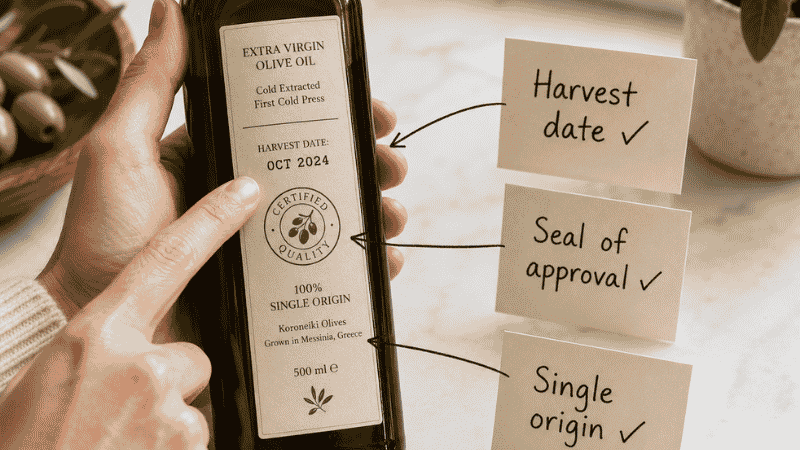
On the Label — Before You Buy
Look for a harvest date. A specific harvest date (example: “Harvest: October 2024”) rather than just a vague “best by” date indicates a producer willing to stand behind their freshness. Olive oil peaks within 12–18 months of harvest and degrades meaningfully after that.
Look for certification seals. The North American Olive Oil Association (NAOOA) seal means the oil has been independently tested for authenticity against IOC standards. The California Olive Oil Council (COOC) seal on California-origin oils indicates compliance with California’s strict extra virgin requirements, which are more stringent than federal standards.
Look for specific origin language. “Bottled in Italy” is not the same as “Italian olives.” Genuine single-origin oils should say “100% [Country] Olives” or list a specific growing region.
Look at the packaging. Genuine extra virgin oil that a producer is proud of is almost always in dark glass or tin — both protect against light degradation. Clear plastic bottles suggest either lower quality or indifference to shelf-life management.
At Home — After You Buy
Smell it. Fresh extra virgin olive oil smells like olives — green, grassy, slightly fruity, possibly peppery. If it smells like crayons, cardboard, or old wax, it has oxidized and gone rancid. If it smells like nothing, it may be a neutral refined oil.
Taste it. A small spoonful of good EVOO should taste fresh with some bitterness and a peppery finish. Flat, tasteless oil has either been refined or has oxidized past its prime.
The refrigerator test (useful but not definitive). Genuine extra virgin olive oil, when refrigerated for 30–60 minutes, will begin to cloud or partially solidify due to its wax content. Oil that shows no change at all after overnight refrigeration may be a highly refined product. Note that this test isn’t 100% reliable — some authentic EVOOs are naturally slower to solidify depending on olive variety — but it’s a reasonable home check when other signals are absent.
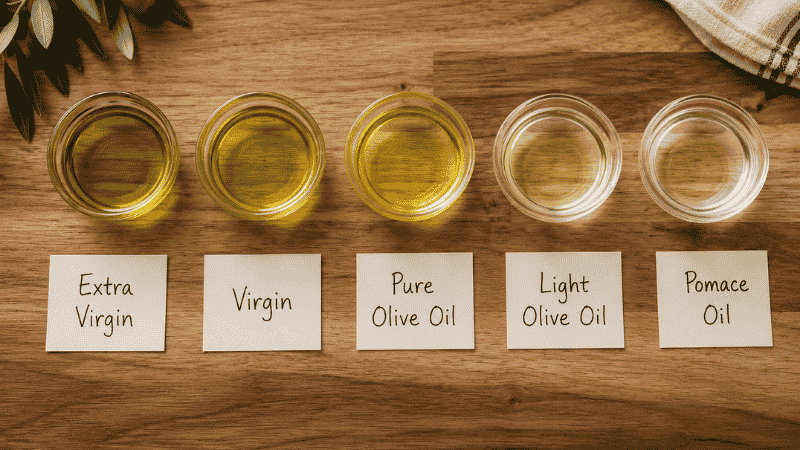
Olive Oil Grades Side by Side: The Complete Picture
Here’s the full picture of olive oil types you’ll encounter, from highest to lowest quality:
| Grade | How It’s Made | Flavor | Polyphenols | U.S. Availability | Best Use |
|---|---|---|---|---|---|
| Extra virgin | Mechanical only | Full, fruity, peppery | Highest | Widely sold | Everything |
| Virgin | Mechanical only | Good, minor imperfections | High | Rarely sold | Cooking, dressing |
| Regular / Pure olive oil | Blend: refined + small EVOO | Neutral, mild | Very low | Widely sold | Neutral cooking |
| Light olive oil | Blend: mostly refined | Almost tasteless | Minimal | Widely sold | Baking, high-heat |
| Olive pomace oil | Chemical solvent extraction | Neutral | Very low | Specialty stores | Industrial frying |
The Smoke Point Question: Which Grade Can Handle Heat?
A persistent myth: extra virgin olive oil can’t be used for cooking because its smoke point is too low.
This is not accurate. Extra virgin olive oil has a smoke point of approximately 375–405°F (190–207°C) depending on quality and freshness. This covers:
- Sautéing (typically 250–350°F)
- Roasting (typically 350–425°F for most recipes)
- Pan-frying at moderate heat (300–375°F)
- Baking (typically 325–375°F)
The smoke point concern applies primarily to deep frying (which requires sustained temperatures above 400°F) and very high-heat searing. For these applications, refined oils with higher, more stable smoke points are appropriate — but these represent a small fraction of most home cooking.
Research published in Food Chemistry actually found that extra virgin olive oil was more resistant to forming harmful oxidation compounds at cooking temperatures than many refined oils, largely because its polyphenol content acts as a natural antioxidant during heating.
FAQ
Q: What is the difference between virgin and extra virgin olive oil?
Both are mechanically extracted from olives without heat or chemicals. Extra virgin must have zero sensory defects and free acidity at or below 0.8% — the strictest grade. Virgin olive oil allows minor flavor imperfections and acidity up to 2.0%. In practice, extra virgin is the grade you’ll find in U.S. stores; genuine virgin olive oil is rarely sold at retail in North America.
Q: Is virgin olive oil better than extra virgin?
No — extra virgin is the higher quality grade by definition. “Extra virgin” means the oil met stricter standards for freshness, flavor, and acidity. Virgin olive oil passed lower-tier standards. For most shoppers, this comparison is theoretical since virgin olive oil is rarely available in U.S. grocery stores.
Q: Is “pure olive oil” the same as virgin olive oil?
No — and this is one of the most common olive oil label confusions. “Pure olive oil” or “olive oil” on a U.S. label typically refers to a blend of heat-refined olive oil with a small amount of virgin or extra virgin oil added back for flavor. It has far fewer polyphenols and antioxidants than either virgin or extra virgin grade and is a fundamentally different product.
Q: Can you cook with extra virgin olive oil or only use it raw?
You can cook with extra virgin olive oil for all standard home cooking methods — sautéing, roasting, pan-frying, baking. Its smoke point (375–405°F) covers the vast majority of home cooking temperatures. The concern about EVOO “breaking down” dangerously at heat is not supported by current research for normal home cooking. Some polyphenols are reduced at high heat, but the oil remains stable and healthier than most refined alternatives.
Q: Why can’t I find virgin olive oil at my grocery store?
Because it’s largely absent from North American retail. The U.S. olive oil market essentially operates with two categories: extra virgin and refined (“olive oil”). Virgin olive oil occupies a narrow middle grade that isn’t commercially compelling for large producers — it’s better than refined but doesn’t get the premium pricing of extra virgin. Specialty food stores and online retailers occasionally carry it.
Q: Is more expensive extra virgin olive oil actually better?
Not reliably. Price correlates loosely with quality at very low price points (extremely cheap “extra virgin” at $3–$4 for a large bottle is a red flag), but above a threshold, price doesn’t predict flavor or polyphenol content reliably. A $9 bottle of Kirkland Signature EVOO has been independently verified as genuine extra virgin and performs comparably to $20+ bottles in cooking applications. Focus on certification seals, harvest dates, and dark packaging rather than price as your primary quality indicators.
Q: What does “cold pressed” mean on an olive oil label?
In the U.S., “cold pressed” is largely an unregulated marketing term. All genuine extra virgin and virgin olive oil is produced without heat by definition — the term is redundant for these grades. It sounds premium but adds no verified information about quality. Focus on the grade (“extra virgin”), certification seals, and harvest date instead.
The Honest Bottom Line
The virgin vs extra virgin olive oil distinction is real and meaningful — but for most American shoppers, the practical decision is simpler than the terminology suggests. Extra virgin is the only grade worth buying as a default because it’s the only one that guarantees both mechanical extraction and a minimum quality standard. Virgin olive oil, if you find it, is a legitimate and often cheaper alternative for cooking. Regular “olive oil” is a different product category entirely, appropriate for specific neutral-cooking applications but not a substitute for the health benefits associated with unrefined olive oil.
The bigger challenge isn’t choosing between grades — it’s making sure the extra virgin you’re buying is actually extra virgin. Use the label tips in this guide and our full extra virgin olive oil buying guide for specific brand recommendations. And if you’re comparing the two most popular budget options at major retailers, our Costco vs. Trader Joe’s olive oil comparison gives you a direct head-to-head with real prices and quality data.
References
- International Olive Council. Trade Standard Applying to Olive Oils and Olive-Pomace Oils. internationaloliveoil.org
- UC Davis Olive Center. Imported Olive Oil Quality Testing Results. University of California, Davis. olivecenter.ucdavis.edu
- American Heart Association. Monounsaturated Fats and Heart Health. heart.org
- Lozano-Castellón J, et al. (2020). Domestic sautéing with EVOO: Change in the phenolic profile. Antioxidants. doi:10.3390/antiox9010077
- North American Olive Oil Association. Olive Oil Standards and Grades. aboutoliveoil.org