
Key Takeaways
- Cooked chicken lasts 3–4 days in the refrigerator when stored at 40°F (4°C) or below, according to USDA food safety guidelines. Under ideal conditions (fridge held at 41°F or below), food safety experts note it can safely last up to 5–7 days — but 3–4 days is the reliable standard for most home refrigerators.
- The 2-hour rule is non-negotiable: cooked chicken left at room temperature for more than 2 hours (or 1 hour if the kitchen is above 90°F) enters the bacterial danger zone and should be discarded.
- Rotisserie chicken, shredded chicken, whole roasted chicken, baked chicken breasts, and fried chicken all follow the same 3–4 day rule. The cooking method doesn’t extend or shorten the fridge life — storage method does.
- Cooked chicken can be frozen for up to 4 months with no food safety concerns, though quality is best within the first 2–3 months. Freezing on Day 1 or 2 (before quality starts to decline) gives you the best results.
- If you’re meal prepping: A Sunday batch of cooked chicken should be eaten or frozen by Wednesday or Thursday at the latest. Any chicken you don’t plan to use by then should go directly into the freezer — not the fridge.
It’s Wednesday evening. You open the fridge and spot the baked chicken from Sunday’s dinner. You do the mental math: Sunday, Monday, Tuesday, Wednesday… that’s four days. Is it still good?
You pick it up, smell it — seems okay. You look at it — looks okay. But you’re not sure, so you end up doing what most people do: either eating it and hoping for the best, or throwing it away just to be safe and feeling guilty about the waste.
Neither option should require guesswork. Knowing exactly how long cooked chicken lasts in the fridge — and what actually determines whether it’s still safe — is one of the most practical pieces of food knowledge a family kitchen can have. It prevents food poisoning, prevents unnecessary waste, and makes the math of meal prepping actually work.
This guide gives you the complete picture: the specific timeframes for every type of cooked chicken, how to store it correctly, how to tell when it’s gone bad, and how to use up what you have before you lose it.
How Long Does Cooked Chicken Last in the Fridge? The Official Answer
The United States Department of Agriculture (USDA) Food Safety and Inspection Service is unambiguous on this: cooked poultry should be refrigerated within 2 hours of cooking and consumed within 3 to 4 days.
This applies regardless of:
- How the chicken was cooked (roasted, grilled, baked, fried, slow-cooked)
- What cut it was (breast, thigh, drumstick, wing, whole bird)
- Whether it was seasoned or plain
- Whether it came from a restaurant, a grocery store rotisserie, or your own oven
The 3–4 day window exists because refrigeration slows bacterial growth but doesn’t stop it. Bacteria like Listeria, Salmonella, and Staphylococcus aureus continue multiplying in cold environments — just more slowly. By day 4–5, bacterial levels in improperly cooled or stored chicken can reach levels that cause foodborne illness even when the chicken looks and smells fine.
The nuance most guides miss: According to food safety researchers at Rutgers University and NC State’s Safe Plates program, cooked chicken in a properly calibrated refrigerator (held consistently at 41°F or below) can safely last up to 7 days. The standard 3–4 day recommendation exists because most home refrigerators open and close frequently, and temperatures can fluctuate above the ideal threshold — especially near the door. If you have a consistent, properly calibrated fridge and have stored the chicken immediately in an airtight container, day 5 may be fine. If you’re at all uncertain about your fridge’s temperature consistency, stick to 3–4 days.
Cooked Chicken Storage Times: Every Type at a Glance
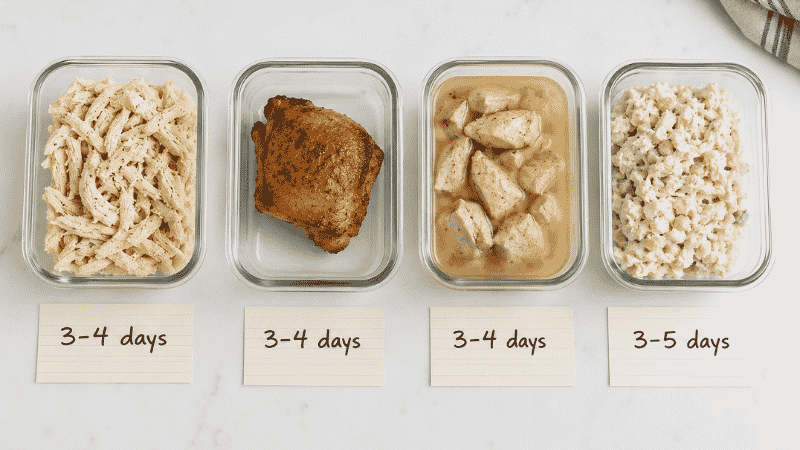
Different forms of cooked chicken have slightly different storage considerations — not because the basic rule changes, but because of how bacteria interact with different preparations.
| Type of Cooked Chicken | Fridge Life | Freezer Life |
|---|---|---|
| Roasted or baked chicken (whole pieces) | 3–4 days | 4 months |
| Shredded or chopped cooked chicken | 3–4 days | 3–4 months |
| Rotisserie chicken (from store) | 3–4 days after purchase | 4 months |
| Fried chicken | 3–4 days | 4 months |
| Grilled chicken | 3–4 days | 4 months |
| Cooked chicken in soup or stew | 3–4 days | 4–6 months |
| Chicken salad (with mayo) | 3–5 days | Not recommended |
| Chicken casserole or pasta dish | 3–4 days | 3 months |
| Cooked ground chicken | 3–4 days | 3–4 months |
| Chicken nuggets or patties | 3–4 days | 1–3 months |
Why chicken salad lasts slightly longer: The acidity and salt in mayonnaise-based chicken salad creates a mildly preservative environment. FoodSafety.gov lists 3–5 days for chicken salad specifically.
Why cooked chicken in soup lasts well frozen: The liquid environment protects the meat from freezer burn and ice crystal damage, resulting in better texture after thawing than dry-stored frozen chicken.
The 2-Hour Rule: Why Getting Chicken Into the Fridge Fast Matters More Than Anything Else
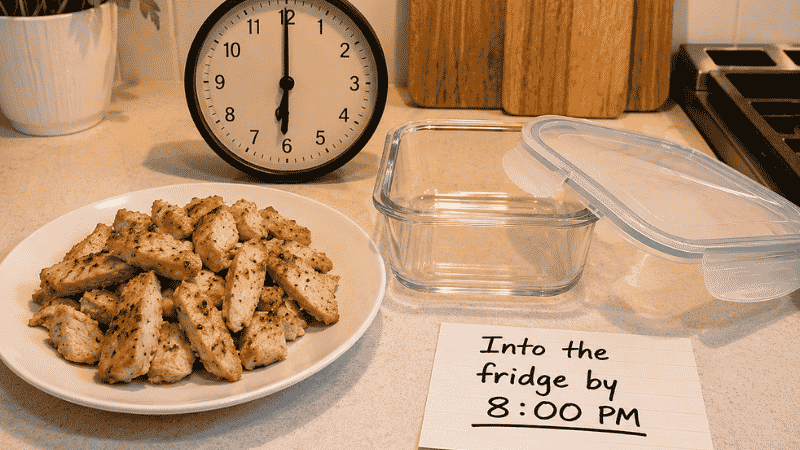
The single most important factor in how long cooked chicken lasts isn’t the storage container or the fridge temperature — it’s how quickly you get it into the fridge after cooking.
Bacteria multiply most rapidly between 40°F and 140°F — the USDA calls this the “Danger Zone.” A freshly cooked chicken breast sitting on the counter goes from safe to dangerous faster than most people realize:
- 0–2 hours at room temperature: Safe to refrigerate, bacteria growth minimal
- 2–4 hours at room temperature: Approaching danger territory, refrigerate immediately
- 4+ hours at room temperature: Discard. Bacteria levels may be high enough to cause illness even if you reheat the chicken thoroughly
The 2-hour window shortens to 1 hour when your kitchen temperature is above 90°F — relevant in summer months or in kitchens without air conditioning.
The practical version of this rule: When you finish dinner, don’t wait until you’ve watched an episode of TV to put the chicken away. Put it in a container within 20–30 minutes of the meal ending. You don’t need to wait for it to reach room temperature — in fact, getting it into the fridge while still slightly warm is better than leaving it on the counter for 2 hours to cool.
The “I forgot” scenario: If you’ve left cooked chicken out overnight, discard it. There is no safe way to recover chicken left at room temperature for more than 4 hours, regardless of how it looks or smells. Reheating does not neutralize the toxins that bacteria produce during the danger zone period.
How to Store Cooked Chicken in the Fridge to Maximize Freshness
The container and storage location make a meaningful difference in whether your chicken lasts 3 days or 4.
Use an Airtight Container
An airtight container does three things: slows down oxidation (which affects flavor and texture), prevents the chicken from absorbing odors from other fridge contents, and prevents cross-contamination in both directions.
Best options:
- Glass containers with snap lids — don’t absorb odors, go microwave to fridge without transfer, last indefinitely
- BPA-free plastic containers with tight-fitting lids — lighter and less expensive, but can absorb odors over time
- Heavy-duty zip-top bags with air pressed out — good for shredded chicken, poor for pieces that will dry out
What not to use: Uncovered plates, loosely wrapped foil, or containers with lids that don’t seal. These allow air circulation that accelerates drying and bacterial growth.
Refrigerator Placement Matters
The back of the fridge is colder and more temperature-consistent than the door or the front shelves. Cooked chicken stored near the door experiences temperature fluctuations every time the fridge opens.
Ideal placement: Second or third shelf from the top, toward the back. Keep cooked chicken on a shelf above raw meat to prevent any drip contamination.
Label With the Date
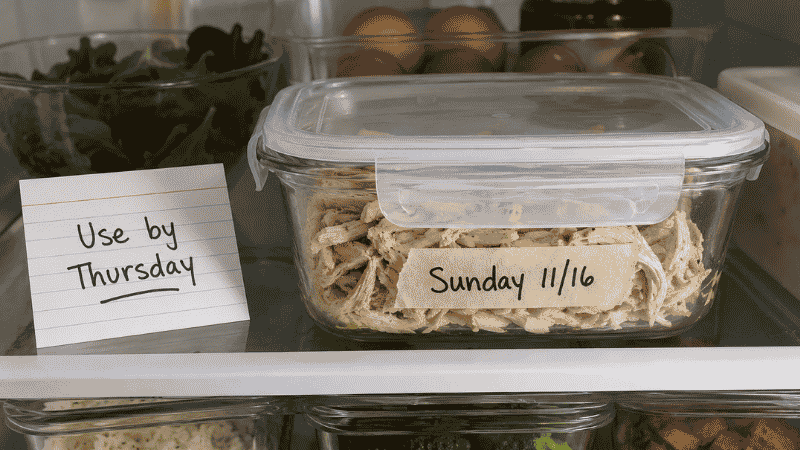
This sounds basic but it’s the habit that prevents the most food waste. A piece of masking tape and a marker takes 5 seconds and eliminates the “how long has this been here?” moment entirely. Write the date you cooked it, not the date you plan to use it.
For meal prep: Label each container with the cook date. If you prepared chicken on Sunday, label it “Sunday 11/16” — when Wednesday arrives, you know exactly where you stand.
How to Tell If Cooked Chicken Has Gone Bad
This is the question most guides answer incompletely. “If in doubt, throw it out” is correct but unhelpful — here’s what to actually look for.
Smell
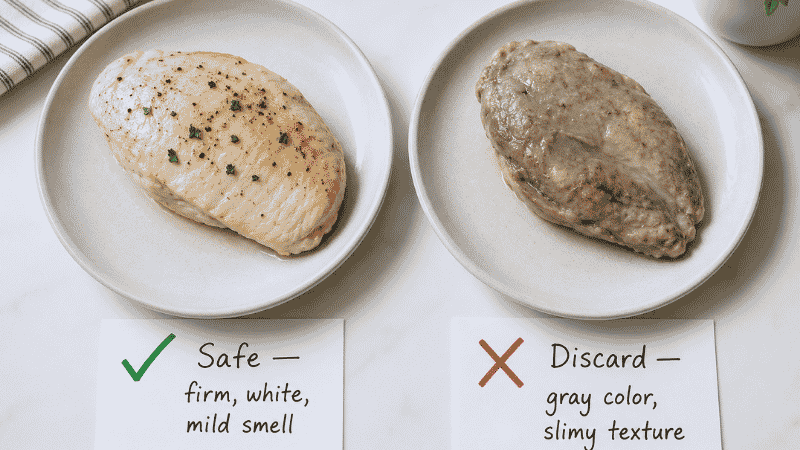
Fresh cooked chicken has a mild, neutral smell — slightly savory, nothing sharp or sour. Spoiled chicken develops a distinctly sour, slightly sulfurous, or “off” odor that’s immediately recognizable once you know what to look for. This smell comes from bacterial activity breaking down proteins.
Important caveat: if you can’t smell anything wrong, the chicken is not necessarily safe. Some dangerous bacteria (including certain strains of Salmonella) don’t produce noticeable odors at unsafe levels. Smell is a useful warning signal, not a safety guarantee. The date matters more than the smell.
Texture
Fresh cooked chicken has a firm texture with some moisture. Spoiled chicken becomes slimy or sticky to the touch — a slick, almost tacky surface that doesn’t wipe away. This sliminess is caused by bacterial colonization on the surface of the meat.
If the chicken feels significantly more moist or slippery than when you first stored it, discard it regardless of the smell or color.
Color and Appearance
Freshly cooked chicken is white or light golden depending on preparation. Gray or greenish tones are a clear sign of spoilage. Some surface color change (slight graying on exposed edges) is normal after 3–4 days, but this should be minimal.
Mold is an unambiguous sign — any visible mold means the entire container should be discarded, not just the affected piece.
The Date
Here’s the honest hierarchy: the date stored matters more than any visual or sensory check. Bacteria that cause foodborne illness are often not detectable by smell, sight, or taste. If the chicken has been in the fridge for 5+ days, the sensory checks are a secondary confirmation, not a primary safety measure.
The rule that prevents 90% of bad chicken situations: If you’re not sure how many days it’s been, discard it. The cost of a food safety incident is far higher than the cost of the chicken.
The Meal Prep Calendar: What to Do With Cooked Chicken Each Day
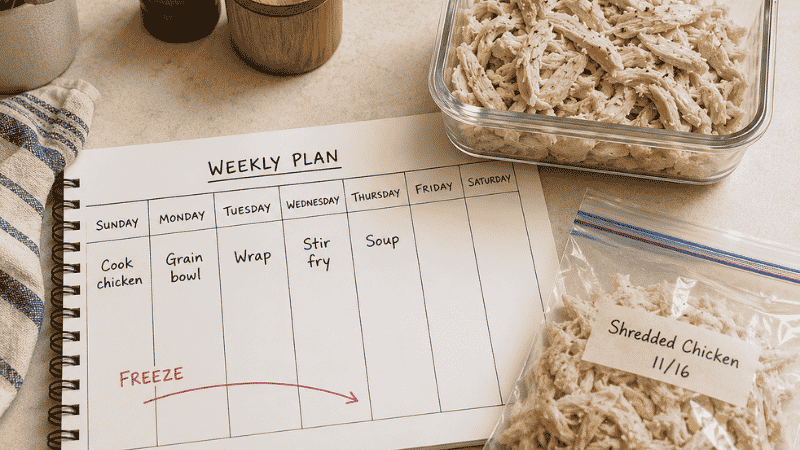
If you cook or buy chicken on Sunday for the week ahead, here’s the practical day-by-day guide:
Sunday (Cook Day): Store in an airtight container within 2 hours. Decide immediately: how many portions will you realistically use by Wednesday? Freeze the rest now, while it’s fresh — don’t wait until Thursday.
Monday (Day 1): Optimal eating window. Chicken is at its best quality — most moisture retained, best flavor. Use for grain bowls, salads, wraps, or any cold application where texture matters most.
Tuesday (Day 2): Still excellent quality. Good for any application — cold or heated. Shredded chicken in pasta, tacos, soups, or sandwiches.
Wednesday (Day 3): Still safe and good. The chicken may be slightly drier than Day 1 — best used in dishes with sauce or moisture added (pasta sauce, soups, stir-fries) rather than cold salads where texture is more noticeable.
Thursday (Day 4): The outer limit of the standard 3–4 day window. If your fridge is consistently cold and the chicken was stored immediately, it’s safe. Use for cooked dishes where the chicken is heated through to 165°F. Not ideal for cold applications.
Friday (Day 5+): Beyond the standard safe window for most refrigerators. If you haven’t used it by now and it wasn’t frozen, discard it. The financial cost of the chicken is not worth the health risk.
The freezer decision rule: Any chicken you don’t expect to use by Day 3 should go into the freezer on Day 1 or 2. Freezing quality-good chicken and thawing it later is better than eating borderline-safe chicken from the fridge.
How to Freeze Cooked Chicken Properly
Cooked chicken frozen correctly maintains food safety indefinitely (bacteria don’t grow in a properly frozen environment) and maintains acceptable quality for 2–4 months.
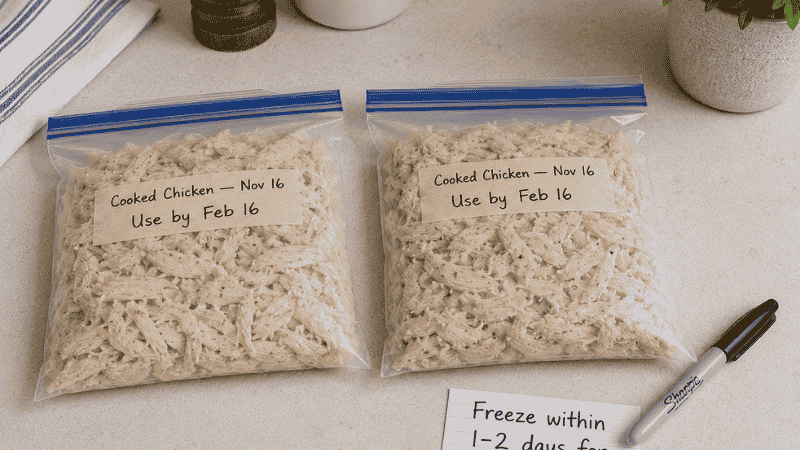
How to Freeze
Cool first: Don’t put hot chicken directly into the freezer — it raises the temperature inside and can partially thaw surrounding items. Cool in the fridge for 30–60 minutes first, or spread on a sheet pan to cool quickly at room temperature for no more than 30 minutes.
Portion before freezing: Freeze in meal-sized portions (enough for 1–2 meals) rather than one large block. This lets you thaw exactly what you need without having to thaw and re-freeze.
Wrap properly: Use heavy-duty freezer bags with air pressed out, or airtight containers with minimal headspace. Freezer burn (the dry, white patches that develop on improperly wrapped frozen food) doesn’t make chicken unsafe but significantly affects texture and flavor.
Label: Date and contents. Frozen chicken that has been in the freezer for 5 months is still safe but won’t taste good — the label prevents the “mystery bag” problem.
How to Thaw Safely
Refrigerator thawing: Move from freezer to fridge the night before. Takes 12–24 hours. This is the safest method and keeps the chicken in a continuously safe temperature zone.
Cold water thawing: Submerge in a sealed bag in cold water, changing the water every 30 minutes. Takes 1–2 hours. Cook immediately after thawing this way.
Microwave thawing: Use the defrost setting. Cook immediately — parts of the chicken may begin to cook during microwave thawing, which raises food safety concerns if not fully cooked afterward.
Never thaw at room temperature. This puts the outside of the chicken in the danger zone for hours while the inside is still frozen.
Reheating Frozen Cooked Chicken
Always reheat to an internal temperature of 165°F (74°C). This is the USDA’s recommended safe temperature for reheated poultry — it ensures any bacteria that may have survived the freezing process are eliminated.
Use a food thermometer rather than estimating — the difference between 155°F and 165°F is not visible to the eye.
How to Use Up Cooked Chicken Before It Goes Bad: 5 Ideas by Day
Day 1–2 (Best Quality): Cold Applications
- Chicken salad sandwich (shredded chicken, mayo, celery, mustard, salt)
- Cold chicken wrap with avocado and greens
- Grain bowl with rice, vegetables, and a sauce of your choice
- Sliced chicken on a green salad
Day 2–3 (Still Good): Quick Weeknight Dishes
- Chicken fried rice with leftover rice and frozen vegetables
- Chicken quesadillas with shredded chicken and cheddar
- Chicken and vegetable stir-fry
- Pasta with chicken, olive oil, garlic, and cherry tomatoes
Day 3–4 (Use in Cooked Dishes): High-Heat Applications
- Chicken soup or chicken noodle soup (simmered with broth and vegetables)
- Chicken tacos (heated in a skillet with cumin, chili powder, and a splash of broth)
- Chicken pot pie filling
- Chicken and rice casserole
Day 4 (Final Use): Extended Cooking
- Chicken chili (simmered for 20+ minutes, chicken heated fully through)
- Chicken enchiladas (baked in the oven at 375°F)
FAQ
Q: Can you eat cooked chicken after 5 days in the fridge?
It depends on storage conditions. The USDA’s standard guideline is 3–4 days. Under ideal conditions (fridge consistently at 41°F or below, chicken stored in an airtight container within 2 hours of cooking), food safety researchers indicate it may be safe for up to 7 days. However, most home refrigerators fluctuate in temperature due to regular opening and closing, making the 3–4 day window the reliable safe standard for most households. If you’re at day 5 and uncertain, err on the side of discarding.
Q: How long does rotisserie chicken last in the fridge?
Store-bought rotisserie chicken follows the same 3–4 day rule once you bring it home and refrigerate it. The cooking date from the store doesn’t extend this window — the clock starts when you get it into your refrigerator. Some stores sell rotisserie chicken that has been sitting under a heat lamp for hours; in those cases, use it within 3 days rather than 4.
Q: Can you freeze cooked chicken and reheat it later?
Yes. Cooked chicken frozen in an airtight container or heavy-duty freezer bag maintains food safety indefinitely and best quality for 2–4 months. Thaw in the refrigerator overnight or use the cold water method. Always reheat to 165°F internal temperature before eating.
Q: How do you know if cooked chicken has gone bad?
Three sensory checks: smell (sour, sulfurous, or “off” odor), texture (slimy or sticky surface), and appearance (gray or greenish color, visible mold). However, some dangerous bacteria produce no detectable odor or visible signs — the date the chicken was stored is more reliable than sensory checks alone. When in doubt, discard.
Q: How long does shredded cooked chicken last in the fridge?
Shredded chicken follows the same 3–4 day rule as other cooked chicken forms. Because shredding increases the surface area of the chicken, it can dry out slightly faster than whole pieces — store in an airtight container with a tablespoon of broth or cooking liquid to preserve moisture.
Q: Is it safe to meal prep chicken for the whole week?
Not if you’re planning to refrigerate all of it. A Sunday meal prep batch should cover Monday through Thursday at most (3–4 days). Any chicken intended for Friday should be frozen on Sunday and thawed in the refrigerator Thursday night. This is the safe meal prep system that works within food safety guidelines without requiring you to prep twice.
The Honest Bottom Line
The 3–4 day rule is the answer to how long cooked chicken lasts in the fridge — but the more useful information is everything around that rule: getting it into the fridge within 2 hours, storing it in an airtight container, labeling it with the date, and deciding on Sunday which portions go in the fridge and which go directly into the freezer.
The families who waste the least food and have the fewest food safety scares aren’t the ones with the best memory — they’re the ones with a system. Label everything, freeze early, and use the calendar above to make cooked chicken decisions before they become guesswork.
For the complete guide to what to buy, how to prep it, and how to make it last all week, our meal prep lunch ideas guide covers the full system. And for the pantry staples that round out a week of meals when the chicken is gone, our pantry staples guide has everything worth keeping on hand.
References
- USDA Food Safety and Inspection Service. Leftovers and Food Safety. fsis.usda.gov
- USDA Food Safety and Inspection Service. Chicken from Farm to Table. fsis.usda.gov
- FoodSafety.gov. FoodKeeper App — Storage Times for Cooked Poultry. foodsafety.gov
- Donald Schaffner, PhD, Rutgers University Food Science. Quoted in Martha Stewart.com: How Long Cooked Chicken Lasts in the Fridge.
- Ellen Shumaker, PhD, NC State Safe Plates Program. Food Safety Research on Leftover Storage Times.