
Key Takeaways
- Raw ground beef lasts 1–2 days in the refrigerator, according to USDA food safety guidelines — regardless of fat content (80/20 or 93/7). If you’re not cooking it within 2 days, freeze it.
- Cooked ground beef lasts 3–4 days in an airtight container in the fridge. Dishes containing ground beef (chili, pasta sauce, tacos) follow the same 3–4 day rule.
- The color of raw ground beef is not a reliable freshness indicator. Beef turns gray-brown when exposed to air — this is normal oxidation, not spoilage. Smell and texture are more reliable.
- The smart buying strategy for families: buy ground beef in bulk (family packs or Costco chubs) when it’s on sale, immediately portion and freeze in 1-pound bags. This is one of the highest-ROI grocery habits for any household.
- Ground beef frozen properly lasts 3–4 months at best quality, and remains food-safe indefinitely when frozen. Buying on sale and freezing is consistently cheaper than buying fresh weekly.
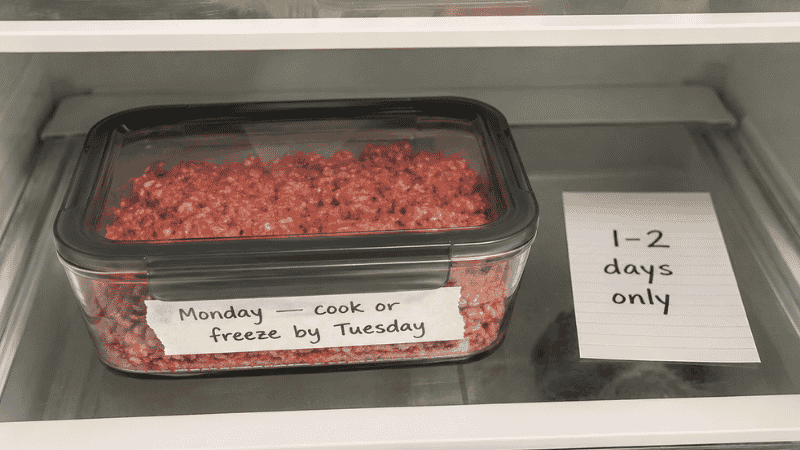
You opened the fridge this morning and there it is — the pound of ground beef you bought on Sunday. Today is Tuesday. You’re pretty sure it’s fine. But “pretty sure” isn’t the same as certain, and now you’re standing there with the package in your hand doing mental math about whether tonight’s tacos are going to be delicious or a bad idea.
The honest answer is: it depends on exactly when you bought it, how it was stored, and what it smells like. The slightly more useful answer is that this exact moment of uncertainty — the fridge-open, package-in-hand pause — is something that happens in almost every household, and it’s entirely preventable with a little knowledge and a small system change.
This guide gives you the clear answer on how long ground beef lasts in the fridge, what actually determines freshness, how to read the signs your beef is telling you, and — because this is Pantryva — how to buy and store ground beef in a way that costs your family significantly less money over the course of a year.
How Long Does Ground Beef Last in the Fridge? The Actual Answer
Let’s start with what the USDA Food Safety and Inspection Service actually says, because this is one of those topics where there’s a lot of conflicting information online.
Raw ground beef: 1–2 days refrigerated at 40°F or below.
That’s it. One to two days. Not three or four, not “up to a week if it smells okay.” The USDA is clear, and the reasoning is straightforward: ground beef has a much larger surface area than a whole cut of meat, which means more exposure to bacteria. The grinding process also distributes any surface bacteria throughout the entire batch. Bacteria that would be only on the outside of a steak are mixed throughout ground beef.
This 1–2 day window applies to:
- Regular grocery store ground beef
- Lean ground beef (93/7, 96/4)
- Regular ground beef (80/20, 85/15)
- Ground turkey and ground pork follow similar guidelines
- Store-ground beef from a butcher counter
- Ground beef from Costco, Aldi, or any other retailer
The fat content question: You’ll see some sources claim that leaner ground beef lasts longer because fat provides “a breeding ground for bacteria.” This is misleading. USDA guidelines make no distinction between fat percentages for refrigerator storage — both lean and fatty ground beef follow the same 1–2 day rule. What fat content affects is cooking behavior and flavor, not meaningful storage time.
Raw vs. Cooked Ground Beef: The Storage Times Are Very Different
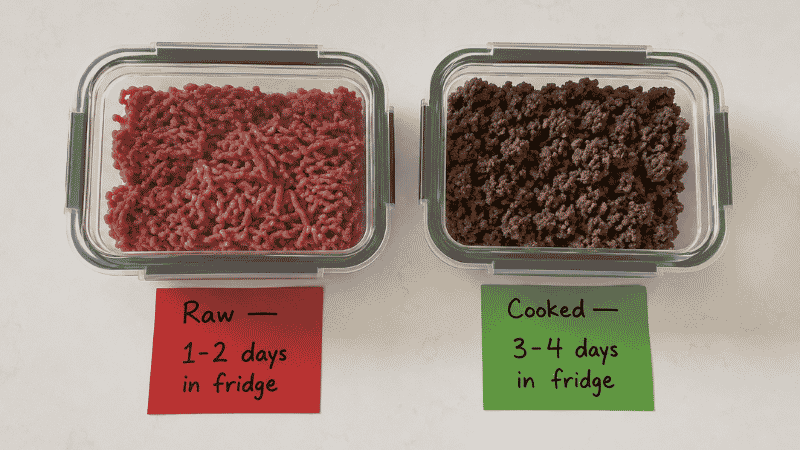
This distinction matters more than most guides acknowledge.
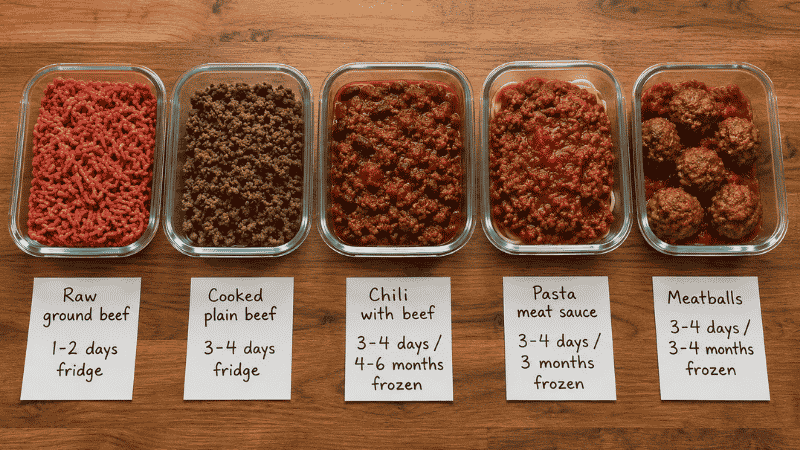
Raw ground beef: 1–2 days refrigerated Cooked ground beef (plain): 3–4 days refrigerated Cooked dishes containing ground beef (chili, pasta sauce, taco filling, casseroles): 3–4 days refrigerated
Cooking doesn’t just change the flavor — it changes the bacterial landscape. The cooking process kills bacteria present in raw meat, giving you a fresh safety window. A bowl of chili you made tonight can safely stay in your fridge through Thursday or Friday. The raw beef you bought today cannot safely wait past tomorrow.
The practical implication for families: If you cook ground beef on Monday night but life happens and nobody eats it until Thursday — that’s still within the safe window. But if you bought raw ground beef Monday and forgot about it until Thursday, it’s gone. The window for raw beef is genuinely very short.
Does Cooked Ground Beef Mixed With Other Ingredients Change the Timeline?
The short answer is: generally no, but the texture will. The 3–4 day rule applies to mixed dishes — chili with beans, pasta with meat sauce, stuffed peppers. The various ingredients don’t extend or shorten the safety window in any meaningful way.
What does change: the texture and quality of cooked dishes can degrade faster when ingredients absorb liquid from each other. A pasta dish with meat sauce may look and taste less appealing on day 4 than a plain batch of cooked ground beef. Food safety is the same; the eating experience differs.
How to Tell If Ground Beef Has Gone Bad: What’s Actually Reliable
This is where most guides give incomplete information — and where a lot of perfectly good beef gets thrown away unnecessarily.
The Color Question (And Why It’s Misleading)
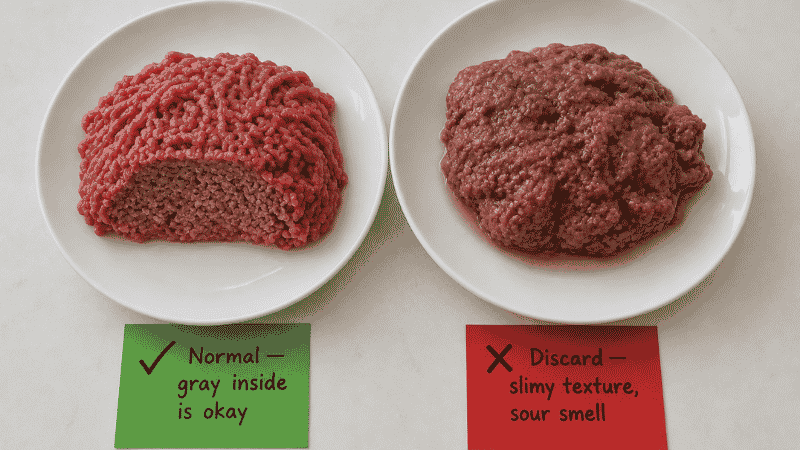
Here’s something most people don’t know: fresh ground beef is supposed to be red-pink on the outside, but gray-brown on the inside. When beef is exposed to oxygen, myoglobin (the protein responsible for color) reacts and turns bright red. In the center of a package, away from oxygen, that same beef is gray-brown. This is completely normal.
What this means at the store: If you cut open a package of ground beef and the interior is grayish while the outside is red, that’s not spoilage — it’s just oxygen exposure doing its thing. Stores sometimes discount beef that looks more gray-brown overall (because customers avoid it), but if it’s within date and smells fine, it’s perfectly good.
What actual color-related spoilage looks like: A uniformly gray-green or iridescent sheen, sometimes with a slightly slimy or sticky surface. This is different from the brown-gray of oxygen-reduced beef.
Editor’s take: The gray beef discount is one of the best deals in the grocery store. Grab it, cook it today, and feel good about it.
Smell: The Most Reliable Indicator
Fresh raw ground beef has a mild, slightly metallic smell — or really no distinctive smell at all. Spoiled ground beef smells sour, ammonia-like, or distinctly “off.” This smell is caused by bacterial activity producing waste products as they break down proteins.
Trust your nose. If you open a package and instinctively pull back or wrinkle your nose, that’s the answer. A mild smell that seems slightly stronger than usual but not unpleasant is likely just the natural smell of raw beef — not spoilage. A smell that makes you uncomfortable is a clear sign.
The caveat: some dangerous bacteria produce no detectable odor at levels that can cause illness. Smell tells you when beef has obviously spoiled, but absence of smell doesn’t guarantee safety. This is why the date matters more than the smell test alone.
Texture: The Underused Check
Fresh raw ground beef feels moist and slightly sticky — this is normal. Spoiled ground beef feels slimy or tacky in a way that doesn’t go away when you press the meat. This surface sliminess is caused by bacterial colonies forming on the meat’s surface.
If you unwrap ground beef and the surface has a slimy film that doesn’t seem like normal moisture, discard it regardless of smell or color.
The Date vs. The Senses: Which Wins?
The date stored wins. Always.
Your senses catch obvious spoilage. They don’t catch early-stage bacterial growth that’s advanced enough to cause illness. If you bought ground beef on Monday and it’s now Thursday, the smell and texture tests might tell you “this seems fine” — and you could be right. Or you could be wrong in a way that results in a very unpleasant 24 hours.
The rule I use: If raw ground beef has been in the fridge for more than 2 days, it goes to the freezer or gets cooked — not the smell test. The smell test is a backup for when I’m uncertain about a day, not a substitute for knowing how long something has been in the fridge.
The Buying and Storing Strategy That Saves Families Real Money
Here’s where ground beef storage stops being just a food safety topic and becomes a grocery budget topic. Because how you buy and store ground beef has a direct and measurable effect on your monthly spending.
The Family Pack Math
A 1-pound package of 80/20 ground beef at Walmart typically runs $4.49–$4.99/lb. A 3-lb family pack of the same beef runs $3.49–$3.79/lb. A 5-lb chub from Walmart or Costco runs $2.99–$3.49/lb.
The difference between buying 1 lb at a time and buying 5 lb at a time: approximately $7–$10 per five pounds of beef. Over a year of weekly ground beef use, that’s $70–$100 in savings, and that’s before any sale pricing.
The catch: you have to actually use or freeze it within the 1–2 day raw window, which brings us to the system.
The Freeze-on-Purchase System
This is the habit that makes bulk buying work without waste:
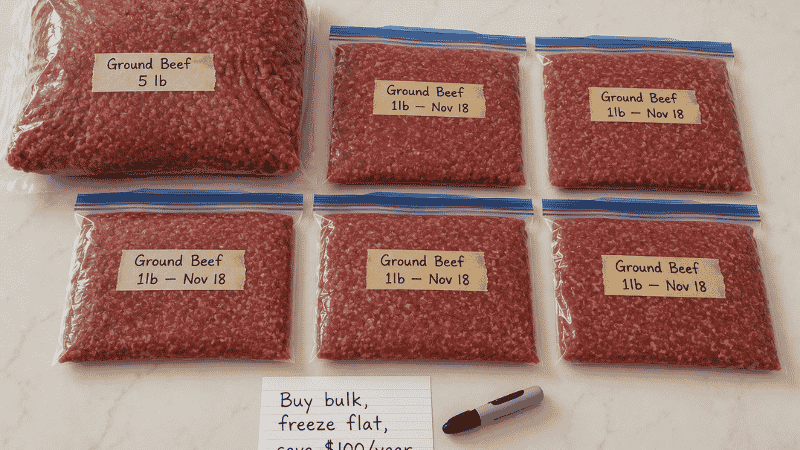
Step 1: When you get home from the store with a large ground beef purchase, don’t refrigerate it. Immediately divide into 1-pound portions (enough for a typical family dinner).
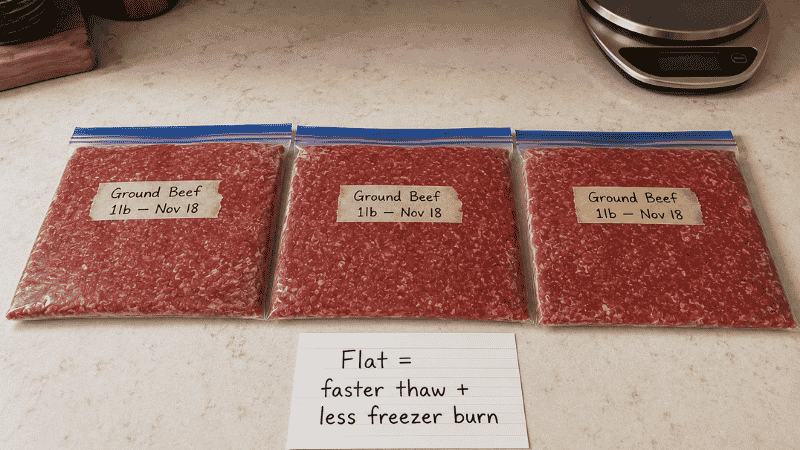
Step 2: Flatten each portion in a zip-top freezer bag, pressing out as much air as possible. Flat portions freeze and thaw faster than compact balls of meat.
Step 3: Label each bag with the date and weight (masking tape + marker takes 10 seconds).
Step 4: Freeze immediately. The beef goes from store to freezer without ever sitting in the refrigerator.
This system means you always have ground beef available, you bought it at the best price, and nothing goes bad in the fridge because the fridge was never involved.
The Best Stores for Ground Beef Value
Aldi: Consistently the cheapest ground beef at most Aldi locations — 80/20 regularly runs $2.99–$3.49/lb. Their weekly specials sometimes bring it lower. Small packages only (usually 1–1.5 lb), so buy multiple and freeze.
Walmart: Family pack ground beef (3–5 lb) offers good per-pound value at $3.49–$3.99/lb for 80/20. The Great Value house brand often undercuts name brands by $0.50/lb.
Costco: 6–8 lb chubs of 85/15 ground beef at approximately $2.99–$3.49/lb, sometimes lower on sale. Best per-pound price available without a specialty butcher relationship. Requires a membership, but for a family using 2+ pounds of ground beef weekly, the math is clear.
Traditional supermarkets: Generally 20–40% more expensive than the above for comparable quality. Most worthwhile when they run loss-leader sales on ground beef — these can bring prices to $2.49–$2.99/lb for 80/20, which is competitive with Costco.
The Markdown Section: An Underrated Strategy
Most grocery stores mark down meat approaching its sell-by date — typically a 20–30% reduction, sometimes stickers, sometimes a designated section. Ground beef marked down for quick sale is perfectly safe to buy if you cook it today or freeze it immediately upon getting home. This is one of the cleanest grocery savings available and one most shoppers walk past.
Freezing Ground Beef: How Long It Lasts and How to Do It Right
Frozen ground beef maintains food safety indefinitely (bacteria don’t grow at freezer temperatures) but best quality for 3–4 months. After that, freezer burn — the dry, white patches caused by ice crystal formation — begins affecting texture and flavor. The beef is still safe; it just tastes worse.
How to Freeze Ground Beef Properly
Use freezer bags, not regular zip-top bags. Freezer bags are thicker and provide better protection against freezer burn. The cost difference is small; the quality difference over 3+ months is significant.
Press out all air. Air is what creates freezer burn. Flatten the meat, seal the bag most of the way, press out remaining air, then seal completely.
Freeze flat. Flat portions take up less space and thaw much faster than round balls. A flat 1-pound portion thaws in the refrigerator overnight; a round one takes significantly longer.
Label with date. “Ground beef — Nov 18” tells you exactly where you are in the quality window. An unlabeled bag is a mystery that usually gets thrown out from uncertainty.
Thawing Ground Beef Safely
Refrigerator thawing: Move from freezer to fridge the night before. Safe and requires zero attention. Best for planned cooking.
Cold water thawing: Submerge sealed bag in cold water, changing water every 30 minutes. 1-pound portions thaw in about an hour. Cook immediately after — don’t refreeze.
Microwave thawing: Use the defrost setting. Cook immediately — parts of the meat will begin warming into the danger zone during microwave thawing.
Room temperature thawing: Never. This is how the outer layer enters the danger zone while the interior is still frozen.
Can You Refreeze Ground Beef?
If you thawed it in the refrigerator and it never got above 40°F: technically yes, you can refreeze it. The USDA says this is safe. But each freeze-thaw cycle degrades the texture (more ice crystals forming and breaking down cell walls), so the quality will be noticeably worse. Better to thaw only what you’ll use.
What Happens If You Eat Bad Ground Beef: Signs to Watch For
Food safety matters more than the cost of throwing away a pound of beef. Here’s what to know if you’re concerned you may have eaten ground beef that had turned.
Common symptoms of foodborne illness from ground beef (primarily Salmonella, E. coli O157:H7, or Staphylococcus aureus) typically include nausea, vomiting, stomach cramps, and diarrhea — usually appearing 6–48 hours after eating contaminated food.
Most healthy adults recover from mild foodborne illness within a few days without medical treatment. Stay hydrated, rest, and monitor symptoms.
Seek medical attention if:
- Symptoms are severe or don’t improve within 48 hours
- There is blood in stool
- You have a high fever (above 102°F / 38.9°C)
- The person affected is elderly, pregnant, immunocompromised, or a young child — these groups face higher risk from foodborne illness and should contact a healthcare provider promptly
- Signs of dehydration appear (dizziness, very dark urine, inability to keep fluids down)
According to the CDC, ground beef is one of the most common sources of E. coli O157:H7 infection in the United States — which is exactly why the USDA’s 1–2 day raw storage guideline exists and why cooking ground beef to 160°F internal temperature is the standard recommendation.
The Quick Reference: Ground Beef Storage at a Glance
| Type | Fridge | Freezer |
|---|---|---|
| Raw ground beef (any fat %) | 1–2 days | 3–4 months best quality |
| Cooked ground beef (plain) | 3–4 days | 2–3 months |
| Chili or stew with ground beef | 3–4 days | 4–6 months |
| Pasta sauce with ground beef | 3–4 days | 3 months |
| Taco filling | 3–4 days | 2–3 months |
| Meatballs (cooked) | 3–4 days | 3–4 months |
| Ground beef casserole | 3–4 days | 3 months |
FAQ
Q: How long does ground beef last in the fridge after the sell-by date?
The sell-by date is a retailer stocking guide, not a safety cutoff. Raw ground beef that has been refrigerated continuously and properly should be safe to cook for 1–2 days after purchase — not after the sell-by date. If you bought beef that was already at its sell-by date, cook or freeze it immediately. Don’t add additional days based on the sell-by date.
Q: Is it okay to cook ground beef that has turned gray?
Gray-brown coloring in raw ground beef is caused by oxygen reduction — it’s normal and not a sign of spoilage. If the beef smells fine, feels normal (not slimy), and is within the 1–2 day storage window, grayish beef is safe to cook. Trust the smell and date over the color.
Q: Can you cook ground beef that’s been in the fridge for 3 days?
No — the USDA guideline for raw ground beef is 1–2 days refrigerated. Three days of raw storage is beyond the safe window. If you’re not certain it’s been fewer than 2 days, discard it. The risk of foodborne illness is not worth the cost of one pound of beef.
Q: How long does cooked ground beef last in the fridge?
Cooked ground beef lasts 3–4 days in an airtight container at 40°F or below. This applies whether it’s plain cooked beef, taco filling, meat sauce, chili, or any other dish containing cooked ground beef.
Q: Is it safe to freeze ground beef after the sell-by date?
If the beef is still within the 1–2 day safe refrigerator window (which may be on or just after the sell-by date if you bought it fresh), freezing is fine. Freezing stops bacterial growth and preserves the meat safely. If it’s already been in the fridge for 2+ days beyond purchase, the quality and safety are already compromised and freezing won’t reverse that.
Q: What’s the best way to buy ground beef to save money?
Buy in bulk (3–5 lb family packs or Costco chubs), immediately divide into 1-pound portions, label, and freeze flat in freezer bags. This captures the per-pound savings of bulk buying without the risk of the 1–2 day raw window. Aldi, Walmart family packs, and Costco consistently offer the best per-pound prices at major U.S. retailers.
The Honest Bottom Line
Ground beef is one of the most useful proteins in a family kitchen — versatile, affordable, and crowd-pleasing — but it’s also one of the most time-sensitive. The 1–2 day raw window is real and worth taking seriously. The good news is that taking it seriously is easier than it sounds: buy in bulk, freeze immediately in portions, and cook from the freezer rather than racing against the clock in the fridge.
The families who waste the least ground beef and spend the least money on it aren’t the ones who remember to check it every day — they’re the ones who built a system so the fridge never becomes a problem in the first place.
For more on building that kind of kitchen system — what to always have on hand, how to shop smarter, and how to turn one grocery run into a week of real dinners — our pantry staples guide and how to save money on groceries guide are the natural next step.
References
- USDA Food Safety and Inspection Service. Ground Beef and Food Safety. fsis.usda.gov
- USDA Food Safety and Inspection Service. Refrigeration and Food Safety. fsis.usda.gov
- FoodSafety.gov. FoodKeeper App — Ground Beef Storage Times. foodsafety.gov
- Centers for Disease Control and Prevention. E. coli and Food Safety. cdc.gov
- USDA Agricultural Research Service. The Science of Color in Fresh Meats. ars.usda.gov