
Key Takeaways
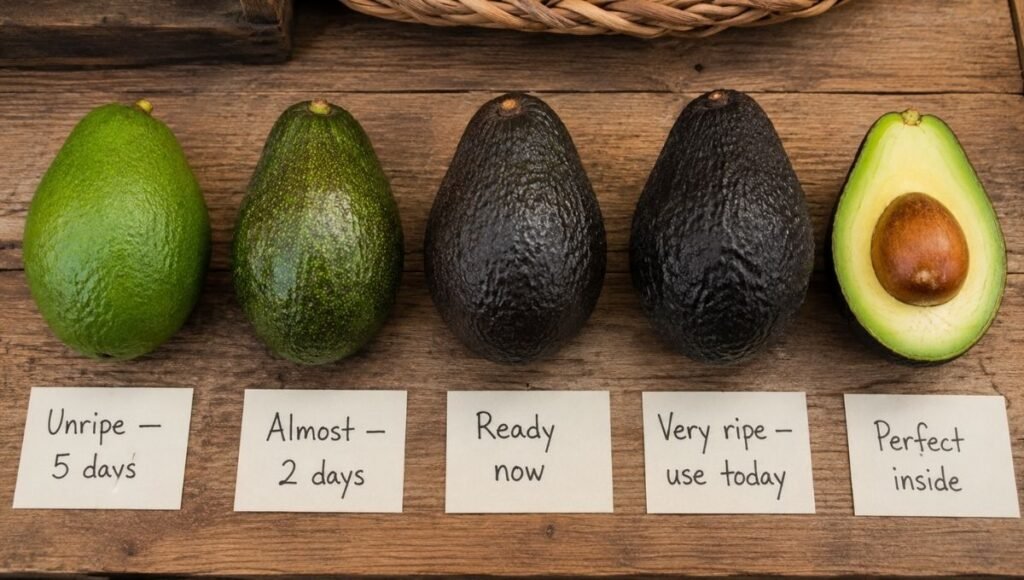
- Color alone is not a reliable ripeness indicator — while Hass avocados do darken from green to near-black as they ripen, the color shift varies significantly between individual fruits, growing conditions, and seasons. Use it as one signal among several, never the only one.
- The palm press test is more accurate than the finger squeeze — gentle pressure from the whole hand rather than fingertips gives you better feedback and doesn’t bruise the fruit for the next person who picks it up.
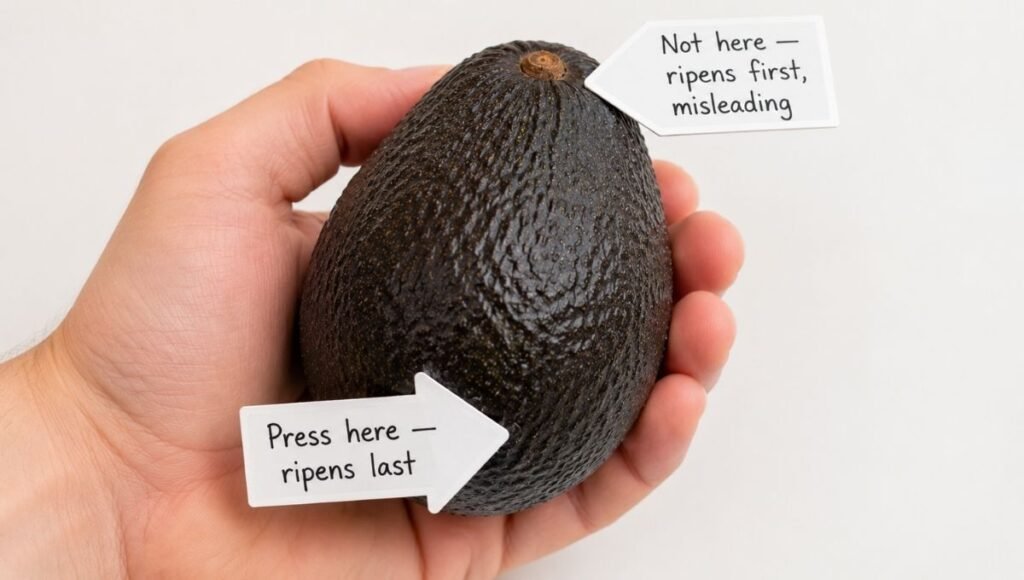
- Avocados do not ripen uniformly. They ripen stem-end first, down toward the base. The correct place to check for ripeness is the wider bottom end, not the stem end — pressing near the stem can feel soft while the bottom half is still underripe.
- The stem test (flicking off the small cap at the top) is commonly recommended — and genuinely useful — but professional avocado growers now warn that removing the cap triggers oxidation and browning even before you cut the fruit open. Save it for the kitchen, not the store.
- For guacamole: You want a fully soft avocado that yields easily. For sliced applications (toast, salads): one to two days before peak soft works better — more control, cleaner cuts.
You know the drill. You spend five minutes at the produce section squeezing avocados, second-guessing every single one. You pick what seems like the right one. You get home. You cut it open and it’s still hard and slightly waxy inside with zero intention of becoming guacamole tonight. Or the opposite: it’s perfectly ripe, but you needed it for tomorrow, and now it’s going to be brown and mushy by the time you reach for it.
One Reddit user put it perfectly: “I’ve never once successfully bought a perfectly ripe avocado on purpose. It just happens by accident.” Hundreds of people agreed with that comment. And that’s not a personal failure — it’s the result of genuinely confusing advice that treats avocado ripeness like a simple yes/no when it’s actually a moving target.
The good news is that learning how to tell if an avocado is ripe is mostly a matter of understanding three or four things that nobody bothers to explain clearly: where to press (not where most people press), what color actually tells you (less than you think), what the stem test does and doesn’t reveal, and — maybe most useful of all — how to match the ripeness you’re buying to what you’re actually going to make.
The Color Test: Useful, But Not the Whole Story
The color of a Hass avocado — the variety you’ll find at almost every U.S. grocery store — does change as it ripens. Unripe Hass avocados are bright, almost lime green. As they ripen, the skin gradually shifts through darker green to a deep green-black or near-purple. By the time a Hass is fully ripe and ready to eat, it’s typically quite dark.
This is genuinely useful as a first filter when you’re facing a pile of avocados. Dark ones have been ripening longer; bright green ones need more time. If you need an avocado tonight, start in the darker section of the pile. If you need one for the weekend, start in the green section.
Where color fails you:
Individual Hass avocados don’t all follow the same color timeline. Some fruits stay relatively green even when perfectly ripe inside. Some appear very dark but are still firm and under-ripe. Fruit grown in different regions, at different times of year, under different conditions doesn’t shift color at the same rate. The off-season for Hass avocados (roughly July through October) produces more color-unreliable fruit than peak season (November through June).
The practical rule: Color narrows your search. It doesn’t end it. Once you’ve identified darker candidates, you need the next test.
The Press Test: Why You’re Probably Doing It Wrong (and So Is Everyone Else)
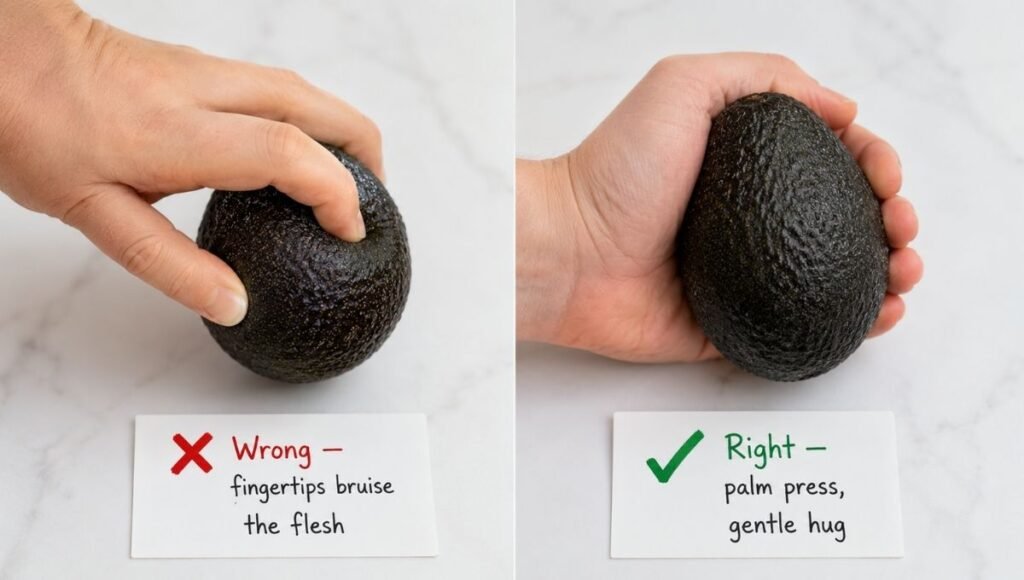
Walk into any grocery store produce section and you’ll see people doing the same thing: poking avocados with their fingertips. This is understandable — it’s intuitive. But it’s counterproductive in two ways.
First, fingertip pressure is too concentrated. The small surface area of a fingertip creates localized pressure that bruises the fruit — crushing cells under the skin and turning them brown. That’s where the thumbprint bruise pattern you find on avocados comes from. It’s not a storage issue. It’s accumulated fingertip testing by every shopper before you.
Second, fingertip pressure gives you less accurate feedback than palm pressure. Avocado flesh is dense and resilient in complex ways — a fingertip pressing hard on one spot tells you something different from what a whole palm pressing gently across the surface tells you.
The right technique: the palm press (or what one chef called “the gentle hug”)
Hold the avocado in one hand. Apply gentle, even pressure from your whole palm — not squeezing with your fingers, but wrapping and pressing lightly from all sides simultaneously. You’re feeling for overall give, not testing a single point.
- No give at all, feels almost hard: Unripe. Needs 3–5 more days at room temperature.
- Slight give, yields a little but mostly firm: 1–2 days away. Buy this one if you need it for the weekend.
- Gentle give that springs back slightly: Ripe and ready. Buy this for tonight or tomorrow, then refrigerate immediately.
- Soft, gives easily, doesn’t spring back: Very ripe. Use today for guacamole or blended applications. Skip for sliced uses.
- Feels mushy in patches or hollow in spots: Bruised or overripe. Look for another one.
Note: Even the best palm press is imperfect. An avocado that’s been dropped or handled roughly can have internal bruising that’s invisible from the outside. This is the main reason why avocados sometimes look and feel perfect and then cut open brown inside — it’s not your reading error, it was damaged earlier.
Where to Press: Avocados Don’t Ripen Uniformly
This is the detail most guides miss entirely, and it changes everything.
Avocados ripen from the stem end down toward the wider base. This means that if you test the firmness near the stem (the narrow top end of the fruit), you might feel softness there and assume the whole fruit is ripe — while the bottom half is still firm and under-ripe.
Chef Rick Bayless of Frontera Grill, one of the most respected Mexican cuisine voices in the U.S., advises pressing the wider, rounded bottom end of the avocado — not the stem end — to get an accurate read on whether the whole fruit has ripened through.
Where to press: the wider, rounder bottom end — opposite the stem.
If the bottom end has gentle give, the whole fruit is likely ripe. If the bottom end is still firm but the stem area is soft, give it another day.
This single adjustment — pressing the right spot — will immediately improve your accuracy at the produce section.
The Stem Test: What It Tells You and What It Costs You
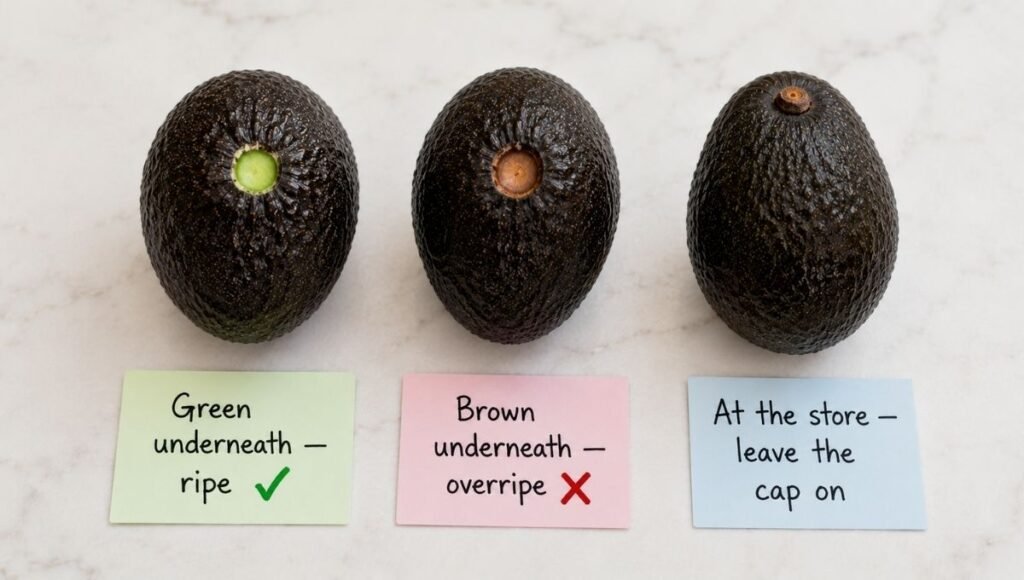
The stem test has become the most-recommended avocado tip on the internet, and for good reason — it genuinely provides useful information. Flick off the small woody cap at the top of the avocado. Green underneath means the flesh is likely still green and ripe. Brown underneath means the fruit is likely overripe or already browning inside.
It works. The problem is the cost.
Jeff Dickinson, a Hass avocado grower and founder of Dickinson Family Farms, warns that removing the stem cap “triggers premature oxidation that can negatively impact color, texture, and taste.” Once the skin is broken — even in that small spot — oxygen begins accelerating browning in the area beneath it, before the avocado has even been cut.
So the stem test gives you useful information, but takes something from the fruit in exchange. The practical compromise:
At the store: Skip the stem test. Use color and the palm press to select your avocado. Removing the stem on a fruit you might put back — or that you’ll sit in your kitchen for another day before using — damages it unnecessarily.
At home, right before you’re ready to cut: The stem test is fine and useful here. You’re about to use the fruit anyway, so any browning triggered by removing the cap is immediately irrelevant.
Editor’s take: The stem test has been massively over-recommended online because it’s visually satisfying and easy to explain. But doing it to 10 avocados in the produce section before picking one is creating exactly the kind of damage you’re trying to assess.
How to Tell If an Avocado Is Ripe for Your Specific Use
Different applications have different ideal ripeness points. This is the most practical section of this guide for actually saving money and reducing waste.
For Guacamole
You want fully ripe, easily mashable flesh. This means the avocado should yield easily to palm pressure, feel slightly soft throughout, and scoop cleanly from the skin. A slightly overripe avocado can work for guacamole if it doesn’t smell rancid — the intensified flavor is often welcome, and you’re going to mash it anyway.
Buy: The darkest, softest options in the pile. Use within 24 hours of purchase.
For Avocado Toast or Sliced Applications
You actually want avocado that’s one to two days away from peak ripeness — what avocado sellers call the “breaking” stage. At this point it’s creamy inside but still holds its shape when sliced, cuts cleanly without mushiness, and won’t slide off your toast in a puddle.
Buy: Slightly firm, dark-colored avocados with slight give. Ripen at home for 1–2 days. Refrigerate the day before you plan to use it.
For Salads Where You Need Clean Cubes
Same as toast — slightly firm is better. A fully soft avocado will fall apart when you try to dice it. Aim for that “breaking” stage where it’s creamy but structured.
Buy: Same as for toast. Test for give but not full softness.
For Smoothies or Freezing
Full ripeness or even slightly overripe is fine here — you’re blending or freezing, so texture is irrelevant. This is the best use for avocados that have gone soft before you got to them.
Buy: Whatever’s been marked down. Ripe and soft avocados on discount at the store are often ideal for freezing or blending. Don’t pay full price for these.
The Stringy Avocado Problem: Why It Happens and Can You Predict It?
This is the question Reddit users ask more than almost any other avocado question, and almost no mainstream guide addresses it.
Some avocados, when cut open, have stringy or fibrous threads running through the flesh. The texture is unpleasant regardless of ripeness — the avocado might be the perfect soft consistency, but the strings ruin it for everything except blending.
Why it happens: Stringiness in avocados is primarily caused by environmental stress during the growing period — temperature extremes, water stress, or physical damage to the tree. It can also increase in avocados picked too early and allowed to ripen off the tree for extended periods (which is how most commercial avocados are handled).
Can you predict it from the outside? Mostly no — this is the frustrating honest answer. There are no reliable external indicators that distinguish a stringy avocado from a smooth one. Some growers and longtime buyers claim that avocados with very rough, bumpy skin textures are slightly more prone to stringiness, but this is anecdotal rather than scientifically established.
What you can do:
- Buy from stores with high avocado turnover, which reduces the off-tree ripening period. Aldi, Trader Joe’s, and Costco tend to move avocados quickly.
- Hass avocados during their peak season (November through June) are less prone to inconsistent ripening and texture issues than off-season fruit.
- If you cut into a stringy avocado: use it for smoothies, guacamole (where you mash through the strings), or any blended application. Don’t try to slice it.
How to Use Ripeness Knowledge to Stop Wasting Money on Avocados
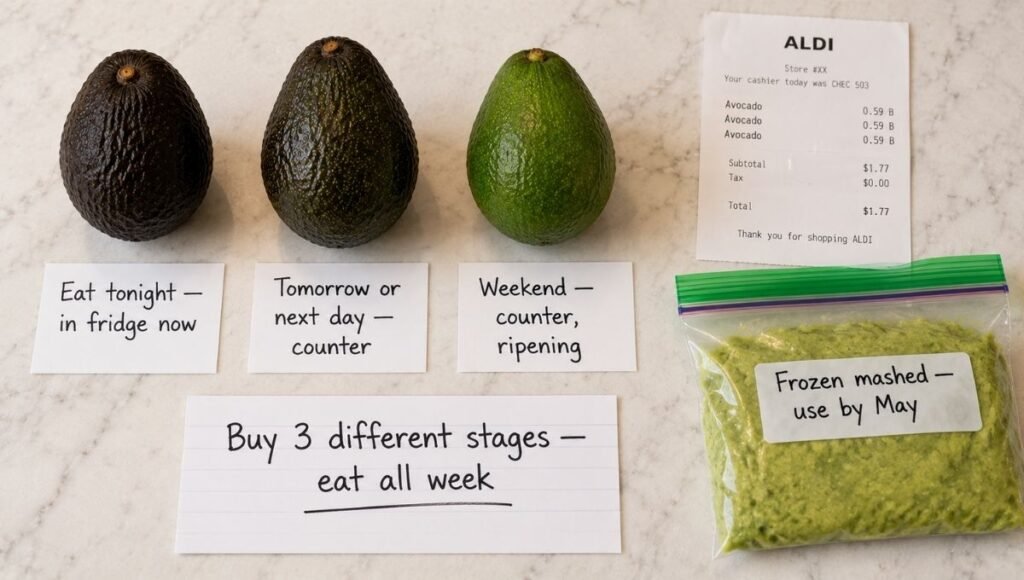
The most practical application of everything above is a buying system, not just individual assessments.
The staggered purchase strategy: Instead of buying one avocado when you need one, buy three at once at different ripeness stages — one dark and ready, one medium-colored with slight give, one still fairly firm. Refrigerate the ripe one when you get home. Leave the others on the counter. You now have fresh avocado across the next 5–7 days without a single stressful moment at the counter.
The sale strategy: When avocados are on sale at Aldi or Trader Joe’s (frequently $0.49–$0.69 during promotions), buy a bag. Let them ripen on your counter, monitoring daily. As each one reaches peak softness, either use it or freeze it. Frozen mashed avocado with lemon juice keeps for 3–6 months and is indistinguishable from fresh in guacamole.
The discount bin strategy: Overripe avocados marked down at grocery stores are excellent candidates for freezing. They won’t work for sliced applications, but they’re perfect for guacamole and smoothies — and at 50% off, the value is excellent.
When an Avocado Is a Write-Off: Signs That Go Beyond “Just Overripe”
There’s a difference between an overripe avocado and a bad one. Overripe is soft and may taste more intensely flavored — often still fine for certain uses. Bad is a food quality and potentially safety concern.
Write it off if:
- The interior is uniformly dark brown or gray throughout, not just near the pit or skin edges
- There’s a rancid, sour, or chemically “off” smell when you open it
- There’s mold anywhere on the flesh
- The texture is watery or slimy rather than soft and creamy
- Large hollow pockets inside the flesh (indicates significant cell breakdown)
Still salvageable (for cooked or blended uses):
- Brown patches near the pit or along the skin edge with green interior remaining — scoop around the brown
- Very soft but normal smell and pale-yellow-green interior
- Slightly more intense or bitter flavor but no off smell
FAQ
Q: How do I tell if an avocado is ripe at the grocery store?
Start with color — darker Hass avocados are further along in ripening. Then use the palm press test: cup the avocado in your whole hand and apply gentle, even pressure. You’re looking for slight give without softness. Avoid using fingertips, which bruise the fruit. Skip the stem test at the store — it causes oxidative damage to the fruit.
Q: Does the stem test actually work for checking avocado ripeness?
It provides accurate information — green under the stem indicates likely unripe flesh; brown indicates likely overripe. However, professional avocado growers now advise against doing it in the store or before you’re ready to use the fruit, as removing the cap triggers browning in the area beneath it. Save it for right when you’re about to cut the avocado open.
Q: Why is my avocado brown inside but felt ripe on the outside?
Most likely internal bruising from being dropped or rough handling during shipping, at the store, or in your kitchen. This can happen to any avocado regardless of how carefully you tested it. The soft exterior was a legitimate ripeness signal — the brown interior was separate physical damage. It’s not a testing error; it’s just avocado reality.
Q: What does a ripe avocado feel like?
A ripe avocado yields to gentle palm pressure — it gives slightly when you press but doesn’t feel mushy or hollow. It should spring back very slightly rather than leaving a permanent dent. The best way to feel for this is with even palm pressure rather than fingertips, and pressing at the wider bottom end of the fruit rather than near the stem.
Q: How do I ripen an avocado faster?
Place the avocado in a paper bag with a ripe banana or apple. Both produce ethylene gas, a natural ripening hormone that speeds up the process. The paper bag traps the ethylene and concentrates the effect — you’ll typically cut 1–2 days off the ripening time. At room temperature without any intervention, a firm avocado typically reaches peak ripeness in 3–5 days.
Q: Can you tell if an avocado will be stringy before you cut it?
Unfortunately, not reliably. Stringiness is caused by growing conditions and extended off-tree ripening, neither of which are visible from the outside. Buying from stores with high turnover during Hass avocado peak season (November through June) reduces the risk. If you cut into a stringy avocado, use it for guacamole or blending where texture is less critical.
The Honest Bottom Line
Learning how to tell if an avocado is ripe is genuinely learnable — but it requires accepting that it’s a probability game, not a certainty. The color narrows the field. The palm press gives you the best reading available without damaging the fruit. The stem test provides a useful data point when you’re about to eat it, not when you’re still shopping. And pressing the right spot — the wider bottom end — gives you significantly better accuracy than where most people press.
The system that eliminates most avocado frustration: buy three at different ripeness stages, stagger their use across the week, refrigerate the ripe one immediately, and freeze anything that gets too soft before you reach it.
For everything that happens after you’ve picked the right one — how to store it correctly at every stage, how to prevent cut avocado from browning, and how to freeze avocados when you find a great sale — our avocado storage guide covers the complete picture. And for the broader grocery strategy that makes staggered produce buying work within a real family budget, our how to save money on groceries guide is the natural companion.
References
- California Avocado Commission. Avocado Ripeness and Handling Guidelines. californiaavocado.com
- Hass Avocado Board / Love One Today. Avocado Ripeness Stages — Firm, Breaking, Ripe. loveonetoday.com
- Jeff Dickinson, Dickinson Family Farms. Quoted in Food & Wine: How to Tell When an Avocado Is Perfectly Ripe.
- Rick Bayless, Frontera Grill. Quoted in Cook’s Country / America’s Test Kitchen: The One Place to Press an Avocado.
- USDA Agricultural Research Service. FoodData Central — Avocado Nutritional and Postharvest Data. fdc.nal.usda.gov