
Key Takeaways
- The average American family of four spends $250–$300 per week on groceries in 2026, according to USDA food cost data. Families who cook strategically from home-stocked pantries consistently spend $100–$150 less per week — without eating worse.
- The biggest driver of grocery overspending isn’t what you buy — it’s unplanned decisions made at 5 PM with no system in place. A simple structure before, during, and after the grocery store eliminates most of the waste.
- Food waste costs the average American family approximately $1,500 per year, according to USDA estimates. Solving the waste problem alone is worth more than any coupon strategy.
- The three stores where most families can immediately save the most money: Aldi (8–10% cheaper than Walmart on most categories), Costco (unbeatable per-ounce value for proteins and pantry staples in the right quantities), and Walmart (best for pantry staples and canned goods when Aldi isn’t accessible).
- Every strategy in this guide is built around one principle: you don’t need to spend less on food. You need to waste less of what you spend.
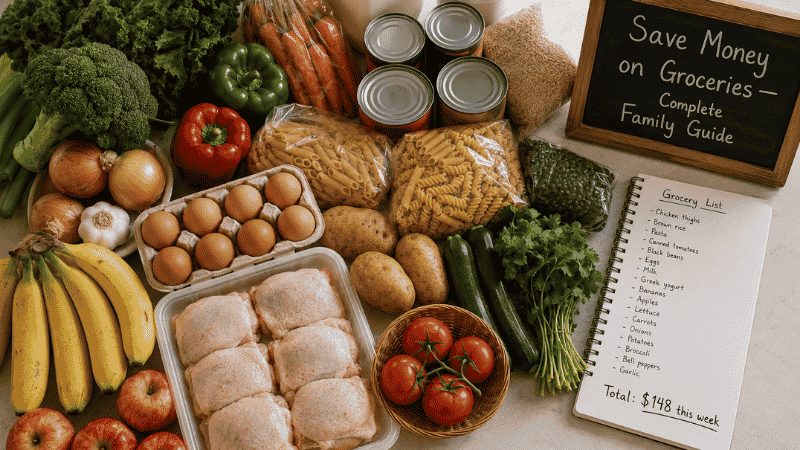
You know that specific feeling. You’re standing at the checkout lane watching the total tick up — $180, $200, $230 — and your cart doesn’t even look that full. You swear you were being careful. You got the store-brand pasta, you skipped the fancy cheese, you didn’t buy the thing you wanted. And somehow you’re still staring at a number that makes you wince.
This happens to almost every family, almost every week. And the frustrating part isn’t the amount — it’s that you can’t quite figure out where the money goes. You’re not buying lobster. You’re buying milk, chicken, vegetables, pasta, and a dozen ordinary things. How is it this expensive?
The answer, for most families, isn’t that food costs too much — it’s that the system around buying food is leaking money at every stage. Food you bought but didn’t use. Proteins you paid full price for that were on sale the week before. Brands you bought out of habit that cost 30% more than the store version for identical quality. Decisions made at 5 PM with an empty fridge and no plan.
This guide is a complete system for closing those leaks — built around how real families actually shop, not around the idealized meal-planning advice that sounds great on Sunday and falls apart by Tuesday. It connects to every relevant guide on this site, so you can go deep on any topic that matters most to your household.
Why Most Grocery Saving Advice Doesn’t Actually Work
Before the strategies, it’s worth understanding why most grocery saving advice fails — so you can avoid the same traps.
The coupon trap. Coupons feel like saving money. They’re actually a retail strategy that gets you to buy things you wouldn’t otherwise buy, spend time you don’t have, and feel virtuous about purchases that often weren’t necessary. Digital coupons on frequently purchased staples are worth using. A coupon-first shopping strategy almost never saves money for most families.
The aspirational shopping trap. You plan ambitious meals for the week — the roasted squash, the homemade curry, the elaborate grain bowl — and buy the ingredients. Then Wednesday happens, you’re exhausted, and you order pizza. The ingredients sit in the fridge until Friday, when you throw most of them out. The plan failed not because you didn’t want to cook but because the plan didn’t account for real Tuesday evenings.
The “I’ll save money by cooking everything from scratch” trap. Sometimes this is true. Often it isn’t. A rotisserie chicken from Costco ($4.99) that produces three dinners and a quart of homemade broth is a better value than the raw chicken you bought to roast yourself and used for one dinner. The math of scratch cooking only works when you actually cook the thing you bought.
The right framework: Saving money on groceries is a systems problem, not a willpower problem. The families who consistently spend significantly less don’t have more discipline — they have a better structure. They know what’s in their pantry before they shop, they have a realistic plan for the week, and they shop at stores that are structurally cheaper for the items they actually buy.
Step 1: Before You Shop — The Foundation That Changes Everything
Everything that happens at the grocery store is downstream of what you do before you go. This is where most families lose the most money.
Know What You Already Have
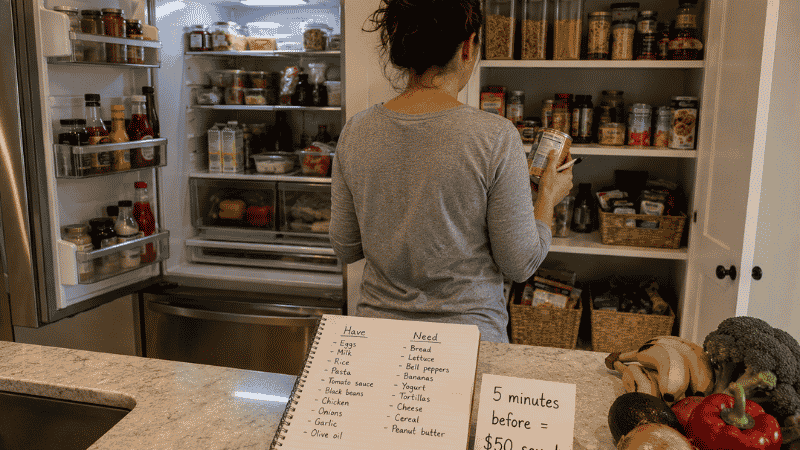
The single most impactful pre-shopping habit: spend five minutes looking at your fridge, freezer, and pantry before making your list. Not a casual glance — actually move things around, check what’s in the back of the cabinet, look at what produce is approaching its limit.
This habit does two things. First, it prevents you from buying duplicates of things you already have (the second jar of cumin, the third box of pasta). Second, it tells you what you need to use up this week — which should anchor your meal planning rather than starting from a blank slate.
A quarterly pantry audit is even more valuable. Set a calendar reminder every three months to go through your dry storage systematically. Anything that’s been pushed to the back and hasn’t been touched is either something you should cook this week or something you should stop buying. Either answer saves money.
Plan Meals Backwards — From What You Have, Not What You Want
Most meal planning starts with recipes and works forward to a shopping list. This creates aspirational shopping. The better approach starts with what you have and builds meals around it — then makes a targeted list for the gaps.
A more honest planning question than “what should we cook this week?” is: “What actually worked last week, and what’s currently in our fridge and freezer?” The answer tells you what your family actually eats versus what you optimistically plan to eat. Closing that gap is worth more than any individual money-saving strategy.
The practical output of this planning process: a list organized by store section, with specific quantities written down. Not “get chicken” — “get 3 lbs bone-in thighs.” Specific lists reduce impulse additions and prevent under-buying that forces a mid-week return trip.
Build a Pantry That Eliminates 5 PM Decisions
The most expensive moment in any family’s week is 5 PM on a Tuesday when there’s no plan and the fridge looks sparse. That’s the moment that produces takeout orders, expensive convenience meals, or a rushed grocery run with bad decisions.
A well-stocked pantry eliminates most of these moments. When you have rice, canned beans, pasta, canned tomatoes, chicken broth, eggs, and basic spices — you can make a real dinner in 20 minutes regardless of what else is happening. The emergency takeout order becomes unnecessary.
The investment in building this pantry pays back continuously. You’re not spending more on groceries — you’re spending differently, with a larger proportion going to shelf-stable staples that reduce your dependence on fresh ingredients you might not use.
→ For the complete list of 25 pantry staples that eliminate 5 PM decisions, with specific brand recommendations and where to buy each one cheapest, see our pantry staples guide.
→ For the kitchen tools and storage setup that make this system work efficiently, see our kitchen essentials guide.
Step 2: Where You Shop — The Stores That Are Actually Cheaper
Not all grocery stores are priced equally, and the differences are significant enough to matter on a family budget. Switching to a cheaper primary store — or learning which items to buy where — is often worth more than any other single strategy.
Aldi: The Cheapest Option for Most Families
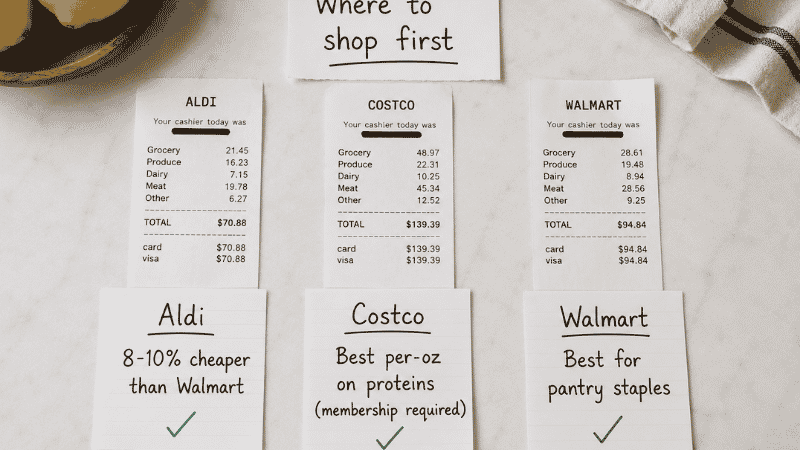
Aldi is consistently 8–10% cheaper than Walmart across most grocery categories, and dramatically cheaper than traditional supermarkets. Their private-label products — which constitute nearly their entire inventory — are produced by the same manufacturers that make major name brands, under strict quality specifications.
What Aldi is best for: proteins (chicken, ground beef, pork), fresh produce, dairy (milk, cheese, eggs, yogurt), canned goods, dried pasta and grains, and frozen vegetables. The selection is intentionally limited — usually one or two options per category rather than 20 — which actually makes shopping faster.
What Aldi doesn’t carry: specialty items, a wide range of international products, and some pantry staples that larger stores carry. The strategy for most families: Aldi as the primary weekly shop for most food, supplemented by another store for specific items.
Costco: Best for the Right Items in the Right Quantities
Costco’s value proposition is real but conditional. The per-ounce price on proteins, certain canned goods, cheese, olive oil, and pantry staples is genuinely the best available at any major U.S. retailer. The $65 annual membership pays for itself on proteins alone for a family of four that shops there regularly.
The condition: you have to use what you buy. A Costco chicken thigh 10-pack purchased and frozen in portioned bags is excellent value. A 10-pack you forget about until it’s past its prime is expensive waste.
Costco’s best value items for families: bone-in chicken thighs, ground beef in bulk (portion and freeze), Kirkland Organic EVOO, large cheese blocks, dried pasta multipacks, canned tomato cases, and eggs.
Items where Costco’s value proposition is weaker: fresh produce (harder to use before it spoils at Costco quantities), spices (often too much for the freshness window), and specialty items that sit in the pantry unused.
Walmart: Best for Pantry Staples and Consistency
When Aldi isn’t nearby or doesn’t carry what you need, Walmart’s Great Value store brand is the reliable alternative for pantry staples — canned goods, pasta, rice, condiments, baking supplies. The pricing is consistent and the selection is comprehensive.
Walmart is particularly useful as a supplement to an Aldi-primary strategy — getting specialty items, household supplies, and the few categories where Great Value outperforms Aldi’s selection.
Traditional Supermarkets: Shop the Perimeter, Use the Sales
Traditional supermarkets (Kroger, Safeway, Publix, regional chains) are typically 15–25% more expensive than Aldi or Walmart on most categories. Their competitive advantage is sales cycles, loyalty programs, and selection.
If a traditional supermarket is your primary store, two strategies recapture significant value: shopping the perimeter (fresh proteins, produce, dairy) where sales are most meaningful, and buying pantry staples at their lowest sale price and stocking up.
The sale cycle for most pantry staples runs 4–6 weeks — meaning if you miss a sale on pasta, it’ll be on sale again within 6 weeks. Knowing your target prices (what you’re willing to pay per unit) and buying extras at that price is the supermarket version of bulk buying.
Step 3: What to Buy — The Proteins That Stretch Your Budget the Farthest
Protein is the most expensive line item in most family grocery budgets, and it’s where the biggest spending differences between families come from. The choice between $6/lb boneless chicken breasts and $1.79/lb bone-in thighs — for essentially the same nutritional value and similar versatility — represents hundreds of dollars per year.
The Budget Protein Hierarchy
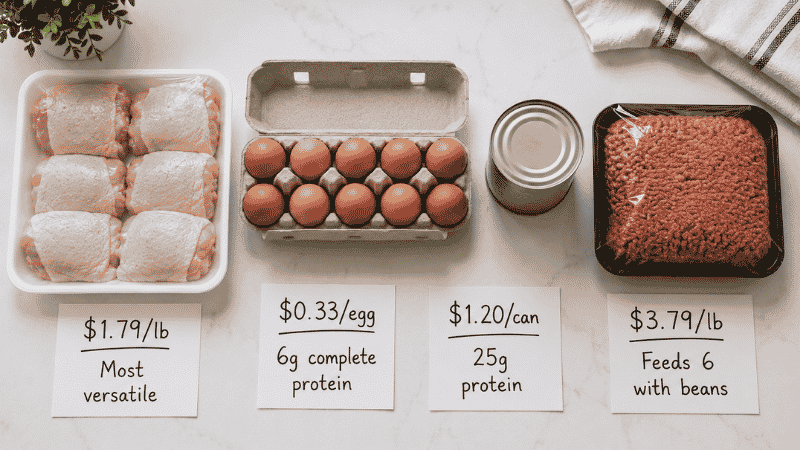
Bone-in, skin-on chicken thighs are the best-value protein in most grocery stores — $1.49–$1.99/lb at Aldi or Walmart, often lower at Costco in bulk. They’re harder to overcook than breasts, more flavorful, and work in soups, sheet pan meals, slow cooker recipes, and stir-fries. Buy in bulk when on sale, freeze in family-sized portions.
Eggs remain one of the most economical protein sources available. At $3–$4/dozen, each egg provides 6 grams of complete protein for about $0.25–$0.33. Egg-based dinners — fried rice, shakshuka, frittatas — are genuinely satisfying at under $1 per serving.
Canned beans cost about $1–$1.20 per can and provide approximately 25 grams of protein per can. A can of black beans added to ground beef tacos stretches 1 lb of meat to feed two more people. Beans in soup, pasta, or rice dishes reduce the protein cost per serving dramatically.
Ground beef (80/20) in family packs runs $3.49–$3.99/lb at Walmart or Aldi, lower at Costco. One pound feeds 4–6 people when mixed with beans, pasta, or rice. The cheapest effective use: chili, pasta sauce, taco filling, and casseroles where it’s one component rather than the centerpiece.
Dried beans bought in bulk cost approximately $1–$2/lb and produce 6 cups cooked — enough to feed a family of six as a protein source. For families willing to do occasional batch cooking of dried beans, the cost is roughly one-third of canned beans at comparable nutrition.
→ For 20 complete dinners built around these budget proteins, with full cooking instructions and cost-per-serving data, see our cheap meals for family guide.
→ For 22 batch-friendly meals specifically designed for larger families or households who want to cook once and eat multiple times, see our cheap meals for large families guide.
Step 4: The Produce Problem — How to Buy Fresh Without Wasting It
Fresh produce is where most families’ good intentions and actual behavior diverge most dramatically. You buy vegetables with real plans to use them. By Thursday, the spinach is slimy, the peppers are wrinkled, and the herbs have gone the way of all things.
Buy for How You Actually Cook, Not How You Plan to Cook
The most expensive produce is the produce you throw away. The second most expensive is the produce that sits in the crisper drawer making you feel guilty until you throw it away.
The honest audit: which vegetables do you actually eat regularly, and which do you buy aspirationally? Most families have a real rotation of 5–8 vegetables they cook consistently. Build your produce buying around those, not around the recipe you’re theoretically going to try.
The Durability Hierarchy
Not all produce ages equally. Planning around durability means the vegetables that last longest carry the end of the week:
Lasts 2–3 weeks: Carrots, celery, cabbage, onions, potatoes, beets, turnips. These are the weeknight workhorses — buy liberally.
Lasts 1–2 weeks: Bell peppers, broccoli, cauliflower, zucchini, cucumbers, apples. Use in the middle of the week.
Lasts 3–7 days: Leafy greens, fresh herbs, berries, tomatoes, corn, asparagus. Use early in the week or don’t buy until you’re ready to use them.
Frozen Vegetables: The Most Underrated Budget Strategy
Frozen vegetables are nutritionally equivalent to or superior to fresh grocery store produce in many cases — they’re processed within hours of harvest, locking in nutrients, while “fresh” produce has often been in transit for days. A 16-oz bag of frozen peas at Aldi costs about $1.29 and has a shelf life of months.
For soups, stews, stir-fries, pasta dishes, and any cooked application: frozen vegetables are the correct choice for both budget and nutrition. Reserve fresh vegetables for raw applications (salads, slaws, crudités) where texture matters.
The Discount Bin
Most grocery stores have a marked-down produce section — overripe bananas, soft tomatoes, slightly bruised apples, aging herbs. These are typically discounted 50–70%. They’re ideal for cooked applications: banana bread, tomato sauce, apple crisp, herb-infused oils. If you cook regularly, spending 5 minutes in this section before the regular produce aisle pays back quickly.
Step 5: Cooking Smarter — Making One Grocery Run Last the Whole Week
Buying well is half the equation. The other half is making what you bought actually feed your family for the full week without mid-week emergency runs or wasted ingredients.
The Overlap Principle
The families who spend the least on groceries don’t make 7 completely different dinners — they build around 4–5 anchor ingredients that appear in different forms across multiple meals. One pack of chicken thighs becomes sheet pan dinner on Monday, chicken noodle soup on Wednesday, and chicken taco filling on Friday. One batch of cooked beans goes into soup on Tuesday and quesadillas on Thursday.
This overlap approach reduces total ingredient count (fewer things to buy, smaller chance of waste), reduces cooking complexity mid-week (you’re using familiar ingredients in slightly different ways), and naturally creates leftovers that become the next day’s lunch.
The Batch Cooking Minimum
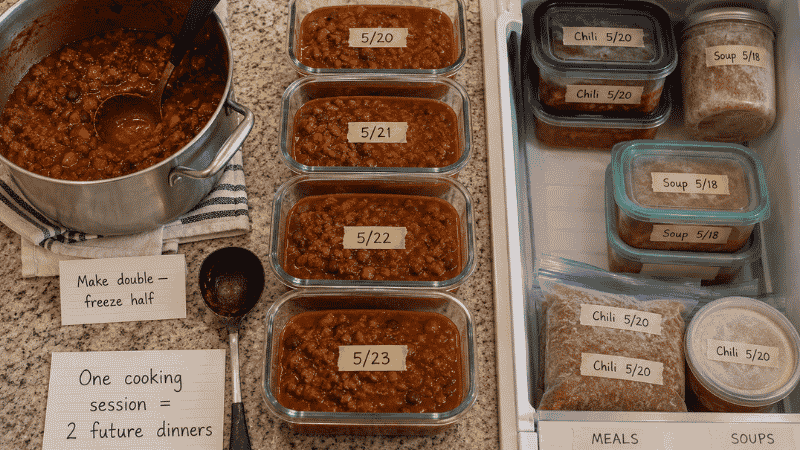
You don’t need to spend Sunday meal-prepping 10 containers of food. The minimum viable batch cooking habit: whenever you make rice, make double. Whenever you make soup or chili, make double and freeze half. Whenever you roast vegetables, roast twice as many as you need.
These micro-batch habits add about 10 minutes to each cooking session and produce an ongoing reserve of components that dramatically reduce weeknight cooking time and emergency takeout decisions.
The Freezer as a Savings Account
The freezer is the most underused tool in most family kitchens. Used intentionally, it captures savings that happen at irregular intervals and converts them into future meals.
When proteins go on sale: Buy significantly more than you need immediately, portion into family-sized freezer bags, freeze. Chicken thighs at $1.29/lb go on sale irregularly — buying 10 lbs when they hit that price and freezing in 2-lb portions means you pay the sale price for the next 5 weeks of chicken.
When you have surplus: A half-used can of tomato paste that you freeze in tablespoon portions is a future ingredient. The extra soup that goes in a quart container is a future dinner. The ripe bananas that you freeze whole are future banana bread.
Double batching specifically for freezer: Baked ziti, chili, bean soups, casseroles — all freeze perfectly and reheat without quality loss. Making double of any of these costs roughly 50% more in ingredients and 10–15 extra minutes, producing a complete future dinner for approximately $7–$10 in a family of four.
→ For 20 complete family meals under $2 per serving sorted by how much time you have, see our cheap easy meals for family guide.
→ For families cooking for 6 or more, with batch cooking and freezer system strategies specifically for large households, see our big family meals cheap guide.
Step 6: The Cooking Oils and Pantry Staples That Most Families Overpay For
Two categories where most families consistently overspend without realizing it: cooking oils and pantry staples. Small per-unit price differences that seem insignificant add up to meaningful amounts over the course of a year.
Cooking Oils
Olive oil is the pantry staple with the widest quality-to-price variation at any grocery store. Most families either overpay for a premium bottle they use for everything, or underpay for a mislabeled product that isn’t what it claims to be.
The verified best value: Kirkland Signature Organic Extra Virgin Olive Oil at Costco (~$0.32–$0.36/oz), Bureau Veritas certified as genuine extra virgin. Without a Costco membership, Aldi Specially Selected EVOO (~$0.45–$0.50/oz) is Consumer Reports’ Smart Buy pick.
The common overspend: buying mid-priced grocery store EVOO at $0.70–$0.90/oz that has less quality verification than either of the above options.
→ For the complete guide to every olive oil grade, which brands are worth buying at each price point, and how to cook with olive oil correctly, see our best olive oil guide.
Store Brand vs. Name Brand: The Honest Guide
For most pantry staples, store brand versions are produced by the same manufacturers as name brands — sometimes literally the same product in different packaging. Consumer Reports testing consistently finds store-brand canned goods, pasta, rice, spices, and dairy comparable to name brands in blind taste tests.
The categories where name brands consistently justify the premium: some canned tomatoes (San Marzano D.O.P. is genuinely different), certain olive oils (where brand affects authenticity, not just marketing), and specialty items where the formulation is proprietary.
The categories where store brand is consistently the correct choice: pasta, rice, flour, sugar, baking staples, canned beans, canned vegetables, frozen vegetables, eggs, butter, milk, and most condiments.
The annual savings from consistently choosing store brand on these categories for a family of four: approximately $600–$900, based on average price differences across major grocery categories.
Step 7: How to Stop Wasting Food — The $1,500 Problem Most Families Ignore
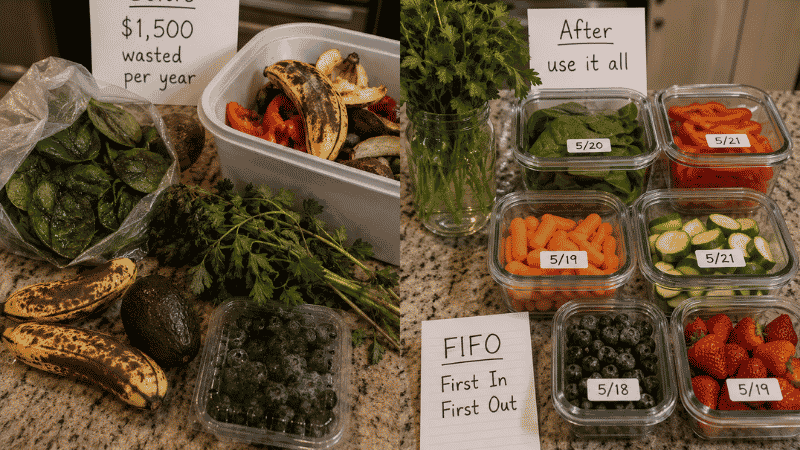
The USDA estimates that the average American family throws away approximately $1,500 worth of food per year. For most families, solving the food waste problem delivers more savings than any shopping strategy.
The First-In, First-Out Rule
The single most effective food waste prevention habit: when you put away groceries, move the older items to the front and put new purchases behind them. This applies to the fridge, freezer, and pantry. You automatically use what’s oldest first rather than discovering forgotten items when they’ve already spoiled.
The “Use It Up” Meal
Build one meal per week specifically around what needs to be used. Before shopping on Friday or Saturday, look at what’s left from the week and make that the dinner — a vegetable stir-fry from the remains of the week’s produce, a grain bowl from leftover rice and whatever proteins are in the fridge, a soup from stock and the vegetable odds and ends.
This habit is worth approximately $30–$50 per week in waste prevention for a family of four — more than most coupon strategies.
The Correct Produce Storage
Most produce lasts significantly longer when stored correctly. The common mistakes:
- Herbs: Treat like flowers — trim stems, put in a glass of water, cover loosely with a plastic bag. Lasts 1–2 weeks versus 3–4 days in the crisper.
- Onions and potatoes: Store separately and in a cool, dark, dry location — not together. Onions emit ethylene gas that accelerates potato sprouting.
- Berries: Don’t wash until you eat them. Wash with a diluted vinegar solution to extend freshness by several days.
- Leafy greens: Dry completely before refrigerating, wrap in paper towels to absorb moisture, store in a bag with a small amount of air.
What to Freeze Before It Goes Bad
Most foods that are approaching their expiration date can be frozen before they cross the line:
- Bread and rolls: slice and freeze, toast directly from frozen
- Bananas: peel, freeze whole, use for smoothies or banana bread
- Fresh herbs: blend with olive oil and freeze in ice cube trays
- Grated Parmesan: freeze in a container, use directly from frozen
- Cooked grains: freeze in portions, reheat in minutes
- Any leftover cooked protein: freeze immediately after cooling
The goal is never to throw away food that could have been frozen — because every item you throw away is money that left your household with zero return.
The Complete Shopping System: A Weekly Checklist
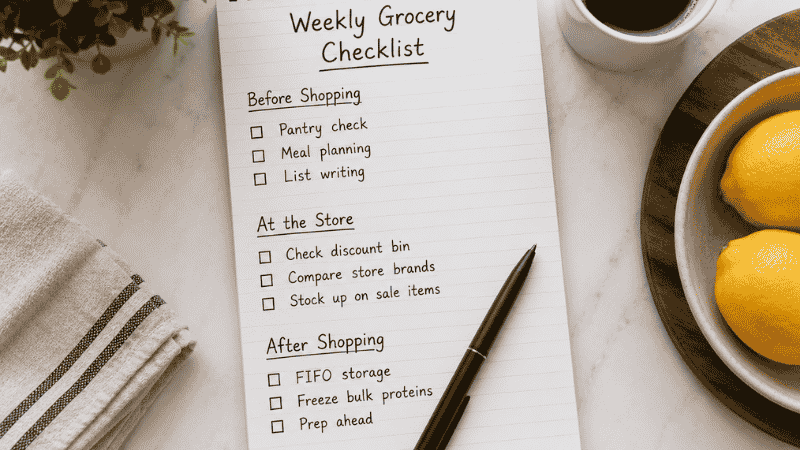
Before shopping (15 minutes):
- [ ] Check fridge, freezer, and pantry — what needs to be used this week?
- [ ] Build meals around what you have, then fill gaps
- [ ] Write a specific list with quantities, organized by store section
- [ ] Check which proteins are on sale this week at your primary store
- [ ] Note anything you should stock up on if it hits a target price
At the store:
- [ ] Shop with your list — add only if you have a specific planned use
- [ ] Check the discount produce bin first
- [ ] Compare store brand vs. name brand on every shelf-stable item
- [ ] Buy extra of anything at or below your target price if you have storage and will use it
After shopping (15 minutes):
- [ ] Put groceries away using first-in, first-out
- [ ] Move anything that needs to be used first to the front of the fridge
- [ ] Portion and freeze any bulk proteins immediately
- [ ] Prep anything you can in advance (wash herbs, chop onions, cook a batch of grains)
This 30-minute investment — 15 before and 15 after — is worth approximately $75–$150 per week for most families compared to unstructured shopping.
How Much Can Your Family Actually Save?
These numbers are based on USDA food cost data and consistent patterns from families who have implemented structured grocery systems:
| Current spending | With this system | Annual savings |
|---|---|---|
| $300/week (family of 4) | $175–$200/week | $5,200–$6,500 |
| $250/week (family of 4) | $150–$175/week | $3,900–$5,200 |
| $200/week (family of 4) | $125–$150/week | $2,600–$3,900 |
| $150/week (family of 4) | $100–$125/week | $1,300–$2,600 |
The savings are highest for families currently shopping primarily at traditional supermarkets without a plan. Families already shopping at Aldi or Costco with some structure will see smaller but still meaningful improvements, primarily from waste reduction.
FAQ
Q: What is the single most effective way to save money on groceries?
Reducing food waste. The average family throws away $1,500 worth of food annually — more than most coupon and sale strategies can recover. A weekly “use it up” meal, correct produce storage, and the habit of freezing food before it spoils deliver more savings than any shopping tactic.
Q: Is Aldi really cheaper than Walmart?
Consistently, yes — by approximately 8–10% across most grocery categories. Aldi’s private-label model (fewer products, all house brand) keeps operating costs low and passes savings directly to shoppers. For most families, switching to Aldi as a primary store is one of the highest-impact budget changes available.
Q: Is it worth getting a Costco membership to save money on groceries?
For a family of four that goes through significant quantities of proteins, dairy, and pantry staples: yes, typically within the first month on protein savings alone. The $65 annual membership pays for itself if you buy chicken thighs and olive oil at Costco vs. a traditional supermarket. For smaller households or light grocery shoppers, the math is less clear.
Q: How much should a family of 4 spend on groceries per week?
The USDA’s Thrifty Food Plan for a family of four in 2026 is approximately $250 per week. Families with structured shopping systems, who cook most meals at home and shop at Aldi or Costco, consistently report spending $100–$150 per week. The gap between $250 and $150 is almost entirely explained by food waste, unplanned purchases, and unplanned takeout — not by the food itself.
Q: Does meal planning actually save money?
Realistic meal planning does. Aspirational meal planning often doesn’t — it produces the same waste as no planning, just with more guilt. The key is planning based on what you actually have and what your family actually eats, not what you’d like to cook in an ideal week.
Q: Should I buy store brand or name brand groceries?
Store brand for most pantry staples, canned goods, frozen vegetables, dairy, pasta, rice, and baking ingredients. Name brand where formulation matters: certain specialty items, some canned tomatoes, and categories where you’ve actually compared and noticed a difference. Consumer Reports blind testing consistently finds store brands comparable to name brands across most grocery categories.
Q: How do I stop making impulse purchases at the grocery store?
Shop with a written list organized by section and don’t deviate unless you have a specific planned use for the addition. Eat before shopping — hunger is the primary driver of impulse purchases. Give yourself permission to stock up on sale items you regularly use, but treat any item not on your list as requiring justification before adding it.
The Honest Bottom Line
Saving money on groceries isn’t about sacrifice, coupons, or buying less food. It’s about wasting less, shopping at structurally cheaper stores, buying the right proteins, and making decisions before you get to the store rather than in the aisle.
The families who consistently spend $100–$150 less per week than average aren’t eating worse. They’re eating better, because a planned kitchen with stocked pantry staples produces better meals than a reactive kitchen making decisions at 5 PM.
Start with one change from this guide. The highest-impact first step for most families: shop at Aldi instead of a traditional supermarket for one month, keep a list of what you actually use and what you throw away, and build from there.
Every deep-dive guide you need is linked below:
Build your pantry foundation:
- Pantry Staples List: 25 Items That Actually Save Money
- Kitchen Essentials List: What a Real Family Kitchen Needs
Put it to work at dinner:
- Cheap Meals for Family: 18 Dinners Under $10 Total
- Cheap Easy Meals for Family: 20 Dinners Sorted by Time
- Cheap Family Meals: 25 Dinners Under $3 Per Serving
- Cheap Meals for Large Families: 22 Dinners That Feed 6+
- Big Family Meals Cheap: Batch Cooking and Freezer System
Master the pantry staple most families overpay for:
References
- USDA Center for Nutrition Policy and Promotion. Official USDA Food Plans: Cost of Food Report, 2026. cnpp.usda.gov
- USDA Economic Research Service. The Estimated Amount, Value, and Calories of Postharvest Food Losses at the Retail and Consumer Levels in the United States. ers.usda.gov
- Consumer Reports. Store Brand vs. Name Brand Grocery Comparison. consumerreports.org
- Bureau of Labor Statistics. Consumer Price Index — Food at Home, February 2026. bls.gov
- USDA Food Safety and Inspection Service. Shelf-Stable Food Safety and Storage Guidelines. fsis.usda.gov
- National Resources Defense Council. Wasted: How America Is Losing Up to 40 Percent of Its Food. nrdc.org