
Key Takeaways
- The USDA’s 3–4 day rule for cooked leftovers is not arbitrary — it reflects how quickly bacteria reach dangerous levels even at refrigerator temperatures. Most foodborne illness doesn’t come from food that obviously looks or smells bad.
- Cooked rice is genuinely one of the highest-risk leftover foods and should be consumed within 1–3 days — Bacillus cereus, the bacterium it harbors, produces heat-stable toxins that survive reheating and has no smell or visual indicator.
- “It smells fine” is not a reliable safety test. The most dangerous foodborne pathogens — Salmonella, Listeria, E. coli O157:H7 — typically produce no detectable odor at levels that can cause serious illness.
- For mixed dishes (soups, casseroles, rice dishes with protein), storage time is determined by the most perishable ingredient in the dish — not the average. A chicken fried rice lasts as long as its chicken, not its rice.
- According to the USDA Food Safety and Inspection Service, most cooked leftovers should be frozen within 3–4 days if not eaten — frozen leftovers maintain best quality for 3–4 months.
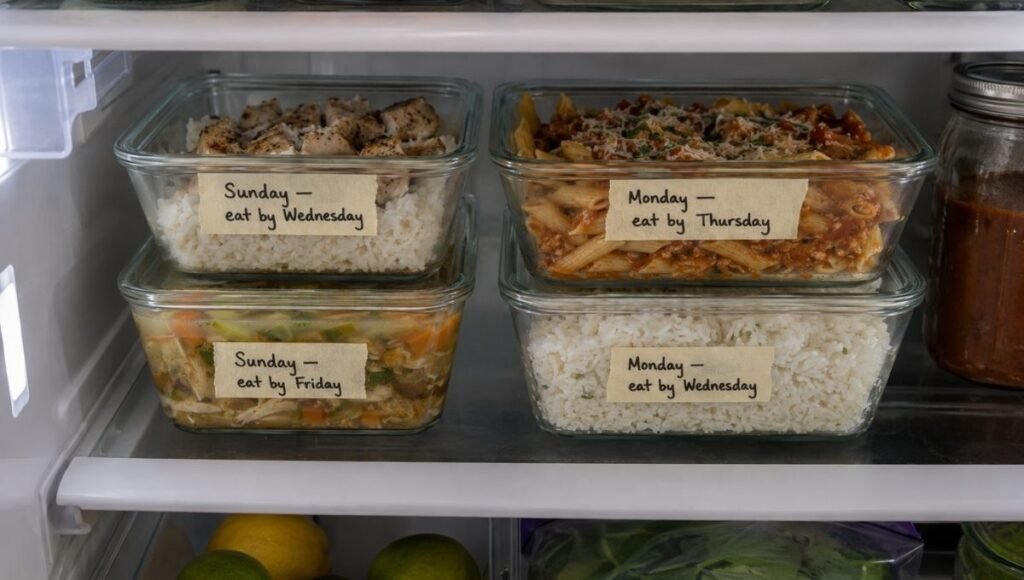
It’s Thursday evening. You open the fridge and see the container of chicken stir-fry from Sunday. Four days ago. You pick it up, smell it — seems fine. You think: probably still good, right?
This exact moment is one of the most common kitchen crossroads in any household. And the decision you make — which is usually some version of “it’s probably fine” or “better safe than sorry” — is almost never based on actual knowledge. It’s a guess. And the stakes of a wrong guess range from throwing away perfectly good food to a very unpleasant 24 hours.
The 3-4 day rule from the USDA is real, it’s based on actual science, and it’s probably more nuanced than you’ve been led to believe by both sides of the debate — the people who say it’s needlessly paranoid and the people who throw away anything over three days old without question. This guide explains the actual reasoning, goes through every major food category with specific timeframes, and settles the questions Reddit has been debating for years.
Why the 3–4 Day Rule Exists: The Science Nobody Explains
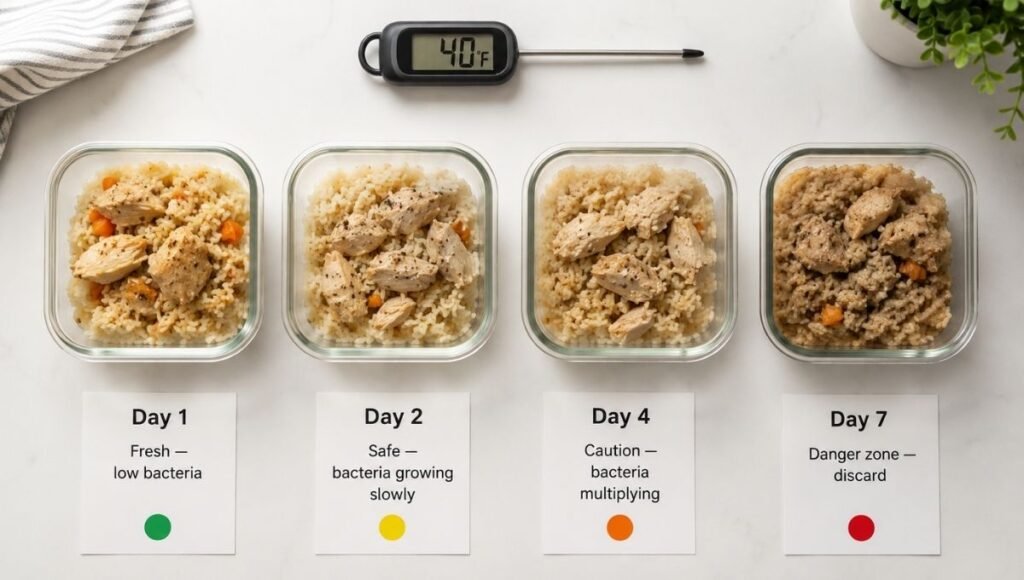
Most guides just tell you “refrigerate leftovers for 3-4 days” without explaining why that number exists. Without the reasoning, it’s easy to dismiss as overcaution — especially when you’ve eaten five-day-old pasta and felt perfectly fine.
Here’s what’s actually happening.
When food sits in your refrigerator, bacteria don’t stop growing — they slow down. At 40°F (4°C) or below, the doubling time for most bacteria lengthens significantly compared to room temperature. But it doesn’t stop. Over several days, even cold-tolerant bacteria like Listeria monocytogenes can reach levels high enough to cause illness. The 3-4 day window is the point where, for most cooked foods under normal home refrigeration, bacterial levels approach the threshold where the risk becomes meaningful for healthy adults.
There’s also a temperature reality that most home refrigerators don’t meet consistently: every time you open your fridge, warm air enters and temperatures spike briefly. The door shelves, in particular, cycle through temperatures significantly above 40°F throughout the day. The official guidelines assume properly maintained refrigerator temperature — and most home refrigerators aren’t quite there.
The “I’ve eaten week-old leftovers and been fine” argument:
This is real but it’s survivorship bias, not safety data. Foodborne illness from common bacteria like Salmonella affects approximately 1.35 million Americans annually, according to the CDC — most of these cases aren’t linked to a specific incident because people don’t always connect the illness to food eaten 12-48 hours earlier. The fact that you haven’t visibly gotten sick from old leftovers doesn’t mean you haven’t experienced subclinical effects, and it definitely doesn’t mean the next time won’t be different — particularly as you age or if your immune status changes.
The risk isn’t zero each time. It accumulates.
How Long Does Food Last in the Fridge: Every Category
Cooked Proteins — The Highest-Stakes Category
Proteins are where foodborne illness most commonly originates, because they provide the nutrient-rich environment bacteria thrive in. The temperature history of cooked protein matters more than almost any other factor — how quickly it was refrigerated after cooking, and whether it’s been sitting at room temperature.
Cooked chicken (all preparations): 3–4 days Cooked ground beef or pork: 3–4 days Cooked steaks, chops, roasts: 3–4 days Cooked fish and shellfish: 1–2 days (significantly shorter — fish spoils faster and some fish-related illness from scombroid poisoning is heat-stable) Deli meats (opened package): 3–5 days Hard-boiled eggs: 7 days (in shell); 5 days (peeled, stored in water)
The “mixed dish” rule that most guides miss: When protein is combined with other ingredients — chicken fried rice, pasta with meat sauce, soup with chicken — the storage clock is set by the most perishable component. A seafood pasta lasts as long as the seafood (1-2 days), not the pasta (3-5 days). A chicken soup lasts as long as the chicken (3-4 days). This is the rule that explains why some leftovers go bad faster than you expect even though some of their ingredients would have lasted longer separately.
Cooked Rice and Grains — The Sneaky Dangerous One
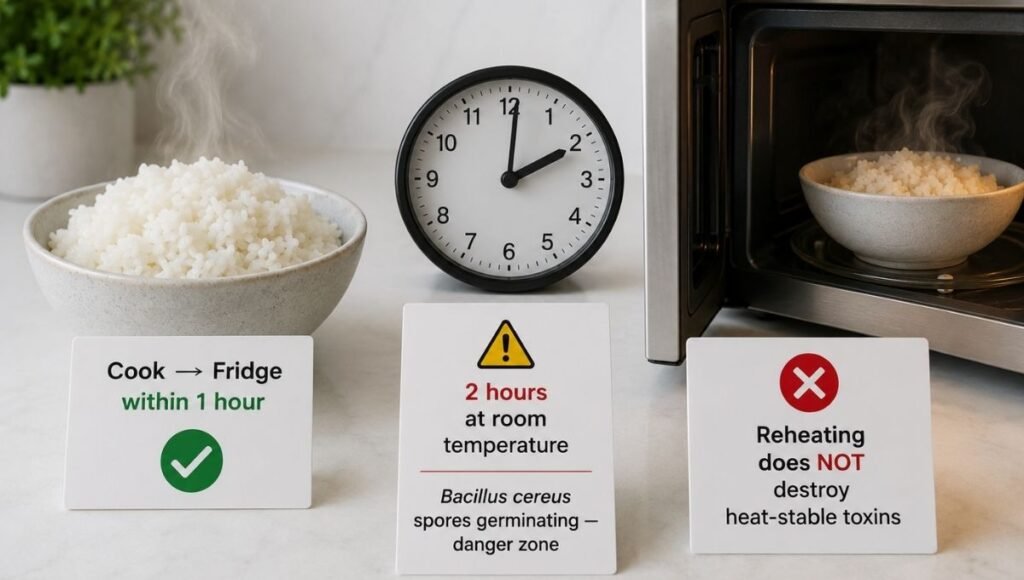
Cooked rice deserves its own section because it’s one of the most underestimated food safety risks in the home kitchen — and it’s the food that generates the most debate in cooking communities.
Cooked rice: 1–3 days (some sources say up to 4-5, but err on 3) Cooked pasta: 3–5 days Cooked quinoa, barley, oats: 3–5 days
The rice situation is genuinely different from other leftovers because of Bacillus cereus — a spore-forming bacterium that’s naturally present in raw rice. Cooking destroys the bacteria but not the spores. When cooked rice sits at room temperature, those spores germinate and multiply rapidly. Once established, B. cereus produces toxins — and here’s the critical part — those toxins are heat-stable. Reheating the rice to 165°F kills the bacteria but does not destroy the toxins they’ve already produced. This means thoroughly reheating rice does not make it safe if it’s been improperly stored.
The practical implications:
- Rice should be refrigerated within 1 hour of cooking (the standard USDA 2-hour rule is less forgiving for rice)
- Rice that has been left at room temperature for more than 2 hours should be discarded — not reheated
- Use or freeze rice within 3 days of cooking
This is why “I just reheat it really well” doesn’t apply to rice the way it does to other foods. The threat from improperly stored rice doesn’t come from live bacteria — it comes from toxins that reheating can’t touch.
Raw Proteins — The Shortest Windows
Raw ground beef or pork: 1–2 days Raw steaks, chops, roasts: 3–5 days Raw chicken (whole or pieces): 1–2 days Raw fish and shellfish: 1–2 days Raw sausage (fresh): 1–2 days
These windows are significantly shorter than most people assume, particularly for chicken and ground meats. Ground meat has dramatically more surface area than a whole cut, which means faster bacterial colonization. Raw chicken’s short window is why the “buy on sale and freeze immediately” strategy is not just economically smart — it’s also the food-safe approach for families who don’t plan to cook their chicken within two days.
Dairy and Eggs
Eggs (in shell): 3–5 weeks after purchase date Milk: 7 days after opening (or use-by date, whichever is earlier) Greek yogurt or regular yogurt: 1–2 weeks after opening Butter: 1–2 weeks at room temperature (in a covered crock); up to 3 months refrigerated Sour cream: 3 weeks after opening Heavy cream: 10 days after opening Opened cottage cheese or ricotta: 1–2 weeks
The yogurt container that’s been in the back of the fridge for a month: Check it with the smell and visual inspection, but know that the best-by date is a quality indicator, not a safety cutoff, for most dairy. Greek yogurt in particular is quite acidic and often safe past its printed date. Use your judgment — and your nose.
Fresh Produce
Fresh produce is highly variable based on the specific item, but some general principles:
Hardiest (1–2 weeks or more): Carrots, celery, beets, cabbage, broccoli, cauliflower, apples, citrus Medium (3–7 days): Bell peppers, zucchini, cucumbers, grapes, berries, leafy greens (whole heads last longer than pre-cut) Shortest (1–3 days): Fresh herbs, cut fruit, mushrooms, avocados (once ripe), tomatoes (though these are better at room temperature for flavor)
Cut produce: Once you cut produce, the storage window shortens significantly due to increased surface area and cellular damage. A whole bell pepper lasts a week; a sliced bell pepper lasts 3–4 days. Wash and cut produce only when you’re ready to use it.
Cooked vegetables: 3–7 days in an airtight container. Cooked legumes (beans, lentils) last 7–10 days and are one of the best value meal-prep options for longevity.
Leftovers by Dish Type
Soups, stews, and chili: 4–5 days (longer than most other leftovers because the liquid environment and cooking process create a relatively hostile environment for bacterial growth) Pasta dishes with meat: 3–4 days (use the protein as your timer) Pasta dishes without meat: 3–5 days Casseroles: 3–4 days Pizza: 3–4 days (refrigerate in an airtight container — the box doesn’t seal) Cooked vegetables: 3–7 days Rice dishes: 1–3 days (see the rice section above) Sandwiches with deli meat: 3–5 days if stored without condiments; eat the same day if made with mayo or dressing
The “It Smells Fine” Myth: What Your Nose Can’t Detect
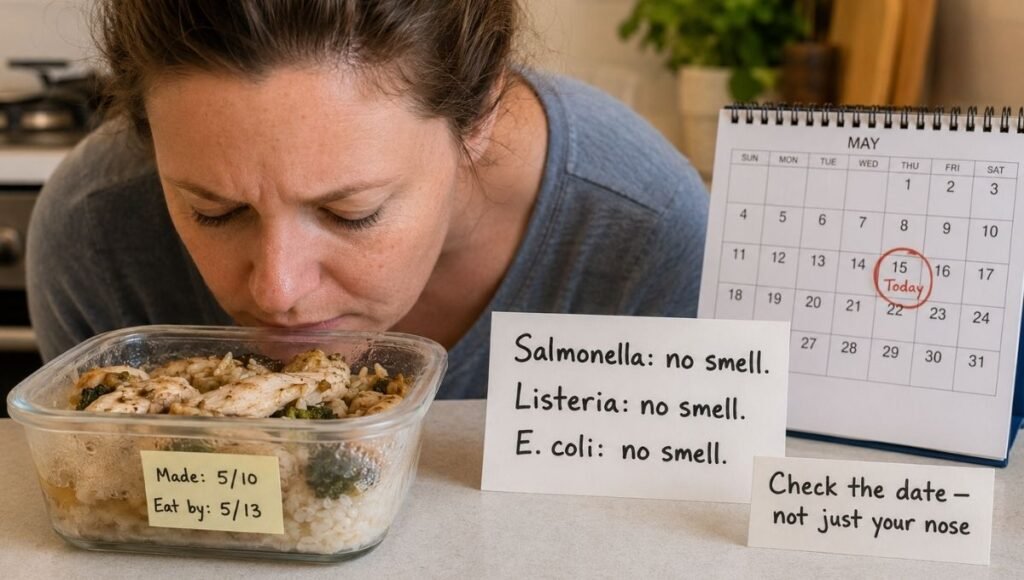
This is the belief that causes the most food safety problems in home kitchens, and it needs to be directly addressed.
The smell test — opening the container, taking a sniff, deciding it’s fine because you don’t notice anything off — tells you almost nothing about whether food is safe to eat. It’s useful for detecting obvious spoilage. It’s useless for detecting dangerous pathogens.
The most common causes of serious foodborne illness in the United States:
- Salmonella: No detectable smell at dangerous levels. Responsible for 1.35 million illnesses annually in the U.S. (CDC).
- Listeria monocytogenes: Grows at refrigerator temperatures, no distinctive smell, particularly dangerous for pregnant individuals and the elderly.
- E. coli O157:H7: No smell indicator. Can cause severe illness including hemolytic uremic syndrome (kidney failure) in severe cases.
- Bacillus cereus toxins in rice: Heat-stable, no detectable smell or taste change.
Smell detects the bacteria and yeasts that cause food to taste and smell “off” — these overlap only partially with the pathogens that cause serious illness. You can have food that smells perfectly normal and contains dangerous levels of Salmonella. You can have food that smells slightly sour and is perfectly safe (think sourdough, fermented foods, aged cheeses).
The smell test is a useful secondary check. It’s not a replacement for knowing how long food has been in your refrigerator.
How to Maximize How Long Food Lasts in the Fridge
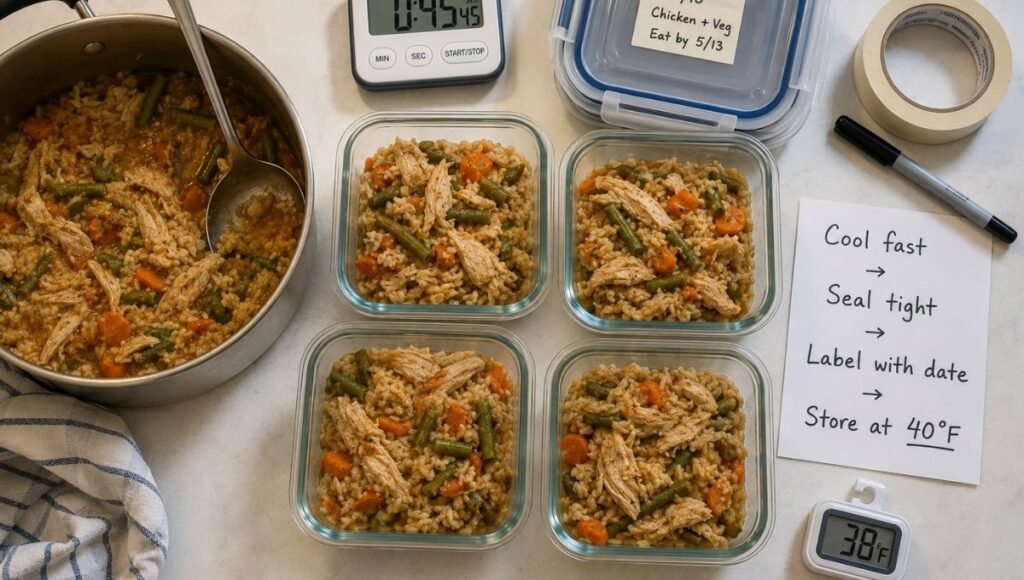
Refrigerate Quickly — The 2-Hour Rule
Cooked food should be in the refrigerator within 2 hours of cooking — 1 hour if your kitchen is above 90°F (a summer kitchen without AC, for example). This is the single most impactful factor in how long your leftovers will last. Food that sits at room temperature for 3 hours before refrigerating has already given bacteria a significant head start that refrigeration can’t fully undo.
The hot-food-in-the-fridge debate: You don’t need to wait for food to cool to room temperature before refrigerating. Modern refrigerators handle hot food without damage to the appliance or to surrounding foods (as long as you’re not putting a massive volume of hot food in all at once). The risk of waiting — letting food sit at room temperature longer — outweighs the marginal benefit of letting it cool first.
Airtight Containers Are Not Optional
Open containers or loosely covered dishes lose moisture (affecting texture and quality), absorb other odors from the fridge, and allow more bacteria from the environment to contact the food. Heavy-duty airtight containers — glass with snap lids, or good-quality plastic with tight seals — make a meaningful difference in actual shelf life compared to a plate covered with aluminum foil.
Store in single-meal portions rather than one large container when possible. Every time you open a container and return it to the fridge, you’re introducing air and potential contamination. Smaller portioned containers that you open once and finish eliminate this issue.
Label Everything With the Date
The “when did I put this in?” question is responsible for a large percentage of food waste and food safety mistakes. A piece of masking tape and a marker takes 5 seconds. Write the food and the date. Remove all guesswork. This is the habit that pays back more than almost any other single kitchen practice.
Know Your Fridge Temperature
The USDA recommends maintaining refrigerator temperature at 40°F or below. Most home refrigerators run slightly warmer than their settings suggest, particularly near the door. A refrigerator thermometer (inexpensive, available at any kitchen store or online) tells you what’s actually happening rather than what the dial claims.
The coldest, most stable location in most refrigerators: the middle to back shelves. The warmest: the door. Keep dairy, eggs, and leftovers on middle or upper shelves — not the door.
The Freezer: The Real Answer to the 3–4 Day Problem
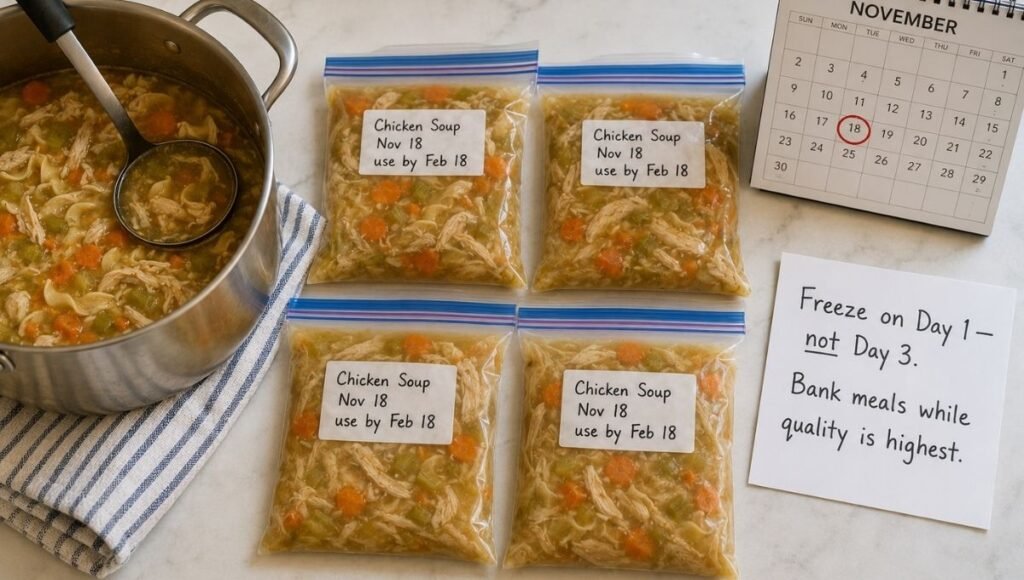
The 3–4 day rule for cooked leftovers represents how long food stays safe in the refrigerator. It is not the limit of how long you can keep food — that’s what the freezer is for.
According to USDA guidelines, leftovers can be kept in the refrigerator for 3 to 4 days or frozen for 3 to 4 months. Frozen food is technically safe indefinitely (bacteria don’t grow at 0°F), though quality deteriorates over months.
The strategic move: When you make a large batch of soup, chili, pasta sauce, or any other dish that exceeds what your household will eat in 3 days, portion the excess into freezer-safe containers immediately after cooking — while everything is fresh. Don’t wait until day 3 when the food is approaching its limit. Freeze on day 1 or 2, when quality is highest.
This approach turns the 3-4 day rule from a constraint into an asset. You’re not racing to eat everything before it goes bad — you’re banking meals.
What freezes well:
- Soups, stews, and chili (excellent)
- Cooked beans and lentils (excellent)
- Cooked ground meat (good)
- Pasta sauce without cream (good)
- Cooked rice (good — freeze immediately, reheat from frozen or thaw in fridge)
- Casseroles (good)
- Cooked chicken pieces (good)
What doesn’t freeze well:
- Salads and dressed vegetables
- Cream-based sauces (often separate)
- Fried foods (lose texture)
- Fresh herbs (better to dry or make herb oil)
- Cooked whole eggs (whites become rubbery)
When Food Safety Becomes a Medical Concern
Most healthy adults who eat food past its safe window experience mild to moderate symptoms — nausea, stomach cramping, diarrhea — that resolve within 24-48 hours without medical treatment. Stay hydrated, rest, and let it pass.
Seek medical attention if:
- Symptoms are severe or worsening after 48 hours
- High fever (above 102°F / 38.9°C) accompanying gastrointestinal symptoms
- Blood in stool or vomit
- Signs of significant dehydration (dizziness, inability to keep any fluids down, very dark urine)
- The affected person is pregnant, elderly, immunocompromised, or a young child — these groups face elevated risk of serious complications from foodborne illness and should contact a healthcare provider at the first sign of illness
Listeria, in particular, is a significant concern during pregnancy — it can cross the placenta and cause serious harm to a developing baby. Pregnant individuals should be especially careful about deli meats, soft cheeses, and any food that’s been in the refrigerator for extended periods.
Quick Reference: How Long Does Food Last in the Fridge
| Food | Fridge Life | Freezer Life |
|---|---|---|
| Cooked chicken | 3–4 days | 4 months |
| Cooked ground beef | 3–4 days | 3–4 months |
| Cooked fish | 1–2 days | 4–6 months |
| Raw chicken | 1–2 days | 9 months |
| Raw ground beef | 1–2 days | 3–4 months |
| Cooked rice | 1–3 days | 1 month |
| Cooked pasta | 3–5 days | 2 months |
| Cooked beans/lentils | 7–10 days | 6 months |
| Soups and stews | 4–5 days | 4–6 months |
| Pizza | 3–4 days | 2 months |
| Deli meat (opened) | 3–5 days | 1–2 months |
| Hard-boiled eggs | 7 days | Not recommended |
| Fresh leafy greens | 5–7 days | Not recommended |
| Berries | 3–5 days | 10–12 months |
| Milk (opened) | 7 days | 3 months |
| Leftovers (general) | 3–4 days | 3–4 months |
FAQ
Q: Is the 3–4 day rule for leftovers really necessary, or is it overly conservative?
It’s based on real microbiology, not arbitrary caution. At refrigerator temperatures, bacteria continue to grow — just more slowly. By day 4-5, many cooked foods have reached bacterial levels where the risk of illness becomes meaningful, particularly for vulnerable populations. The fact that many people regularly eat 5-6 day old leftovers without obvious illness reflects both individual variation in immune response and the fact that foodborne illness is often mild and not recognized as food-related. The rule reflects the threshold where the risk is no longer trivially small for healthy adults.
Q: How long is cooked rice safe in the fridge?
1–3 days is the conservative, well-supported answer. Rice is uniquely risky because Bacillus cereus spores survive cooking, germinate when rice cools, and produce heat-stable toxins that survive reheating. Rice should be refrigerated within 1 hour of cooking and not kept longer than 3 days. If in doubt, freeze immediately after cooling rather than refrigerating for extended periods.
Q: If food smells fine, is it safe to eat?
Not necessarily. The most dangerous foodborne pathogens — Salmonella, Listeria, E. coli O157:H7 — typically produce no detectable odor at illness-causing levels. Smell is a useful indicator of obvious spoilage, but it’s an unreliable safety test for pathogens. Date labels on your containers are more reliable than your nose.
Q: How long do soups and stews last in the fridge?
4–5 days — slightly longer than most other cooked foods because soups are brought to a rolling boil (which creates a clean starting point), and the liquid environment is less hospitable to some bacteria than protein surfaces. Soups with seafood or shellfish follow a shorter timeline (2–3 days) because of how quickly seafood proteins support bacterial growth.
Q: Can you put hot leftovers directly into the fridge?
Yes — and this is actually recommended over leaving food at room temperature to cool. Modern refrigerators handle hot food without damage to the appliance or surrounding foods. The risk of leaving food at room temperature (bacterial growth) significantly outweighs the minimal benefit of waiting for it to cool. Exception: very large volumes of very hot food (like an entire pot of soup) should be divided into smaller containers to cool more quickly.
Q: How long does cooked pasta last in the fridge?
3–5 days in an airtight container. Pasta dishes containing meat or seafood should follow the timeline of the protein — a meat sauce pasta lasts 3–4 days (the meat), not 5 days (the pasta). Plain pasta (no sauce, no protein) lasts closer to the 5-day end of the range.
The Honest Bottom Line
How long food lasts in the fridge is one of those topics where the official guidelines feel strict until you understand the reasoning behind them — and then they make complete sense. The 3-4 day rule isn’t a legal requirement or arbitrary number. It’s a practical threshold where, for most cooked foods under normal home refrigerator conditions, bacterial levels in perishable food approach the point where risk becomes real.
The habits that matter most: refrigerate within 2 hours, label everything with a date, keep your fridge at or below 40°F, and freeze anything you don’t expect to eat within 3 days. These four practices together eliminate most of the food safety uncertainty and most of the food waste that the uncertainty creates.
For connecting this knowledge to a practical weekly grocery system — what to buy, how to store it, and how to make one shopping run cover a full week of meals without anything going to waste — our how to save money on groceries guide covers the complete picture. And for the pantry staples that round out a week of real meals when the fridge gets sparse, our pantry staples guide is the natural companion.
References
- USDA Food Safety and Inspection Service. Leftovers and Food Safety. fsis.usda.gov
- FoodSafety.gov. Cold Food Storage Chart — Refrigerator and Freezer Storage Times. foodsafety.gov
- Centers for Disease Control and Prevention. Salmonella — Burden of Illness and Annual Estimates. cdc.gov
- Centers for Disease Control and Prevention. Listeria (Listeriosis) — Prevention. cdc.gov
- Healthline. How Long Are Leftovers Good For? A Food Safety Guide. healthline.com