
Key Takeaways
- Cheese shelf life depends entirely on moisture content — hard aged cheeses like Parmesan and Cheddar last 3–4 weeks after opening; soft fresh cheeses like ricotta and cottage cheese last just 1–2 weeks. The rule is simple: the harder the cheese, the longer it lasts.
- White specks or crystallized patches on aged hard cheeses are not mold — they’re calcium lactate crystals, a completely normal byproduct of aging that’s safe to eat. Knowing this single fact could save your household $20–$30 a year in perfectly good cheese that gets thrown away unnecessarily.
- According to USDA food safety guidelines, mold on hard cheese can be managed — cut at least 1 inch around and below the visible mold spot and the rest is safe to eat. Mold on soft cheese means discard the entire container.
- Most hard cheeses freeze well for up to 6 months — buying Costco blocks of Cheddar, Parmesan, or Gruyère, dividing into portions, and freezing is one of the most effective dairy savings strategies for families.
- The best-by date on cheese packaging is a quality indicator, not a safety cutoff. Well-stored hard cheese is routinely safe to eat weeks past its printed date.
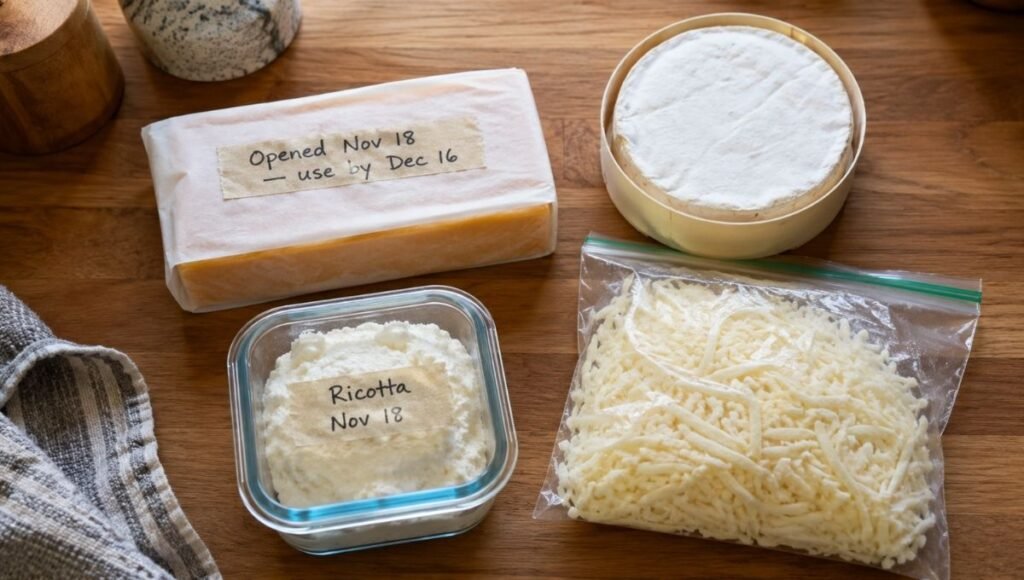
There’s a specific kind of kitchen anxiety that happens with cheese. You open the fridge, pull out a block of cheddar you’re pretty sure you bought two or three weeks ago, and you notice something — a spot, a different color, a smell that’s maybe slightly stronger than usual. And now you’re standing there holding a $7 block of cheese trying to decide whether to risk it or toss it.
Meanwhile, the pasta water is already boiling.
This exact moment happens in most households more often than anyone would like to admit. And the frustrating part is that the answer is genuinely different depending on what type of cheese you’re holding. The rules for a block of aged Parmesan and a container of fresh ricotta are almost opposite. The rules for a Brie that smells funky and a mozzarella that smells funky are completely different. The white stuff on your three-week-old cheddar might be perfectly safe calcium crystals — or it might be mold that needs to go.
This guide settles it all. Every major cheese type, clear storage windows, the spoilage signs that actually matter versus the ones that don’t, and the freezing strategy that makes bulk cheese buying from Costco actually work.
How Long Does Cheese Last in the Fridge? A Complete Guide by Type
The short version: moisture content determines shelf life. High moisture = more perishable. Low moisture = longer storage. Everything else — smell, texture, the mold question — flows from this basic principle.
Hard Aged Cheeses (Parmesan, Cheddar, Gouda, Gruyère, Manchego)
These are the workhorses of the cheese fridge. Low moisture, high salt content, extended aging — all of these work in your favor.
Unopened block: Up to 6 months refrigerated. Some hard cheeses, particularly Parmesan, can last even longer.
Opened block: 3–6 weeks, properly wrapped. Per the U.S. Department of Health and Human Services, hard aged cheeses like Cheddar and Parmesan last 3–4 weeks after opening under normal refrigerator storage.
Sliced or pre-shredded: 1–2 weeks. Once cheese is sliced or shredded, the dramatically increased surface area exposes more of it to air and bacteria, shortening the window significantly.
The Costco block situation: A 2-lb block of Kirkland Parmesan might seem like too much to use in 6 weeks — but it doesn’t have to all be in the fridge at once. More on this in the freezing section.
Semi-Hard Cheeses (Swiss, Colby, Pepper Jack, Muenster, Fontina)
Unopened: 2–4 months refrigerated.
Opened block: 3–4 weeks, well wrapped.
Sliced: 1–2 weeks.
These cheeses occupy the middle ground — more perishable than hard aged varieties but much more forgiving than fresh soft cheeses. The same wrapping principles apply: porous wrapping (wax paper, parchment, cheese paper) beats plastic wrap for anything longer than a few days.
Soft Ripened Cheeses (Brie, Camembert, Taleggio)
This category has the widest gap between what people expect and what’s actually true — mostly because these cheeses smell funky even when they’re perfectly fine.
Unopened: Follow the best-by date closely. Unlike hard cheeses, soft ripened varieties don’t have significant buffer past their printed date.
Opened: 1–2 weeks maximum. Once you cut into a Brie, the clock moves fast.
The smell question: Brie and Camembert are supposed to smell pungent — earthy, mushroomy, sometimes faintly ammonia-adjacent when very ripe. This is normal. What’s not normal: a sharp, acrid ammonia smell that hits you the moment you open the container, or a sour smell that’s clearly wrong rather than just funky. Getting familiar with what your specific cheese smells like at purchase helps you identify when it’s crossed the line.
Blue Cheeses (Gorgonzola, Roquefort, Stilton, Maytag)
Opened: 3–4 weeks, wrapped tightly in foil (not plastic, which can trap off-flavors).
Blue cheeses are intentionally moldy — the blue-green veining is Penicillium mold that’s deliberately introduced during production and is completely safe to eat. This means that the normal “discard if you see mold” rule doesn’t apply in the usual way. What you’re looking for instead: unusual colors that aren’t part of the expected blue-green veining (pink, red, fuzzy white or black growth that looks distinct from the intentional marbling), or a sour smell that’s clearly wrong rather than just assertively funky.
Fresh Soft Cheeses (Ricotta, Cottage Cheese, Cream Cheese)
These are the most perishable cheeses in your fridge. High moisture content, minimal aging, no salt or acid preservation to speak of — they need to be used quickly.
Unopened (following best-by date): 1–2 weeks past purchase is typical.
Opened: 1–2 weeks maximum, kept in original sealed container or airtight container. The USDA recommends consuming opened soft cheeses within 1 week for best safety.
The liquid on top of cottage cheese: A small amount of liquid separation (whey) is completely normal — it’s the same protein-rich liquid you see on top of yogurt. Stir it back in. What’s not normal: a slimy texture throughout, a sour or “off” smell distinct from the mild tang that’s normal, or visible pink/orange discoloration.
Fresh Mozzarella and Feta (Brined Fresh Cheeses)
These cheeses are sold in liquid (brine or water) and need to stay in it.
In original brine, unopened: Follow the best-by date.
Opened, kept in brine: 5–7 days. Don’t drain it — the brine is what’s keeping it fresh. If you drain the package before you’re ready to use it all, cover the remaining cheese with cold water or make a light salt solution (1 teaspoon salt per cup of water) and submerge it.
Ball mozzarella out of water: 2–3 days maximum.
Smell check for mozzarella: Fresh mozzarella should smell mild and slightly milky. If it smells sour, yeasty, or like vinegar — discard it. Mozzarella doesn’t have the assertive funk of aged or ripened cheeses, so any strong smell is a clear warning.
Shredded and Sliced Packaged Cheese
Unopened bag: Follow the best-by date, usually 1–2 months.
Opened bag: 1–2 weeks in a sealed bag with as much air removed as possible. The pre-shredded or pre-sliced processing dramatically increases surface area, meaning it dries out and can develop mold significantly faster than a block of the same cheese.
Why pre-shredded bags seem to go bad so fast: They often contain anti-caking agents like powdered cellulose. These help the shreds stay separate, but they also absorb moisture from the cheese, which can accelerate drying and texture changes. Buying a block and grating it yourself produces cheese that keeps better in the fridge — and usually costs significantly less per ounce.
The White Stuff on Your Cheese: Mold or Crystals?
This is the question that trips up more people than any other cheese storage issue — and understanding it correctly is worth real money, because the answer determines whether you keep eating or throw away.
Calcium Lactate Crystals (Safe to Eat)
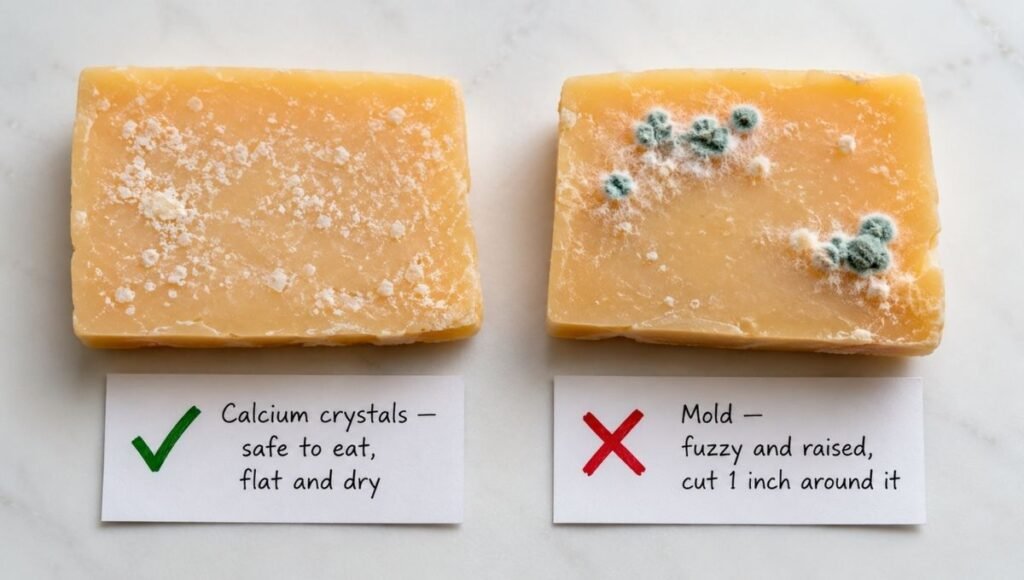
On hard aged cheeses like aged Cheddar, Parmesan, and Gouda, you’ll sometimes find white spots or crystallized patches that look alarming. These are calcium lactate crystals — a completely normal result of the cheesemaking and aging process. When lactic acid in the cheese combines with calcium, it can form these white deposits on the surface or interior.
What they look like: White, chalky, slightly powdery patches. Sometimes scattered, sometimes concentrated. They don’t have the fuzzy or slightly raised texture of mold — they’re flush with the cheese surface and have a dry, crystalline appearance.
What they taste like: Slightly crunchy if you eat them directly, otherwise flavor-neutral. Entirely safe.
How to tell them from mold: Calcium crystals are flat, white, and dry. Mold is typically fuzzy, slightly raised from the surface, and may be green, blue, gray, or black. When in doubt, look at the texture — smooth and powdery vs. fuzzy and raised is the key distinction.
Editor’s take: The number of times people throw away a $10 block of aged Parmesan because of calcium crystals is genuinely painful. This is the most important “save your cheese” fact in this entire guide.
When Mold on Cheese Is Fine (and When It’s Not)
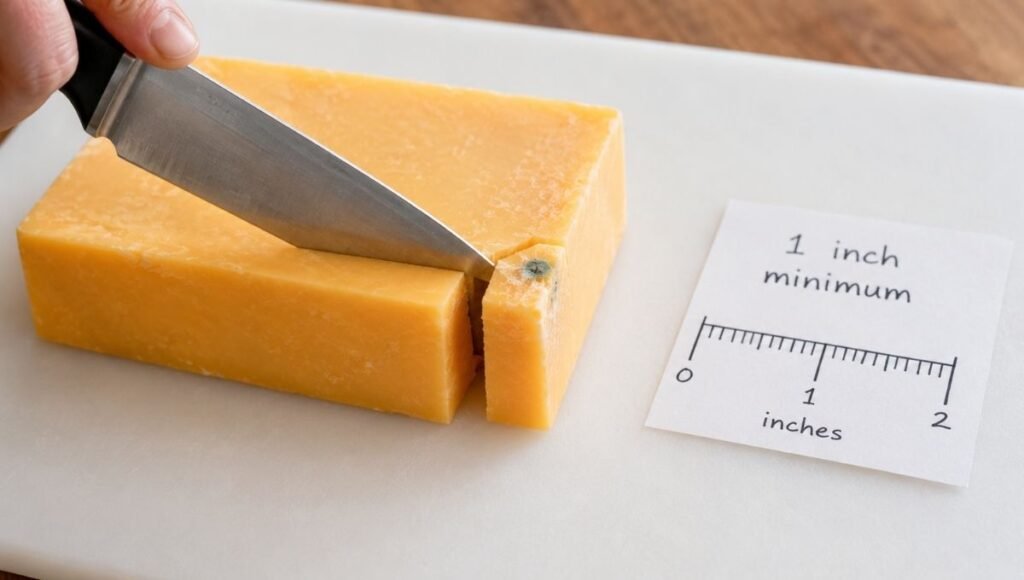
The USDA provides clear guidance on this, and it’s more forgiving for hard cheeses than most people realize:
Hard and semi-hard block cheeses (Cheddar, Parmesan, Swiss, Gouda): If you see mold, cut at least 1 inch (2.5 cm) around and below the visible mold spot. The rest of the block is safe to eat. The key is that the mold on hard cheese typically hasn’t penetrated deep into the dense structure. Keep the knife clean as you work.
Soft cheeses, fresh cheeses, crumbled or shredded cheese: Discard the entire container if you see any mold. In these high-moisture formats, mold penetrates throughout the product — there’s no safe “cut around it” option.
Blue cheeses: The intentional blue-green mold is safe. Any mold growth that appears to be a distinctly different color or texture from the expected veining is a sign to discard.
How to Tell If Cheese Has Gone Bad: What to Actually Look For
Smell
The challenge with cheese smell is that some perfectly good cheese smells genuinely strong. Brie, Camembert, Taleggio, and blue cheeses can be aggressively pungent at peak quality. Getting familiar with what your specific cheese smells like when fresh gives you a baseline.
Signs of actual spoilage by smell:
- A sharp, acrid ammonia smell that’s much stronger than the usual funk (common in overripe Brie)
- A sour, distinctly “wrong” smell in a cheese that shouldn’t be sour (mozzarella, Colby, cream cheese)
- A rancid or unclean smell in any cheese
Normal smells that alarm people unnecessarily:
- Earthy, mushroomy funk in Brie and Camembert
- Strong assertive sharpness in aged Cheddar
- The pungent complexity of blue cheeses
Texture
Signs of spoilage:
- Slimy surface on a cheese that wasn’t previously slimy (distinct from the washed-rind style intentional sliminess of cheeses like Limburger)
- Cottage cheese, ricotta, or cream cheese that’s become watery and unpleasantly separated
- Extremely dry and cracked hard cheese that has been in the fridge too long
Normal texture changes:
- Slight surface dryness on hard cheese that’s been open for a few weeks — slice off the dried edge and the interior is fine
- Slight moisture separation on cottage cheese or Greek-style cheese — stir it back in if it smells normal
Appearance
Beyond the mold and crystal question already covered: pink, orange, or black discoloration on any cheese that shouldn’t have those colors is a discard signal. These colors indicate contamination by specific bacteria or molds that aren’t safe.
How to Store Cheese Properly to Maximize Shelf Life
The Wrapping Problem with Plastic
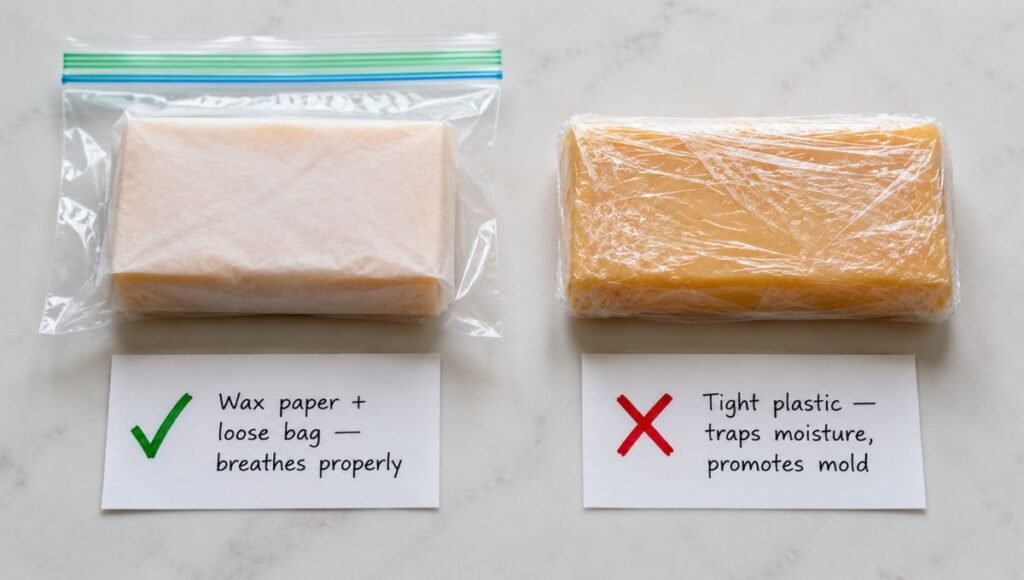
Plastic wrap seems like the obvious choice but it’s actually one of the less effective options for cheese storage. Tight, non-porous plastic traps moisture against the cheese surface, which promotes mold growth, and it also traps gases that affect flavor.
Better options:
- Wax paper or parchment paper: Wraps the cheese, allows it to breathe slightly, doesn’t trap moisture
- Cheese paper (specifically designed for this): Combines a porous inner layer with a wax outer layer — the best option
- Wax paper + a loosely sealed zip bag: A practical compromise that most households can do immediately
After wrapping, store cheese in the middle or upper shelves of your refrigerator — colder and more temperature-stable than the door. Keep it above raw meat, poultry, and seafood to prevent cross-contamination.
The Fridge Location Question
The cheese drawer or vegetable crisper drawer works well for many cheeses — the slightly higher humidity helps prevent surface drying. The door is the worst location — temperature fluctuates every time you open it, accelerating quality loss for any cheese stored there.
Freezing Cheese: The Costco Strategy That Works
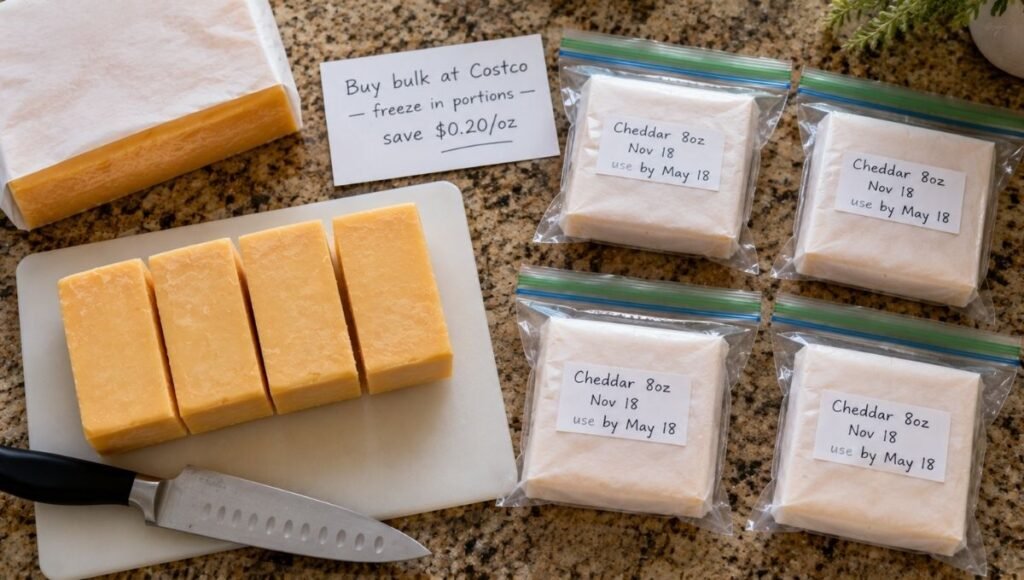
Freezing cheese works well for most hard and semi-hard varieties, and it’s the key that makes bulk buying economical.
Cheeses that freeze well:
- Cheddar (blocks or slices)
- Parmesan (grated or block)
- Gouda
- Swiss
- Gruyère
- Mozzarella (low-moisture, packaged variety — not fresh ball mozzarella)
- Colby, Monterey Jack, Pepper Jack
Cheeses that don’t freeze well:
- Fresh mozzarella (ball)
- Ricotta
- Cottage cheese
- Cream cheese (texture becomes grainy and separated after thawing)
- Brie and Camembert (texture breakdown is significant)
How to freeze cheese properly:
For block cheese: divide into portions you’ll realistically use in a recipe or two (roughly 4–8 oz for most families). Wrap each portion tightly in wax paper, then place in a freezer bag with air pressed out. Label with the date and type. Freeze for up to 6 months.
For pre-grated Parmesan: transfer to a freezer bag, press out air, freeze flat. You can take out exactly as much as you need and return the rest — frozen grated Parmesan goes directly from the freezer to your pasta or dish without any thawing needed.
After thawing: Frozen cheese is best used in cooked applications where texture is less critical — pasta, pizza, casseroles, soups, omelets. Thawed cheese tends to be slightly more crumbly than fresh, which makes it less ideal for sliced applications but perfectly fine for anything melted.
The Costco math: A 2-lb block of Kirkland Sharp Cheddar costs approximately $7–$9 (roughly $0.28–$0.35/oz). The same cheese in a standard 8-oz grocery store block runs $3.50–$4.50 ($0.44–$0.56/oz). Buy two Costco blocks, use one fresh over 3–4 weeks, divide the second into four 8-oz portions and freeze. Repeat when the fresh block is nearly gone. Your per-ounce cost stays at Costco prices and nothing goes to waste.
Cheese Storage Quick Reference
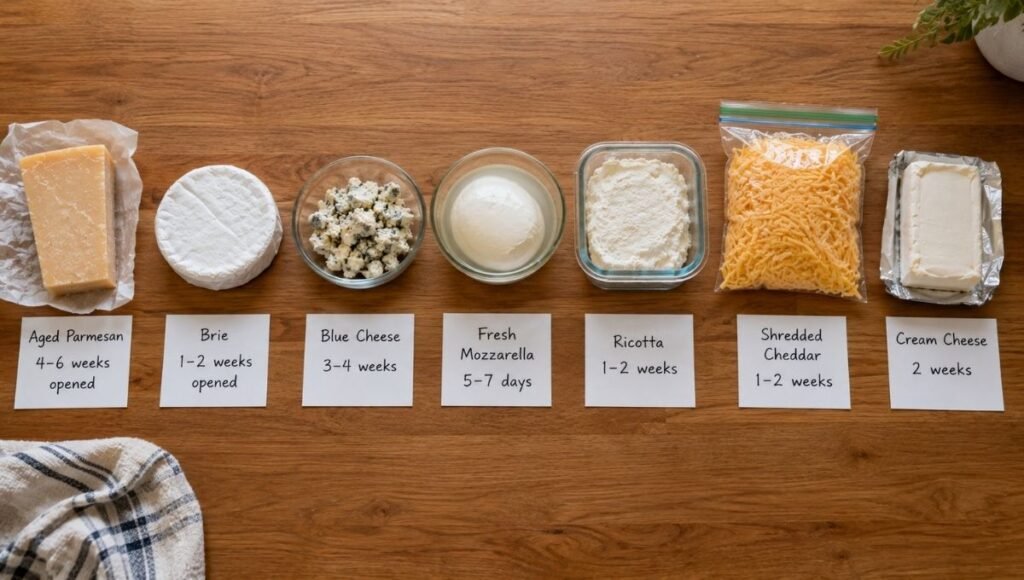
| Cheese Type | Unopened | Opened (fridge) | Freezes Well? |
|---|---|---|---|
| Parmesan (block) | 6 months | 4–6 weeks | Yes ✅ |
| Aged Cheddar (block) | 6 months | 3–6 weeks | Yes ✅ |
| Gouda, Gruyère | 6 months | 3–4 weeks | Yes ✅ |
| Swiss, Colby | 2–4 months | 3–4 weeks | Yes ✅ |
| Shredded (any type) | 1–2 months | 1–2 weeks | Yes ✅ |
| Sliced (any type) | 2–3 weeks | 1–2 weeks | Yes ✅ |
| Brie, Camembert | Best-by date | 1–2 weeks | No ❌ |
| Blue cheese | Several months | 3–4 weeks | Partially ⚠️ |
| Fresh mozzarella | Best-by date | 5–7 days (in brine) | No ❌ |
| Feta | Best-by date | 5–7 days (in brine) | No ❌ |
| Ricotta | Best-by date | 1–2 weeks | No ❌ |
| Cottage cheese | Best-by date | 1–2 weeks | No ❌ |
| Cream cheese | Best-by date | 2 weeks | No ❌ |
FAQ
Q: How long does cheese last in the fridge after the expiration date?
Hard aged cheeses like Cheddar and Parmesan are routinely safe and good to eat for 3–6 weeks past their best-by date when properly stored. The best-by date indicates quality, not safety — an inspection for mold, unusual smell, and texture is more informative than the date alone. Soft fresh cheeses (ricotta, cottage cheese, cream cheese) should be treated more cautiously — a week past the date is the reasonable limit for these.
Q: Can you eat cheese with mold on it?
For hard block cheeses (Cheddar, Parmesan, Gouda, Swiss): yes — cut at least 1 inch around and below the mold spot and the rest is safe to eat, per USDA guidance. For soft cheeses, fresh cheeses, and any pre-shredded or pre-sliced cheese: no — mold penetrates throughout these products and the entire container should be discarded.
Q: What are the white spots on my aged cheddar?
Almost certainly calcium lactate crystals — a completely normal byproduct of cheese aging where lactic acid combines with calcium to form white crystallized deposits. They’re safe, slightly crunchy if you eat them directly, and very commonly mistaken for mold. Mold is fuzzy and raised from the surface; crystals are flat, smooth, and dry. This distinction alone can save you from throwing away perfectly good expensive cheese.
Q: How long does shredded mozzarella last after opening?
1–2 weeks in a sealed bag with as much air removed as possible. Pre-shredded cheese has dramatically more surface area exposed to air than block cheese, which accelerates drying and mold. Signs it’s gone: fuzzy mold growth (discard), sour smell (discard), significant color change. Slight clumping is normal and doesn’t indicate spoilage.
Q: Can you freeze a block of Parmesan?
Yes — hard cheeses like Parmesan freeze very well for up to 6 months. For grated Parmesan, transfer to a freezer bag and use directly from frozen without thawing. For block Parmesan, wrap in wax paper then a freezer bag, freeze, and thaw in the refrigerator before use. Frozen-thawed Parmesan is best for cooked applications (pasta, soups, sauces) rather than as a fresh garnish where texture matters most.
Q: How do I know if Brie has gone bad?
Brie is supposed to smell funky — earthy, mushroomy, and assertively pungent. That’s normal. What’s gone bad: a sharp, acrid ammonia smell significantly stronger than the usual funk, or a sour smell that’s distinctly wrong. Also: any mold growth that’s pink, orange, black, or appears as fuzzy growth distinctly separate from the natural white rind. If the rind has become slimy (beyond its natural slightly-yielding texture) and the interior smells wrong, it’s done.
The Honest Bottom Line
How long cheese lasts in the fridge is a question with a clear answer once you know that moisture content is the governing factor. Hard aged cheeses are generous with their shelf life — 4–6 weeks after opening is normal and safe with proper storage. Fresh soft cheeses are much more time-sensitive and need to be treated accordingly.
The two habits that prevent the most cheese waste: wrapping hard cheeses in wax paper rather than plastic wrap, and knowing that white crystallized spots on aged cheese are not mold. Those two things together could genuinely save most households $20–$40 per year in cheese they would otherwise throw away unnecessarily.
For building the kind of refrigerator and pantry system that makes food last longer and reduces weekly waste across all categories — not just cheese — our pantry staples guide covers the full picture. And for the broader grocery strategy that makes bulk buying (Costco blocks, Aldi finds) actually work within a family budget, our how to save money on groceries guide is the natural next step.
References
- USDA Food Safety and Inspection Service. Molds on Food: Are They Dangerous? fsis.usda.gov
- USDA Food Safety and Inspection Service. How long can you keep dairy products like yogurt, milk, and cheese in the refrigerator? ask.usda.gov
- FoodSafety.gov. FoodKeeper App — Cheese Storage Times. foodsafety.gov
- U.S. Dairy / Dairy Farmers of Wisconsin. How Long Can Cheese Sit Out? usdairy.com
- Healthline Nutrition. How Long Does Cheese Last in the Fridge? healthline.com