
Key Takeaways
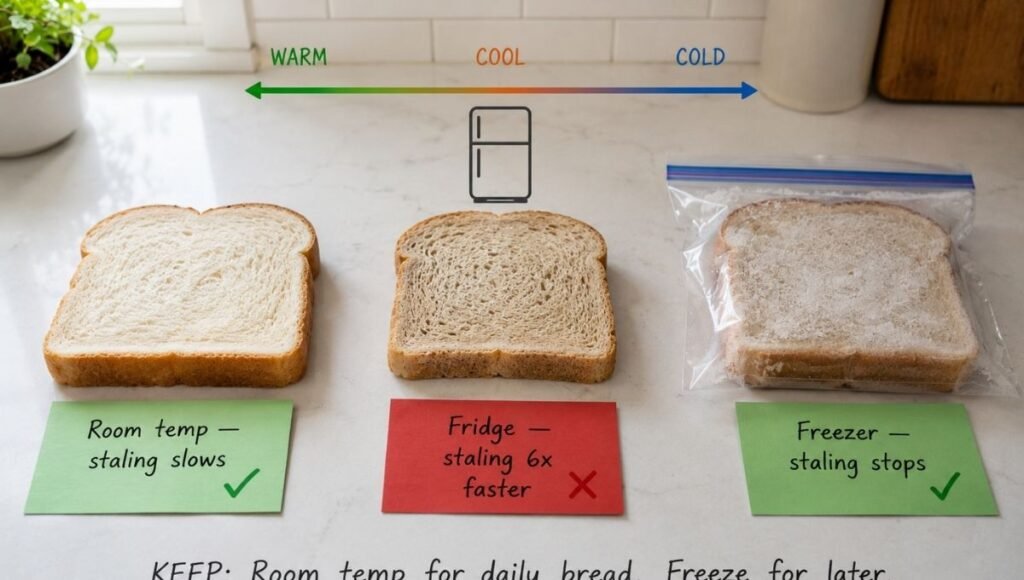
- The refrigerator makes bread go stale faster, not slower — this is the most counterintuitive and most important bread storage fact. Starch retrogradation (the process that makes bread firm and dry) happens approximately 6 times faster at refrigerator temperatures than at room temperature.
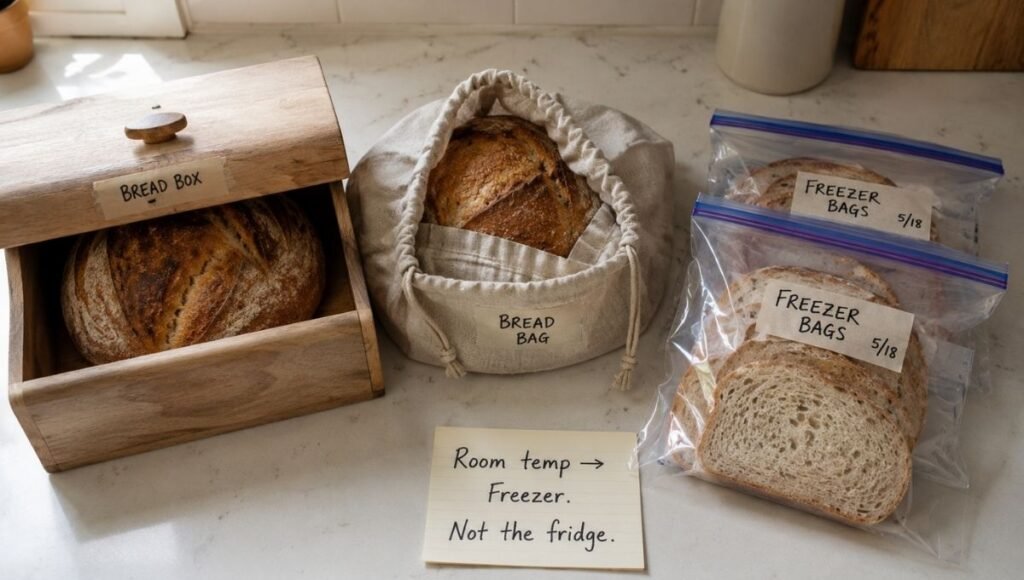
- The freezer is the correct long-term storage tool — unlike the fridge, freezing almost completely halts staling. Bread frozen on day 1 or 2, then toasted directly from frozen, tastes virtually indistinguishable from fresh.
- If you find mold on one slice of soft bread, discard the entire loaf. Unlike hard cheese, soft bread’s porous structure allows mold to spread through the entire loaf even when you can only see it in one spot.
- Different breads need different storage. Sandwich bread with preservatives lasts 5–7 days at room temperature. Artisan bread and sourdough: 2–4 days. Homemade bread without preservatives: 2–3 days. Baguettes: ideally eaten the same day or next.
- The bread box is genuinely useful — not just decorative — for families who go through a loaf in 3–5 days. It maintains the right balance of humidity and airflow that plastic bags and bare countertops can’t provide.
You bought a loaf of bread on Sunday. It’s Thursday and you still have half of it left. You put it in the refrigerator because that’s where perishable things go when you want them to last, right?
By Friday, you open it and it’s dry, oddly firm, and kind of dense in a way that fresh bread never is. The texture is just off. You’ve experienced this before and assumed it was normal — bread going bad is bread going bad. But here’s the thing: the bread didn’t go bad in the fridge. It went stale faster in the fridge than it would have sitting on your counter.
The refrigerator is actively making your bread worse. This is one of the most counterintuitive facts in food storage, and it’s the primary reason most people consistently lose bread to staleness rather than to mold.
This guide explains exactly what’s happening, the correct storage method for every type of bread in your kitchen, the mold question nobody answers directly, and whether a bread box is actually worth buying or just a pretty kitchen object taking up counter space.
Why Bread Goes Stale: The Science in Plain English
Most people think bread goes stale because it dries out — the moisture leaves and the bread becomes dry and hard. This is partly true but mostly wrong, which is why the instinct to put bread in the fridge (which slows moisture evaporation) doesn’t actually keep bread fresh.
The real process is called starch retrogradation, and it goes like this:
When bread is baked, the starch molecules in the flour absorb water and form a soft, gel-like structure — that’s the tender, springy crumb of fresh bread. As the bread cools and sits over time, those starch molecules start to re-crystallize into their original rigid structure, releasing water in the process. The bread becomes firm, dense, and dry — not because the moisture left through evaporation, but because the starch structure changed.
Here’s the critical part: retrogradation happens much faster in cold temperatures. At refrigerator temperatures (36–40°F), starch molecules re-crystallize approximately six times faster than at room temperature (68–72°F). The freezer, at 0°F, essentially stops the process entirely.
This explains several things that might have confused you:
- Why bread in the fridge seems to go stale within a day or two even though it hasn’t dried out from air exposure
- Why slightly stale bread becomes soft again when you heat it in the oven — heat temporarily reverses retrogradation by re-melting the starch crystals
- Why frozen bread, toasted directly from frozen, can taste almost exactly like fresh bread
Editor’s take: Once you understand retrogradation, the entire bread storage picture clicks. The fridge is cold enough to accelerate staling but not cold enough to stop it. The freezer is cold enough to stop it entirely. Room temperature is warm enough to slow it. The bread box just helps manage room temperature storage properly.
How to Keep Bread Fresh at Room Temperature
For bread you’ll eat within 3–5 days, room temperature is correct. The question is how you manage it at room temperature.
What Actually Works
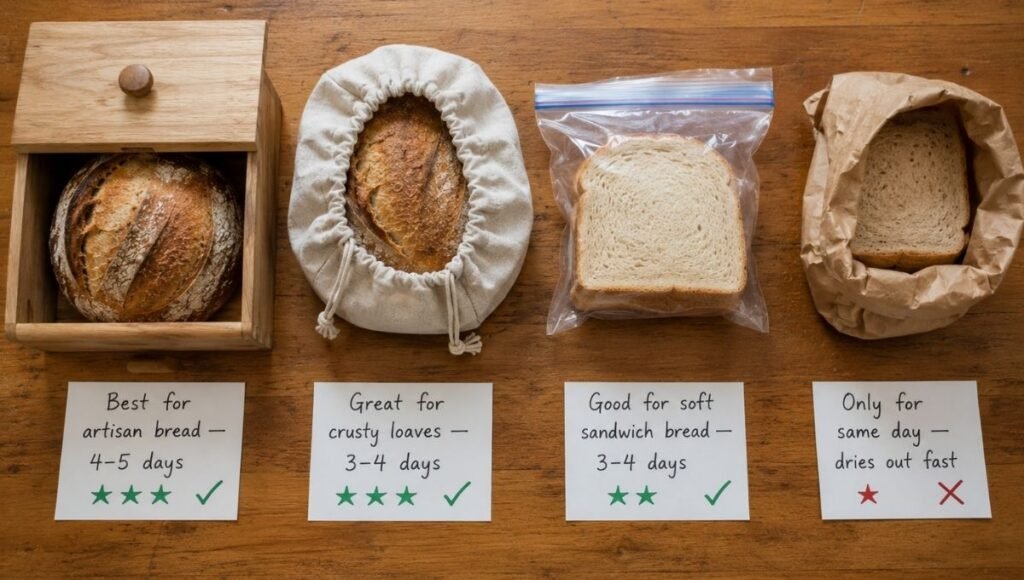
A bread box: The best room-temperature storage for most bread types. A good bread box maintains the right microenvironment — slightly elevated humidity from the bread’s own moisture, with enough airflow to prevent that humidity from building up into mold-promoting conditions. The temperature inside stays close to room temperature but consistent. If your family goes through a loaf within 4–5 days, a bread box is genuinely the best tool for the job.
A cloth or linen bread bag: A close second to a bread box, particularly for artisan breads with a crust you want to preserve. Cloth allows the bread to breathe (preventing moisture buildup) while keeping it from drying out too fast. Good for crusty sourdough and artisan loaves.
Airtight bag or container: Best for soft sandwich bread that you want to maintain softness in. Plastic traps moisture, which is good for soft bread (keeps it from drying at the surface) but creates mold risk faster than a bread box or cloth bag. Use airtight storage for soft bread you’ll finish within 3–4 days.
Cut-side down on a cutting board: An old-school method for unsliced loaves. The cut face of the bread dries out fastest, so placing it face-down against a board creates a natural seal. Works for a day or two.
What Doesn’t Work Well
Plastic wrap directly on artisan bread: Traps moisture against the crust, making it soft and somewhat unpleasant while also creating mold conditions faster.
Paper bag (open): Fine for the day you buy it. After that, the bread dries too quickly.
Sitting uncovered on the counter: Fastest path to a dry, stale exterior.
The refrigerator — as covered above, this is the wrong tool for room-temperature bread. If mold prevention is your primary concern, the freezer does that better while preserving quality.
How Long Does Bread Last? By Type
Different breads have dramatically different shelf lives based on their ingredients, moisture content, and whether they contain preservatives.
Store-Bought Sandwich Bread (with Preservatives)
The most forgiving type. Commercial sandwich bread contains preservatives (calcium propionate is most common) that actively inhibit mold growth.
At room temperature in original packaging: 5–7 days past purchase date, sometimes longer
In a bread box: 5–7 days
In the fridge (not recommended): Will last 1–2 weeks without visible mold, but the texture degrades significantly within 2–3 days
In the freezer: 3 months. Slice before freezing and toast directly from frozen — this is the correct approach for buying in bulk.
Artisan Bread, Bakery Loaves, Sourdough
No preservatives, higher moisture, often denser crumb structure.
At room temperature (bread box or cloth bag): 2–4 days for most artisan breads. Sourdough lasts 4–5 days due to its natural acidity, which inhibits mold.
In the fridge: Not recommended. Staling accelerates significantly.
In the freezer: 4–6 months. Slice before freezing, or freeze the whole loaf. Reheat a whole loaf by running briefly under cold water (creates steam) and baking at 375°F for 15–20 minutes. Individual slices can be toasted from frozen.
Baguettes and Crusty French Bread
High water activity, open crumb, minimal fat or preservatives — these are designed to be eaten the day they’re made.
Day of baking: Best quality
Day 2: Acceptable, a bit chewier. Warm briefly in the oven to restore.
Day 3+: Best repurposed as croutons, toast, or panzanella. Accept the limitation.
Frozen baguette: Surprisingly successful. Freeze immediately after cooling. Reheat from frozen at 375°F for 10–12 minutes — the crust revives remarkably well.
Homemade Bread (No Preservatives)
At room temperature: 2–3 days, wrapped in a cloth bag or foil
In the fridge: 3–5 days, but quality degrades faster than the commercial version
In the freezer: 3 months. Slice before freezing.
Tip for homemade bread: If you’re baking a full loaf, consider immediately slicing and freezing half of it the day it’s made. You lock in peak freshness rather than trying to eat an entire homemade loaf in 2–3 days.
How to Keep Bread Fresh Longer in the Freezer
The freezer is not a last resort. Starch retrogradation occurs about six times faster at refrigerator temperatures than at room temperature. The freezer stops it almost entirely, which means properly frozen bread is significantly better than refrigerated bread for anything you’re not eating immediately.
The Correct Freezing Method
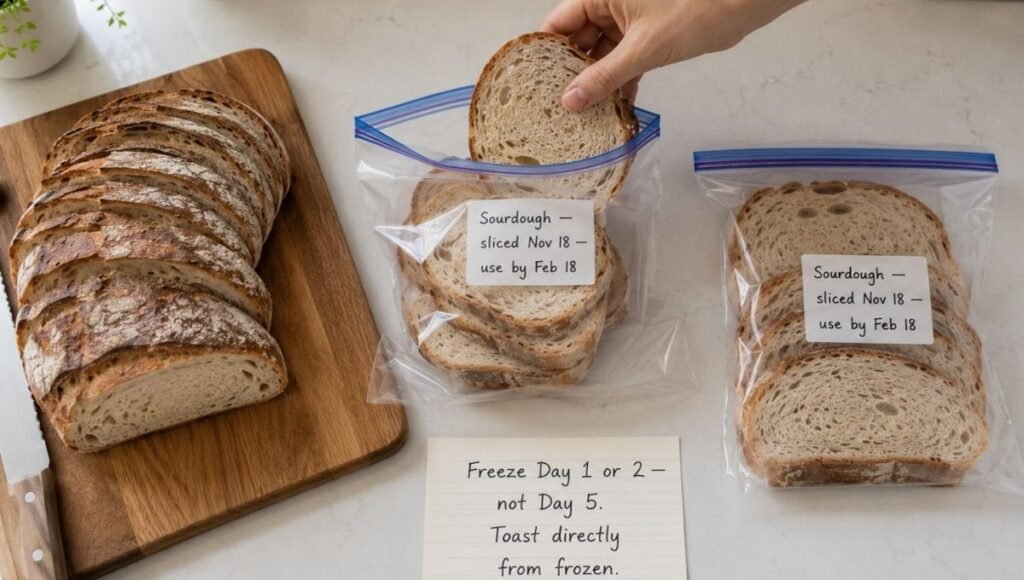
Slice before freezing: Unless you specifically want a whole loaf for a dinner occasion, slice the bread before it goes in the freezer. This lets you take out exactly the number of slices you need without thawing and refreezing.
The wrap: For short-term freezing (under 1 month), a good zip-top freezer bag with air pressed out is sufficient. For longer storage, wrap slices or the loaf in plastic wrap first, then put in a freezer bag. This double layer prevents freezer burn.
Label with date: Bread doesn’t become unsafe in the freezer but quality does decline after a few months. A date label tells you what you have.
Freeze fresh: Freeze on day 1 or 2, not day 5 when the bread is already approaching staleness. Freeze early — not at the last minute. Frozen stale bread tastes the same as fresh stale bread.
How to Use Frozen Bread
Individual slices: Toast directly from frozen. This is genuinely as good as fresh for most sandwich bread and sourdough. The toaster handles the thawing and heating simultaneously.
Whole loaf or large sections: Thaw at room temperature for 1–2 hours, still wrapped (to prevent condensation from forming on the surface, which causes sogginess). Or use the water-and-oven method for artisan bread.
For artisan whole loaves: Run the frozen loaf under cold water for 10–15 seconds, place directly in a 375°F oven for 15–20 minutes. The best way to reheat frozen bread is to briefly run the frozen loaf under cold water before placing it in the oven at 350 or 400 degrees Fahrenheit for 15–20 minutes. The steam from the water rehydrates the crust beautifully.
The Mold Question: What To Do When You Find a Spot
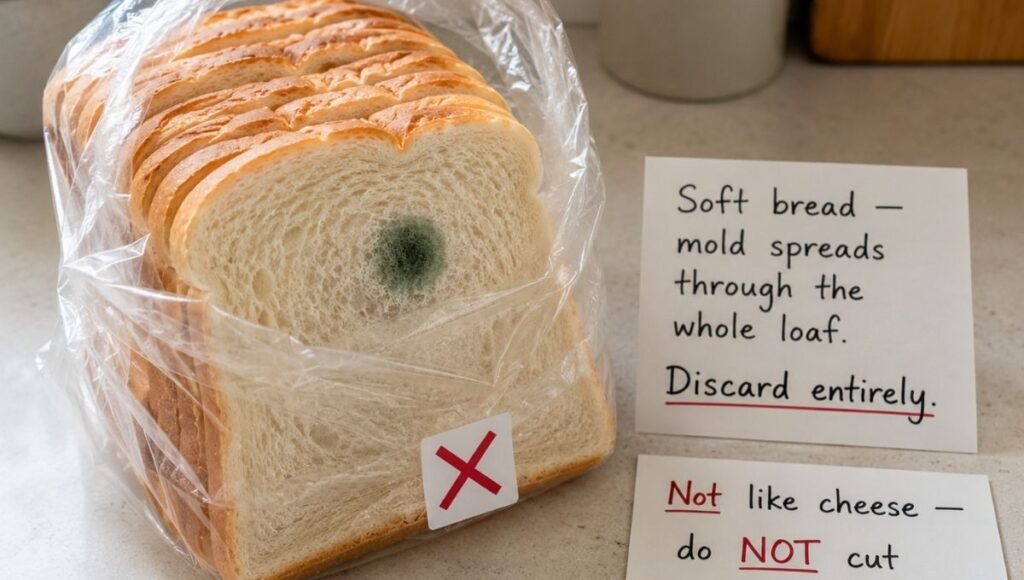
This is the question most bread guides carefully sidestep, so here’s the direct answer.
For soft bread (sandwich bread, brioche, most store-bought sliced bread): Discard the entire loaf when you find mold on any part of it. This is the FDA’s recommendation, and the reason is straightforward: soft bread’s porous, open structure allows mold to spread throughout the loaf even when you can only see it on one spot. The mold has likely penetrated deeper than the visible patch.
For hard, dense bread (very dry artisan loaves, bread that’s quite firm throughout): The FDA’s guidelines for hard cheeses — cut 1 inch around the mold — don’t directly apply to bread, but the principle is closer than with soft bread. If a very dense, dry artisan loaf has a small surface mold spot and the interior is completely dry and firm, cutting around it with a generous margin is lower-risk than doing the same with soft bread. That said, discarding is the safer default.
Why some molds matter:
Some molds produce mycotoxins — toxic compounds that can cause illness. According to USDA food safety guidelines, you cannot tell by looking at mold whether it’s producing toxins. This is why “just cut off the moldy part” is a lower-risk approach for hard cheeses (where mold penetration is limited) but a higher-risk approach for soft bread (where it isn’t).
The honest call: Bread costs $2–$5. It’s not worth the health risk to eat around mold. Discard and buy a new loaf.
Is a Bread Box Worth It? An Honest Assessment
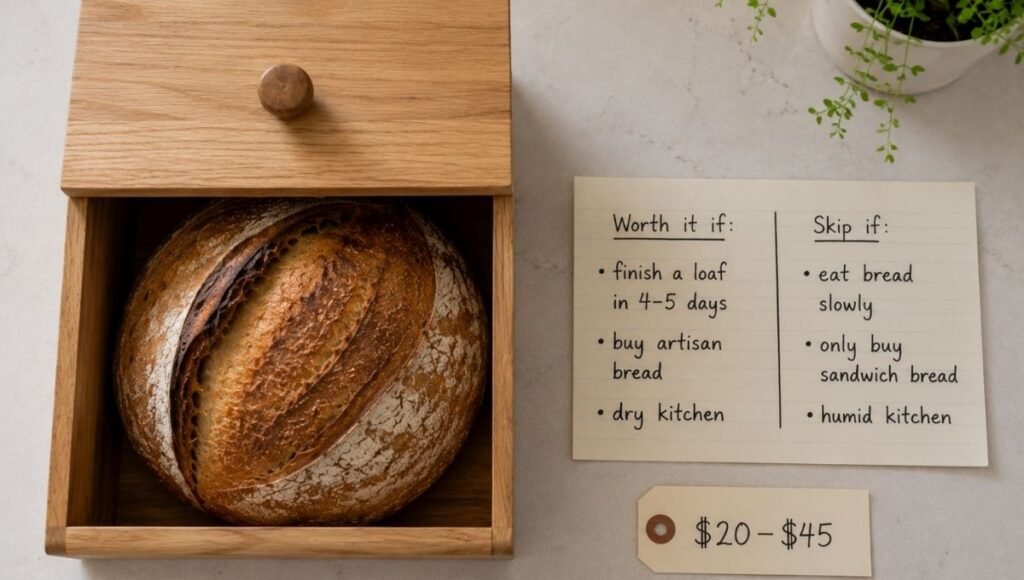
This is a genuine buying decision worth analyzing, because bread boxes cost anywhere from $15 to $80+ and take up counter space.
What a bread box actually does:
A bread box creates a small, enclosed environment where the bread’s own moisture raises the humidity slightly above ambient room air, while the small vents (most bread boxes have them) allow enough airflow to prevent that humidity from reaching mold-promoting levels. The enclosed space also shields bread from kitchen temperature fluctuations and light.
The bread box is worth buying if:
- Your family consistently goes through a loaf within 4–5 days
- You buy artisan or bakery bread that needs breathable storage (not plastic)
- Your kitchen is dry, which causes bread to dry out quickly without any enclosure
- You have counter space for it and would actually use it
The bread box is NOT worth buying if:
- You go through a loaf of bread slowly (more than a week) — in that case, slice and freeze
- You only buy sandwich bread with preservatives that handles plastic bag storage fine
- Your kitchen is humid — a humid kitchen environment makes bread moldy faster, and a bread box may compound this
What type of bread box to consider:
Wood or bamboo bread boxes maintain temperature slightly better than metal and add no condensation. Metal bread boxes look good but can get warm in a sunny kitchen. Ceramic bread crocks (a different shape) work well and seal tightly. Price range $20–$45 is where most worthwhile options sit.
Editor’s take: A bread box makes the most difference for people who buy artisan bread or bake at home. For a family that exclusively buys commercial sandwich bread in plastic bags, a bread box offers minimal additional benefit over just leaving it in the original bag.
How to Revive Stale Bread
Before we get to the guide, the science: staling from retrogradation is partially reversible with heat. When you heat stale bread above 140°F, the re-crystallized starch molecules re-melt and the bread temporarily regains a fresher texture. This is not a permanent fix — the bread will re-stale as it cools — but it’s genuinely effective for immediate use.
Oven method (best for texture): Sprinkle the bread lightly with water. Wrap in aluminum foil. Bake at 375°F for 10–12 minutes. The steam inside the foil rehydrates the crumb while the heat reverses retrogradation. Open the foil for the last 3–5 minutes if you want to crisp the crust.
Microwave method (fastest): Wrap the bread in a lightly damp paper towel. Microwave on medium power for 10–15 seconds. Check and repeat if needed. The revived texture lasts only about 30 minutes before it re-stales, so use this method only if you’re about to eat the bread immediately.
What to do with bread that’s too far gone:
- Breadcrumbs: Pulse in a food processor, freeze in a bag. Use for coating chicken, topping casseroles, making meatballs.
- Croutons: Cube, toss with olive oil and seasonings, bake at 375°F until crisp.
- French toast: Stale bread actually makes better French toast than fresh — it absorbs the egg mixture without falling apart.
- Panzanella (Italian bread salad): Torn stale bread soaked in tomato juices and olive oil. A dish invented specifically for this scenario.
Quick Reference: Bread Storage by Situation
| Situation | Best Storage | How Long |
|---|---|---|
| Eating the bread within 3 days | Room temp, bread box or original bag | 3–5 days |
| Sandwich bread, using slowly | Slice and freeze immediately | 3 months |
| Artisan/sourdough loaf | Bread box or cloth bag | 2–5 days |
| Baguette | Eat same day; freeze for later | Day of, or 4 months frozen |
| Homemade bread | Cloth bag or foil, room temp | 2–3 days |
| Half-loaf leftover | Freeze the half immediately | 3 months |
| Bread going stale | Revive in oven, then use immediately | Same day |
| Bread with any mold (soft) | Discard entire loaf | — |
FAQ
Q: Should you put bread in the refrigerator?
No — for almost all bread types, the refrigerator accelerates staling rather than preventing it. Starch retrogradation (the process that makes bread firm and dry) happens approximately six times faster at refrigerator temperatures than at room temperature. If mold prevention is your concern, the freezer does that job while also preserving quality. The fridge is the worst of both worlds for bread — it doesn’t stop mold as effectively as freezing, and it actively makes bread stale faster.
Q: How do you keep bread fresh for a week?
For sandwich bread with preservatives: room temperature in original packaging is fine for 5–7 days. For artisan or homemade bread: freeze half immediately and use the other half within 2–4 days. No storage method keeps fresh artisan bread with full quality for a full week at room temperature — the freezer is the right tool for anything beyond 4–5 days.
Q: Can you freeze bread and still have it taste fresh?
Yes — when done correctly, frozen bread is far better than refrigerated bread. Slice before freezing, wrap airtight, and toast individual slices directly from frozen. For whole artisan loaves, the water-and-oven method (brief cold water rinse, then bake at 375°F for 15–20 minutes) revives crusty bread remarkably well. The key is freezing while the bread is still fresh, not after it’s already staling.
Q: Is a bread box worth it?
For families who consistently finish a loaf within 4–5 days and buy artisan or bakery bread, yes — a bread box provides better storage conditions than either plastic bags or bare counter storage. For families who use bread slowly or exclusively buy commercial sandwich bread, the value is marginal. Price range of $20–$45 is where most worthwhile options sit.
Q: If there’s mold on one slice of bread, can you eat the rest?
No — for soft bread, discard the entire loaf. Unlike hard cheese, soft bread’s porous structure allows mold to spread throughout the loaf even when only visible on one spot. Some molds produce mycotoxins that can cause illness, and you cannot tell by looking which type is present. The risk of eating around soft bread mold is not proportional to the cost of a new loaf.
Q: How long does sourdough bread last?
Sourdough lasts longer than most bread at room temperature — typically 4–5 days — because its natural acidity (from lactic and acetic acid produced during fermentation) inhibits mold growth. Store in a cloth bag or bread box, cut-side down if unsliced. Sourdough also freezes well for 4–6 months and revives excellently using the water-and-oven method.
The Honest Bottom Line
Keeping bread fresh longer comes down to three corrections for most households: stop putting bread in the refrigerator, start freezing any bread you won’t use within 3–4 days, and discard the entire loaf when you find mold — not just the affected slice.
The fridge mistake is the most common and the most damaging to bread quality. Once you shift to the counter-for-now, freezer-for-later approach, bread waste drops significantly and the quality of what you’re eating improves. A $3 loaf of sandwich bread that gets properly sliced and frozen on day 2 delivers better bread for two weeks than the same loaf deteriorating in the refrigerator door.
For the pantry staples that round out a well-stocked kitchen alongside your bread supply, our pantry staples guide covers everything worth keeping on hand. And for the broader grocery system that reduces waste across all categories, our how to save money on groceries guide connects all of it into a practical weekly approach.
References
- USDA Food Safety and Inspection Service. Molds on Food: Are They Dangerous? — Bread and Bakery Products. fsis.usda.gov
- The Fresh Loaf / Food Science Research. Starch Retrogradation and Bread Storage — Testing Results. thefreshloaf.com
- USDA Food Safety and Inspection Service. Shelf-Stable Food Safety — Bakery Products. fsis.usda.gov
- Musim Mas. 5 Ingredients That Extend the Shelf Life of Bread — Preservative Science. musimmas.com
- USDA Agricultural Research Service. FoodData Central — Bread Nutritional and Safety Data. fdc.nal.usda.gov