
Key Takeaways
- The 3–4 day rule for most cooked leftovers is real science, not overcaution. Bacteria continue to multiply at refrigerator temperatures — just more slowly. By day 4–5, many foods reach bacterial levels that can cause illness even when they look and smell perfectly fine.
- Cooked rice is uniquely dangerous and should be consumed within 1–3 days — not the standard 3–4 days. Bacillus cereus spores survive cooking, germinate as rice cools, and produce heat-stable toxins that reheating cannot destroy.
- Hard-boiled eggs last significantly longer than most people expect — up to 7 days in the shell, 5 days peeled and stored in water. This is one of the best-value refrigerator storage scenarios for meal preppers.
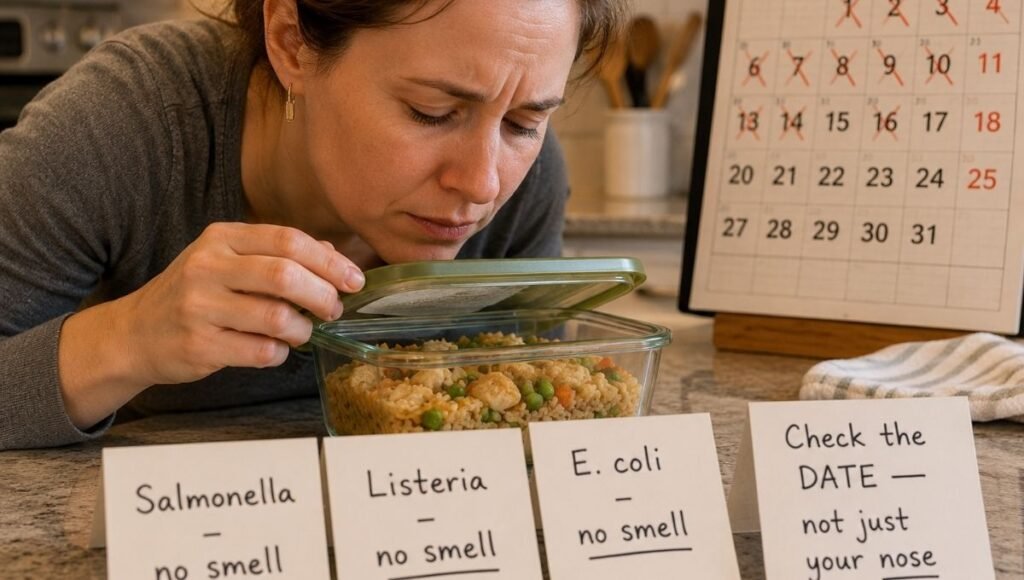
- “It smells fine” is not a safety test. Salmonella, Listeria, and E. coli O157:H7 — three of the most common causes of serious foodborne illness — typically produce no detectable odor at dangerous levels.
- According to the USDA Food Safety and Inspection Service, the two-hour rule is non-negotiable: cooked food left at room temperature for more than 2 hours enters the bacterial danger zone and should be refrigerated or discarded — regardless of how it looks or smells.
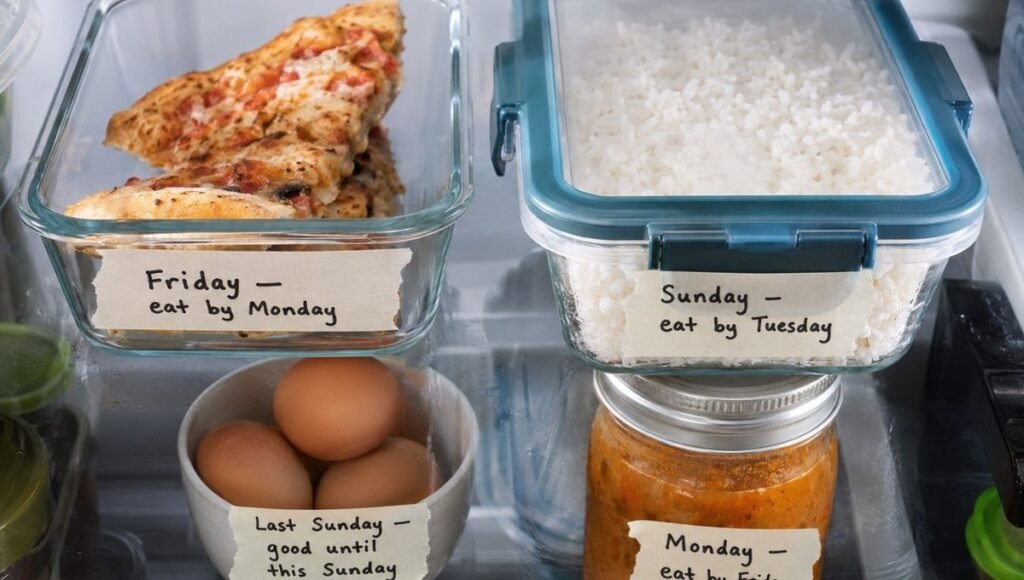
It happens to just about everyone. You open the fridge and do the mental math. The pizza was Friday. Today is Tuesday. That’s… four days? You pick up the box and smell it. Seems fine. You look at the slices. They look totally normal. And now you’re standing there genuinely unsure whether you’re about to have lunch or a problem.
Meanwhile you’ve got leftover soup from Sunday, some hard-boiled eggs you made for meal prep last week, and cooked rice from a stir-fry that might be day 3 or day 4 — you can’t remember exactly. All of it is making you do math you shouldn’t have to do.
The honest answer to most fridge leftover questions isn’t complicated, but it does require knowing a few things that most food safety guides either bury or skip entirely — like why rice is genuinely different from everything else, why the smell test is less reliable than people think, and what “I ate it after 6 days and I’m fine” actually means in terms of risk.
This guide answers every common leftover question in one place, organized by food type, with the specific numbers and the reasoning behind them.
The Rule That Governs Everything: Why 3–4 Days Exists
The 3–4 day rule for cooked leftovers isn’t arbitrary. It’s based on how bacteria behave in refrigerated environments.
Cold temperatures slow bacterial growth but don’t stop it. Bacteria that could double every 20 minutes at room temperature might take hours to double in a properly cold refrigerator. But over 4–5 days, even that slow growth adds up. By day 4–5, many cooked proteins and dairy-containing foods have accumulated enough bacterial load that the risk of illness becomes meaningful — even when nothing looks or smells wrong.
The complicating factor is that home refrigerators aren’t always as cold as they should be. The USDA recommends 40°F or below. Door shelves, frequently-opened fridges, and improperly calibrated refrigerators often run warmer than their settings suggest. The 3–4 day rule assumes ideal conditions. In a warmer-than-optimal fridge, the window is shorter.
The “I ate week-old leftovers and I’m fine” response:
This comes up constantly in food safety discussions, and it deserves an honest answer. Most healthy adults can recover from mild foodborne illness without even recognizing it as food-related — they attribute it to a stomach bug, stress, or something else. And some exposures don’t cause noticeable illness at all, because the bacterial load wasn’t quite high enough that particular time. None of this means the food was safe. It means the outcome was lucky. The risk doesn’t disappear because you’ve gotten away with it before — and the consequences of a serious food poisoning event aren’t trivial, particularly for children, elderly people, pregnant women, or anyone with a compromised immune system.
How Long Do Specific Leftovers Last in the Fridge?
Pizza: 3–4 Days
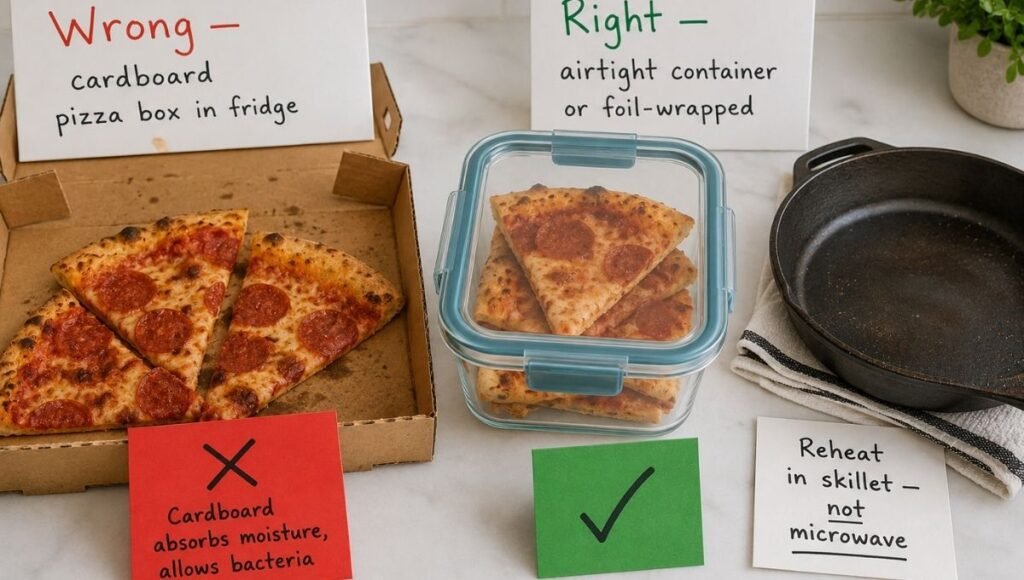
Pizza sits in a uniquely contested zone because it’s such a beloved leftover and because it seems more shelf-stable than it is. According to the USDA and professional food safety researchers, pizza follows the same 3–4 day rule as other cooked foods — even though people routinely eat 5- and 6-day-old pizza without apparent issue.
The risk comes from the toppings, not the crust. Cheese and meat toppings provide exactly the protein-rich, moisture-present environment that bacteria like Staphylococcus aureus thrive in. Vegetarian pizzas have slightly more margin. Heavy-meat pizzas have slightly less.
The storage method that most people get wrong: Leaving pizza in the delivery box in the fridge. The cardboard absorbs moisture from the pizza while allowing airflow that dries the crust unevenly and introduces environmental bacteria. Transfer pizza slices to an airtight container or wrap each slice in foil or plastic wrap within 2 hours of ordering or cooking.
Reheating: The skillet method produces the best result — place slices in a skillet over medium heat, add a few drops of water around the edges, cover with a lid for 2–3 minutes. The steam restores moisture to the toppings while the pan crisps the crust. Better than any microwave method and better than the oven for 1–2 slices.
Freezer option: Pizza freezes well for 1–2 months. Wrap individual slices tightly in foil or plastic wrap, freeze in a bag. Reheat from frozen in a 375°F oven for 10–12 minutes.
Hard-Boiled Eggs: 7 Days (Shell On) / 5 Days (Peeled)
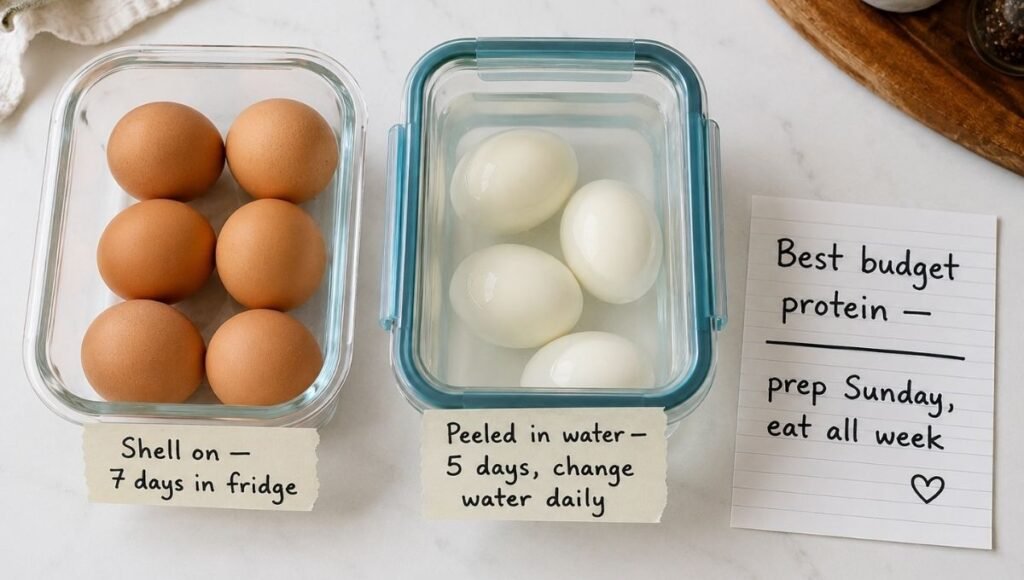
Hard-boiled eggs last significantly longer than most people expect — and significantly shorter than raw eggs in the shell. The cooking process destroys the natural antimicrobial coating on the egg white and shell, and removes the membrane just inside the shell that helps protect raw eggs from bacterial entry.
In shell: Up to 7 days refrigerated. Keep in the original carton or an airtight container. The shell provides some protection against absorbing refrigerator odors (eggs are notoriously smell-absorbent through their porous shells).
Peeled: Up to 5 days, stored submerged in a bowl of cold water in an airtight container. Change the water daily. Without the shell, peeled eggs dry out and develop an unpleasant rubbery surface within a day or two without water storage.
The meal prep math: Hard-boiled eggs prepped on Sunday last until Friday in the shell — making them one of the most practical meal prep proteins available. At $3–$4 per dozen at Aldi or Walmart, they’re also one of the cheapest protein sources per serving.
How to tell if a hard-boiled egg has gone bad: The sulfurous smell is unmistakable if it has. A hard-boiled egg that smells fine when you peel it is almost always safe to eat. If there’s any greenish ring around the yolk — this is harmless iron sulfide from the cooking process, not spoilage.
Cooked Rice: 1–3 Days (Not 3–4)
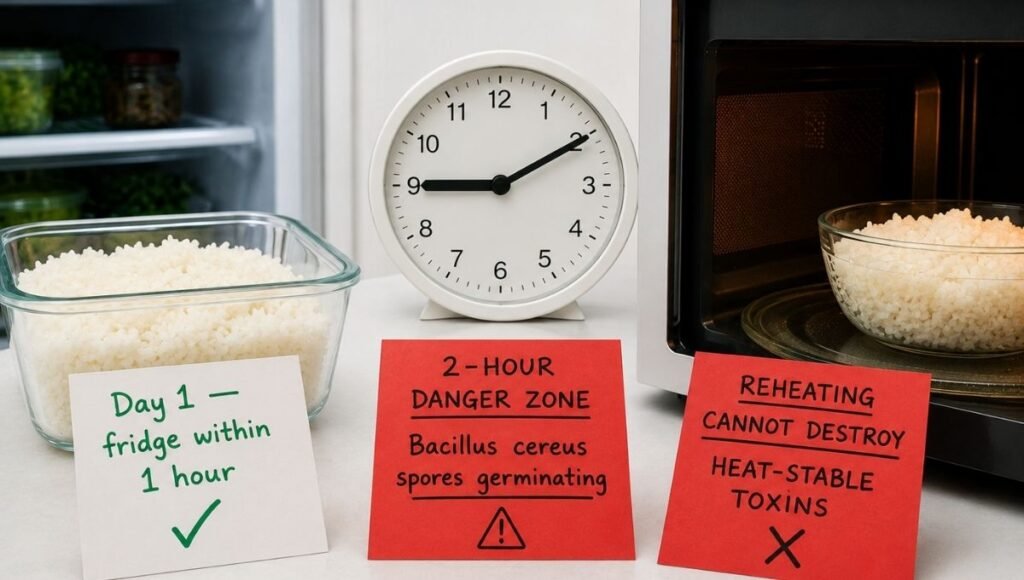
This is the food that gets its own warning, because it’s genuinely different from everything else in the fridge, and most people don’t know why.
Bacillus cereus is a spore-forming bacterium naturally present in raw rice. Boiling and steaming kill the active bacteria but not the spores. When cooked rice cools, those spores germinate and bacteria multiply — particularly rapidly between 40°F and 140°F. Once established, B. cereus produces toxins, and here’s the critical part: those toxins are heat-stable. Reheating the rice to 165°F kills any remaining live bacteria but does absolutely nothing to the toxins that have already been produced.
This is why “just reheat it really well” doesn’t apply to rice the way it does to other foods. The threat isn’t the bacteria in reheated rice — it’s the toxins that cooking can’t touch.
What this means practically:
- Refrigerate rice within 30–60 minutes of cooking (shorter window than most foods)
- Use or freeze within 3 days maximum
- Rice left at room temperature for more than 2 hours should be discarded — not reheated
- If you’re meal prepping rice for the week, freeze Thursday and Friday’s portions on Sunday
Reheating cooked rice: Add 1–2 tablespoons of water per cup of rice before microwaving, cover tightly, and reheat on medium power. The added water restores the moisture the rice absorbed during refrigeration and prevents the hard, dry texture most people associate with reheated rice.
Soup and Stew: 4–5 Days
Soup and stew last slightly longer than most other cooked foods because of how they’re made — brought to a full boil, which creates a clean bacterial starting point, and the acidic and salty liquid environment is less hospitable to bacterial growth than exposed protein surfaces.
The caveat: Soup containing seafood follows a shorter timeline — 2–3 days maximum. Fish and shellfish proteins support bacterial growth significantly faster than chicken or beef.
Storage: Let soup cool to room temperature (within 2 hours) before refrigerating — divide large pots into smaller containers to cool faster. Soup in a large pot takes a long time to cool in the center, creating warm conditions that accelerate bacterial growth even in the refrigerator. A large pot of soup left in the fridge can stay dangerously warm in the middle for hours.
Freezing: Soup and chili freeze excellently for 4–6 months. This is one of the highest-value batch cooking strategies available — making a double batch on Sunday and freezing half produces future dinners with almost no additional effort.
Cooked Pasta: 3–5 Days
Plain cooked pasta (no sauce) lasts up to 5 days in an airtight container. Pasta dishes with protein — meat sauce, chicken pasta, seafood pasta — follow the shorter timeline of the protein component. A pasta with shrimp lasts 2 days. A pasta with ground beef lasts 3–4 days.
Storage tip: Toss plain cooked pasta with a small amount of olive oil before refrigerating to prevent the noodles from sticking together. Without this, cold pasta becomes a single clump that doesn’t separate well even after reheating.
Reheating: Add a small splash of water and reheat in a covered pan on the stovetop, or in a covered microwave-safe dish on medium power. The added moisture restores what the pasta absorbed during refrigeration.
Garlic: How Long Does It Last?
Raw garlic shelf life varies significantly by form:
Whole head, unpeeled: 3–5 months at room temperature in a cool, dark, ventilated location. This is the best storage method — the papery skin protects the cloves from moisture and airflow.
Individual cloves, unpeeled: 3 weeks at room temperature; 1–2 months refrigerated.
Peeled cloves: 1 week refrigerated in an airtight container. Peeled garlic deteriorates significantly faster because the protective skin is removed and the clove surface is exposed.
Minced or chopped garlic: 1 week refrigerated in an airtight container, or up to 3 months submerged in olive oil and refrigerated (the oil provides an oxygen barrier).
Garlic in olive oil at room temperature: Do not store garlic in oil at room temperature — this creates an anaerobic (oxygen-free) environment that can support Clostridium botulinum growth, which produces botulinum toxin. Always refrigerate garlic-in-oil preparations and use within 1–2 weeks.
How Long Do Mushrooms Last in the Fridge?
Raw mushrooms: 5–7 days, stored in a paper bag (never sealed plastic). Mushrooms need to breathe — sealed plastic traps moisture and causes sliminess within 1–2 days. The paper bag absorbs excess moisture while allowing air circulation.
Cooked mushrooms: 3–5 days in an airtight container.
Signs they’ve gone bad: Slimy surface (discard), excessive darkening beyond normal browning, strong unpleasant odor. Slightly wrinkled or dried mushrooms are safe for cooked applications even if they don’t look great raw.
Deli Meat: 3–5 Days After Opening
Unopened deli meat follows the sell-by date closely. Once opened, use within 3–5 days regardless of the remaining time on the package — opening introduces bacteria from the air and surfaces.
Deli meat requires special attention because Listeria monocytogenes can grow at refrigerator temperatures — unlike most foodborne pathogens, which need warmer conditions to multiply. This is why deli meat is specifically flagged as a high-risk food for pregnant women, elderly individuals, and immunocompromised people, who should heat deli meat to steaming (165°F) before eating.
Smell test limitation: Listeria contamination produces no detectable odor. Deli meat that smells perfectly normal can still be contaminated. The date and the storage window matter more than your nose for this particular food.
Yogurt: 1–2 Weeks After Opening
Unopened yogurt can last 2–3 weeks past its sell-by date when refrigerated — the acidity created by the live cultures creates a naturally preservative environment. Once opened, 1–2 weeks is the practical window.
Signs it’s gone: Mold (any color — discard the entire container), extremely watery with separation beyond what’s normal (small amounts of whey separation are normal — stir it back in), or a yeasty/unpleasant smell distinctly different from normal yogurt tang.
Greek yogurt vs. regular yogurt: Greek yogurt’s lower moisture content and higher acidity give it a slightly longer effective shelf life. Both follow the same general guidelines.
Soup Left Out Overnight: What to Do
This question comes up regularly: you made soup, forgot to put it in the fridge before bed, and found it on the stove in the morning. What now?
The honest answer: discard it. Soup that has been at room temperature for more than 2 hours — and overnight almost certainly means 8+ hours — has been in the bacterial danger zone long enough for significant growth to have occurred. Reboiling the soup kills the bacteria, but doesn’t neutralize toxins that Staphylococcus aureus or Bacillus cereus may have already produced. The visual and smell inspection won’t tell you whether these toxins are present.
This is one of the more painful food safety calls because soup takes time and ingredients to make. But the risk is real and not worth taking, particularly for children and elderly household members.
The Complete Leftover Fridge Life Reference Table
| Food | Fridge (days) | Freezer | Key Notes |
|---|---|---|---|
| Pizza | 3–4 | 1–2 months | Transfer from box to airtight container |
| Hard-boiled eggs (shell) | 7 | Not recommended | Best meal prep protein for the week |
| Hard-boiled eggs (peeled) | 5 | Not recommended | Store submerged in water |
| Cooked rice | 1–3 | 1 month | Freeze early; reheating can’t fix toxins |
| Soup or stew (no seafood) | 4–5 | 4–6 months | Divide into small containers to cool fast |
| Seafood soup or stew | 2–3 | 3 months | Shorter window — use early in week |
| Cooked pasta (plain) | 3–5 | 2 months | Toss with oil before storing |
| Pasta with meat sauce | 3–4 | 3 months | Protein sets the timer |
| Cooked chicken | 3–4 | 4 months | Thighs reheat better than breasts |
| Cooked ground beef | 3–4 | 3–4 months | Freeze excess immediately |
| Deli meat (opened) | 3–5 | 1–2 months | Listeria risk — heat if high risk person |
| Raw mushrooms | 5–7 | Not recommended | Paper bag only — never sealed plastic |
| Cooked mushrooms | 3–5 | Not recommended | Use early in week |
| Yogurt (opened) | 7–14 | Not recommended | Acidity extends window |
| Whole garlic (unpeeled) | 3–5 months (room temp) | Not needed | Best stored in pantry |
| Minced garlic | 7 (fridge) | 3 months | Never room temp in oil |
FAQ
Q: Is it safe to eat pizza that’s been in the fridge for 5 days?
According to USDA food safety guidelines, 3–4 days is the recommended window. Day 5 is beyond the standard safe window for pizza with cheese and meat toppings. Even if it looks and smells fine, bacteria may be present at levels that can cause illness. The smell test is not a reliable safety indicator for most foodborne pathogens. If it’s day 4 and you’re questioning it, reheat to 165°F and eat it. If it’s day 5 or beyond, the safer call is to discard.
Q: Why does cooked rice go bad faster than other leftovers?
Because of Bacillus cereus — a spore-forming bacterium whose spores survive cooking. As rice cools, the spores germinate and multiply, producing heat-stable toxins that reheating cannot destroy. This makes rice one of the higher-risk leftover foods, and why the USDA recommends consuming it within 1–2 days (some sources say up to 3). Refrigerate rice within 1 hour of cooking and freeze any portions you won’t eat within 3 days.
Q: How long are hard-boiled eggs good for in the fridge?
Hard-boiled eggs in the shell: up to 7 days. Peeled: up to 5 days, stored submerged in cold water (change the water daily). Hard-boiled eggs are one of the best-value meal prep proteins for this reason — prepped Sunday, they last the entire workweek.
Q: Can leftovers make you sick if they smell fine?
Yes. The most dangerous foodborne pathogens — Salmonella, Listeria, E. coli O157:H7, and Bacillus cereus toxins — typically produce no detectable odor at levels that cause illness. The smell test identifies obvious spoilage from yeasts and some bacteria, but it’s not a reliable indicator of pathogen safety. The date the food was stored is a more reliable guide than your nose.
Q: How long does homemade soup last in the fridge?
4–5 days for most meat-based soups, 2–3 days for seafood-based soups. Cool quickly by dividing into smaller containers before refrigerating — a large pot stays dangerously warm in the center for hours even in a cold fridge. Soup freezes excellently for 4–6 months.
Q: How long does deli meat last after opening?
3–5 days. Once opened, deli meat should be consumed within this window regardless of the remaining package sell-by date. Listeria monocytogenes is a specific concern with deli meat because it can grow at refrigerator temperatures — making it higher-risk than most other foods. Pregnant women, elderly people, and immunocompromised individuals should heat deli meat to 165°F before eating.
The Honest Bottom Line
Most of the fridge leftover questions people Google every week — is this pizza still okay, what about this rice, can I eat these eggs — have clear, specific answers that don’t require guesswork. The standard 3–4 day rule covers most cooked proteins and dishes. Rice is the exception that needs a shorter window. Hard-boiled eggs are the exception that earns a longer one. And “it smells fine” is less useful than knowing when something was cooked.
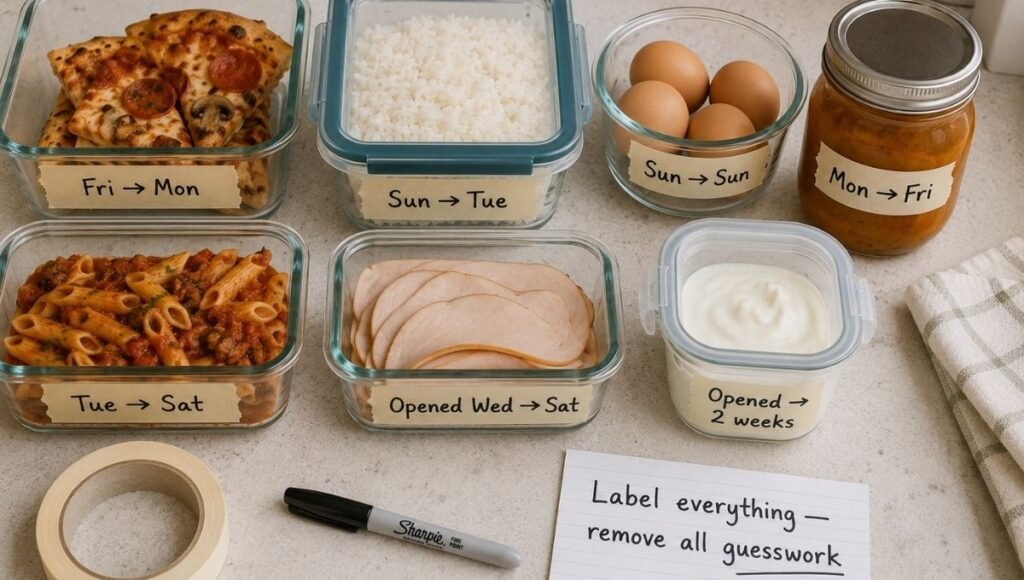
The habit that eliminates most of this uncertainty: label everything with the date it was cooked before it goes into the fridge. Masking tape and a marker. Five seconds per container. Removes all the mental math and guesswork — and the guesswork is what leads to either throwing away perfectly good food or eating something that’s genuinely past its window.
For the complete system of building a kitchen that wastes less and costs less — including how to shop smarter, what to freeze, and how to make one grocery run cover a full week — our how to save money on groceries guide connects all of it. And for the pantry staples that fill the gaps when leftovers run out, our pantry staples guide is the natural next step.
References
- USDA Food Safety and Inspection Service. Leftovers and Food Safety — Storage Times. fsis.usda.gov
- FoodSafety.gov. Cold Food Storage Chart — Refrigerator and Freezer Storage Times. foodsafety.gov
- Centers for Disease Control and Prevention. Listeria (Listeriosis) — Foods That Can Cause Listeriosis. cdc.gov
- USDA Agricultural Research Service. Bacillus cereus Food Safety Information. ars.usda.gov
- FDA Center for Food Safety and Applied Nutrition. Refrigerator and Freezer Storage Chart. fda.gov