
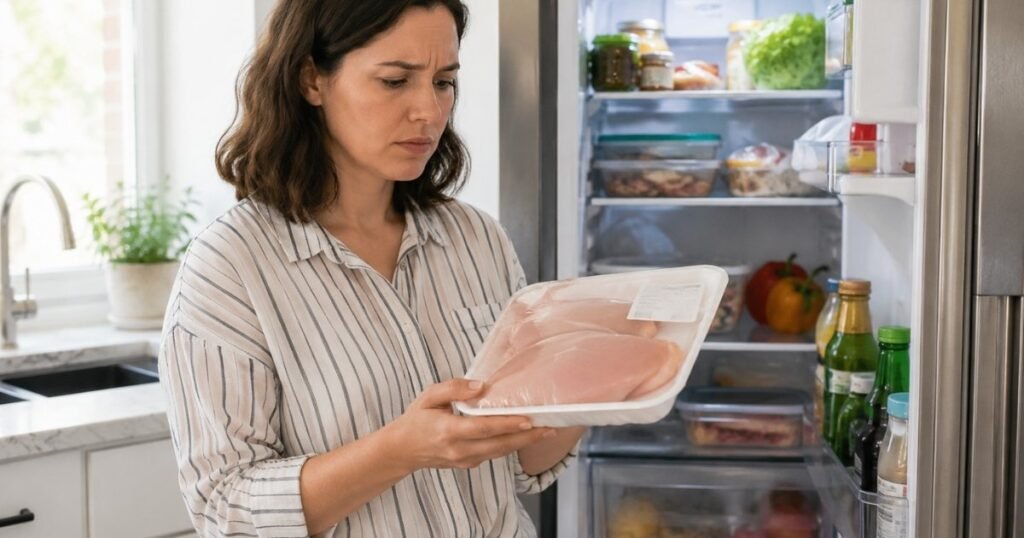
Standing in front of the fridge, holding a package of chicken and wondering, “Is this still safe to eat?” It’s a question almost every home cook has asked. If you’ve ever searched how to tell if chicken is bad, you’re not alone. I’ve had moments where the chicken smelled a little different after opening the package, and I wasn’t sure whether I was being overly cautious or about to waste perfectly good food.
The truth is, there’s no single test that gives you the answer. A slight odor when you first open the package can be normal, color changes aren’t always a sign of spoilage, and the sell-by date doesn’t tell the whole story. Looking at only one clue is how people end up throwing away perfectly good chicken—or, even worse, cooking chicken that should have been tossed.
In this guide, you’ll learn a simple four-step method—Look, Smell, Feel, and Time—to confidently decide whether raw chicken, cooked leftovers, or frozen chicken is still safe to eat. You’ll also find practical storage tips that help your chicken stay fresh longer, so you can waste less food and feel more confident every time you open the fridge.
Overview: The Quick Answer
To tell if chicken is bad, check four things together: smell (sour or ammonia-like means spoiled), texture (slimy, not just moist), color (gray or greenish tints, not just pale pink), and time (raw chicken is good for 1–2 days in the fridge, cooked chicken for 3–4 days). If two or more of these signs point to spoilage, don’t risk it.
No single sign is enough on its own — smell can be misleading right out of vacuum-sealed packaging, and color can vary naturally between cuts. It’s the combination of signs, plus how long the chicken has actually been stored, that gives you a reliable answer.
As always: when in doubt, throw it out. Chicken is inexpensive relative to the risk of foodborne illness, and it’s never worth the gamble to save a few dollars.
30-Second Chicken Safety Check
| Check | Fresh Chicken | Spoiled Chicken |
|---|---|---|
| Smell | Mild or no strong odor | Sour, sharp, or ammonia-like |
| Texture | Slightly moist/wet | Slimy or sticky film |
| Color | Pink to pale pink, white fat | Gray, greenish, or dull |
| Time (raw, fridge) | Within 1–2 days | Past 2 days |
| Time (cooked, fridge) | Within 3–4 days | Past 4 days |
If it fails two or more of these checks, toss it. If it only shows one mild sign — like a faint smell that fades after airing out — it’s usually worth a closer look before deciding.
How to Tell If Raw Chicken Is Bad: Check These 4 Signs Together
I’ve opened a package that smelled a little unusual at first, only to find it disappeared after a minute. Other times, chicken looked perfectly normal but had been sitting in the fridge far too long. That’s why it’s important to check smell, texture, color, and storage time together before deciding whether it’s safe to cook or time to throw it away.
What Fresh Chicken Should Smell Like
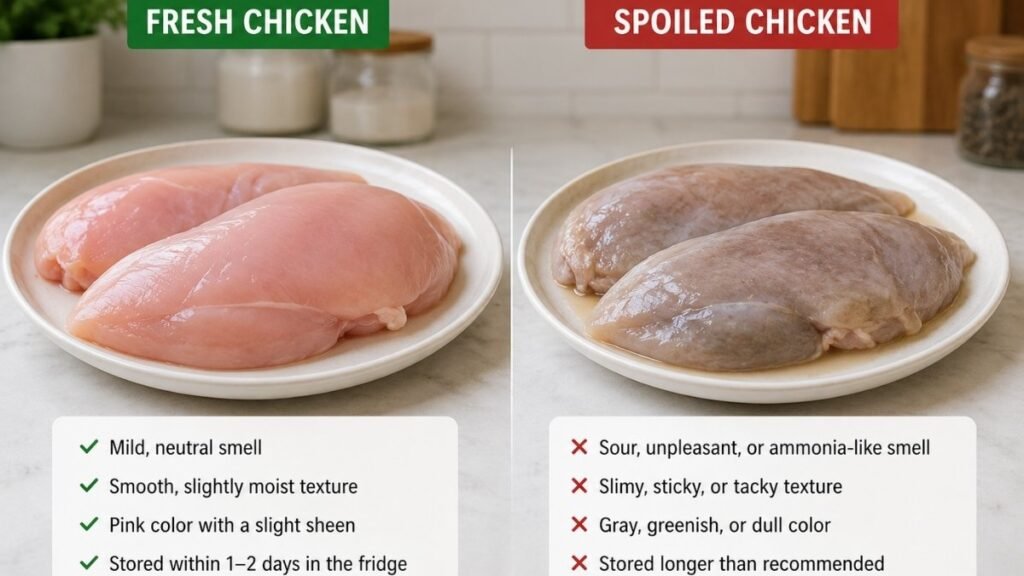
Fresh raw chicken has a very mild smell, sometimes almost no smell at all. It should never smell sharp, sour, or unpleasant. If something smells “off” the moment you open the package, that’s worth paying attention to — but it’s not automatically a dealbreaker on its own, which brings us to a common source of confusion.
Why Vacuum-Sealed Chicken May Smell Strange
It’s surprisingly common for chicken straight out of vacuum-sealed packaging to have a faint sulfur-like or slightly odd smell that has nothing to do with spoilage. This happens because the packaging process limits airflow, and that smell typically fades within a minute or two of exposure to air. A good practice: if the smell disappears after letting the chicken sit uncovered for a couple of minutes, it was very likely just packaging odor, not spoilage.
Wet vs. Slimy Chicken
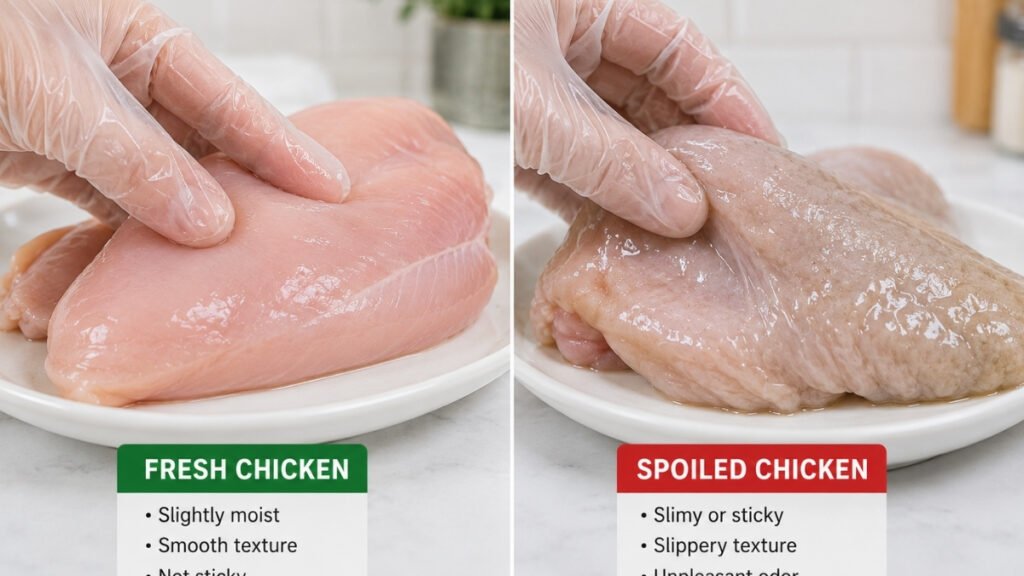
Raw chicken is naturally a little wet or tacky — that’s normal moisture, not a warning sign. What you’re actually checking for is a slimy, sticky film that clings to your fingers and doesn’t rinse off easily. That distinct sliminess, not simple wetness, is the real red flag.
Normal Color Changes vs. Spoilage
Raw chicken color can range from pale pink to a slightly deeper pink depending on the cut and how it was processed — this variation alone doesn’t mean anything is wrong. What does matter is a shift toward gray, greenish, or notably dull coloring, especially if it appears alongside a bad smell or slimy texture.
Yellow fat, by the way, is usually completely normal — it often just reflects what the chicken was fed and isn’t a spoilage indicator on its own.
Fresh Raw Chicken vs. Spoiled Raw Chicken
| Sign | Fresh Raw Chicken | Spoiled Raw Chicken |
|---|---|---|
| Smell | Mild, fades quickly if from packaging | Sour, sharp, doesn’t fade |
| Texture | Slightly wet/tacky | Slimy, sticky film |
| Color | Pink to pale pink | Gray or greenish |
| Fat | May appear yellowish (normal) | Discolored alongside meat |
Look • Smell • Feel Checklist
- [ ] Let the chicken sit uncovered for 1–2 minutes before judging the smell
- [ ] Check for a slimy film versus normal moisture
- [ ] Look for gray or green tints, not just natural pink variation
- [ ] Confirm how many days it’s been stored in the fridge
- [ ] If two or more signs point to spoilage, discard it
One thing I’ve learned is not to judge chicken the second I open the package. A slight odor from the packaging or a little extra moisture can be completely normal. Let the chicken sit for a minute before deciding—it has saved me from throwing away perfectly good chicken more than once.
How to Tell If Cooked Chicken Is Bad: 5 Signs It’s Time to Throw It Out
Cooked chicken is considered safe in the fridge for 3 to 4 days, and after that window, even chicken that looks and smells fine is a risk not worth taking.
Beyond the general timeline, watch for the same core spoilage signs: a sour smell, visible mold (fuzzy spots or unusual discoloration), or a slimy texture on the surface. Any one of these on cooked chicken is reason enough to discard it, since cooked chicken tends to spoil in more obvious ways than raw chicken does.
One important thing to understand: reheating doesn’t reset the clock. Warming spoiled chicken back up doesn’t make it safe again — it may even make certain bacterial toxins more concentrated, not less. If leftover chicken has been in the fridge longer than 4 days, reheating won’t rescue it.
Cooked Chicken Leftover Check
- [ ] Has it been in the fridge longer than 3–4 days? → Discard
- [ ] Any sour or unusual smell? → Discard
- [ ] Any visible mold or discoloration? → Discard
- [ ] Slimy surface film? → Discard
- [ ] Was it labeled with the date it was cooked? → Helps you decide faster next time
It’s a familiar scene in a lot of kitchens: a container of cooked chicken gets pushed to the back of the fridge behind other leftovers and forgotten for the better part of a week. Labeling containers with the date you cooked them — even just with a piece of masking tape — takes a few seconds and removes all the guesswork later.
If you’re regularly cooking chicken in batches for the week, it’s worth reading through how long cooked chicken lasts in the fridge in more detail, since portion size, container type, and cooling speed can all shift that window slightly.
How to Tell If Frozen Chicken Is Bad or Just Has Freezer Burn
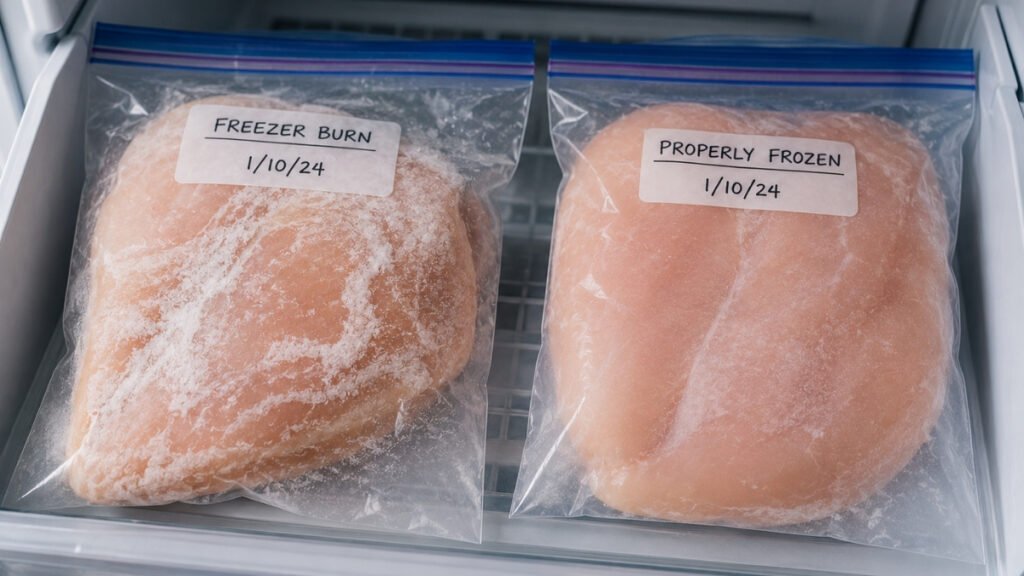
I’ve found freezer-burned chicken that’s perfectly safe to cook—it just wasn’t as juicy or flavorful as usual. If there are no signs of spoilage, freezer burn is mostly a quality issue rather than a food safety concern.
Freezer burn shows up as dry, grayish-brown patches or ice crystals on the surface of the chicken, caused by air exposure inside the freezer. It happens gradually over time, especially in bags that weren’t sealed tightly. It looks concerning, but it’s really more of a quality issue than a safety one.
Actual spoilage in frozen chicken is rare, since freezing halts bacterial growth almost entirely. But it’s not impossible — if chicken was already starting to spoil before it was frozen, or if it’s been thawed and refrozen improperly, it can still pose a risk once thawed.
Freezer Burn vs. Spoiled Frozen Chicken
| Sign | Freezer Burn | Spoiled Frozen Chicken |
|---|---|---|
| Appearance | Dry, grayish-white patches, ice crystals | Discoloration throughout, not just surface patches |
| Smell (after thawing) | Normal, mild | Sour or off-smelling |
| Safety | Safe to eat, quality reduced | Not safe to eat |
| Cause | Air exposure in freezer | Spoilage before freezing or improper thawing/refreezing |
Freezer-burned chicken is genuinely still useful — it’s just not the best candidate for a dish where texture matters, like a pan-seared chicken breast. It works well in soups, stews, or shredded dishes where the slightly drier texture and minor flavor changes go unnoticed. Trimming off the affected areas before cooking also helps.
Safe thawing basics: Thaw chicken in the refrigerator, in cold water (changed every 30 minutes), or in the microwave if cooking immediately after — never on the counter at room temperature. And remember: freezing pauses bacterial growth, it doesn’t kill bacteria, so chicken should go into the freezer while it’s still fresh, not as a last resort.
How Long Does Chicken Last in the Fridge?
Raw chicken lasts about 1 to 2 days in the fridge, cooked chicken lasts 3 to 4 days, and most chicken keeps well in the freezer for 9 months to a year — but the type of chicken and how it’s stored both affect these numbers.
| Chicken Type | Fridge | Freezer |
|---|---|---|
| Raw chicken (whole) | 1–2 days | Up to 1 year |
| Raw chicken (pieces) | 1–2 days | 9 months |
| Ground chicken | 1–2 days | 3–4 months |
| Cooked chicken | 3–4 days | 4 months |
| Thawed chicken (raw) | Cook within 1–2 days | Don’t refreeze raw |
Keep your refrigerator at or below 40°F (4°C) — this single detail affects every timeline in the table above. A fridge that runs even a few degrees warm shortens how long chicken realistically stays safe, regardless of what the label says.
For a broader sense of how chicken compares to other proteins and pantry staples, it’s worth checking a general guide on how long food lasts in the fridge, especially if you’re trying to plan a week’s worth of meals around what needs to be used first.
Labeling chicken with the date you bought it, thawed it, or cooked it is a small habit that removes almost all the guesswork later — instead of trying to recall “was that Tuesday or Wednesday,” the answer is right there on the container.
Can You Trust the Sell-By Date? Here’s What Really Matters
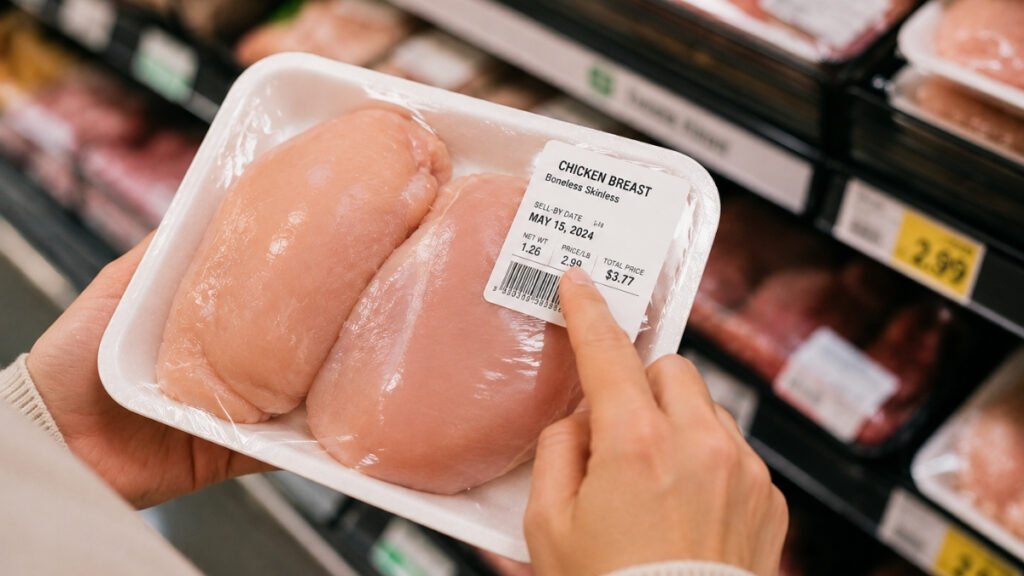
I’ve looked at a package of chicken that’s one day past the sell-by date and wondered if it needed to be thrown away. The date alone doesn’t always give you the answer. If the chicken has been stored properly, it’s often more important to check the smell, texture, and color before deciding whether it’s still safe to cook.
Sell-By vs. Use-By vs. Best-By
| Date Type | What It Means | Trust It for Safety? |
|---|---|---|
| Sell-By | Tells the store how long to display the item | No — it’s inventory guidance |
| Use-By | Manufacturer’s estimate of peak quality | Close, but not absolute |
| Best-By | Similar to use-by, focused on flavor/quality | No |
Because chicken spoils faster than many other meats, it’s worth being a bit more cautious here than you might be with something like unopened bacon. If chicken is past its date and shows any spoilage signs, don’t take the risk — but a date that passed yesterday, on chicken that still checks out on smell, texture, and color, isn’t automatically unsafe.
Discount Chicken Buying Checklist
- [ ] Check the package for leaks, tears, or excess liquid
- [ ] Confirm the package feels cold, not warm or room temperature
- [ ] Plan to cook or freeze it the same day if it’s discounted for quick sale
- [ ] Smell and inspect it again once home, before cooking
- [ ] Avoid packages with a strong odor already noticeable through the wrap
“Manager’s Special” or markdown chicken can be a genuinely good deal — it’s often discounted simply because the sell-by date is approaching, not because anything is wrong with it. The key is committing to cook or freeze it that same day, rather than letting it sit in the fridge for several more days on top of an already-close date.
Can Cooking Bad Chicken Make It Safe?
No — cooking chicken thoroughly kills many bacteria, but it does not reverse spoilage or destroy all the toxins that spoiled chicken may already contain. Some bacteria produce heat-resistant toxins that survive cooking even at safe internal temperatures.
Cooking chicken to an internal temperature of 165°F (74°C) is what makes fresh, unspoiled chicken safe to eat — this is a food safety standard, not a spoilage cure. It confirms that harmful bacteria present in normal, properly handled raw chicken have been killed. It does nothing to fix chicken that was already spoiled going into the pan.
This is also why tasting a small bite of chicken that seems questionable is never a safe way to check — some contaminants aren’t detectable by taste, and the risk isn’t worth it under any circumstance.
How to Buy, Store, and Freeze Chicken to Keep It Fresh Longer
Choosing fresh chicken at the store, getting it into the fridge or freezer as soon as you get home, and freezing it in meal-sized portions before you forget about it.
Buy Smart
- Check that packaging is intact, cold, and free of excess liquid pooling inside.
- Match the package size to what your household will realistically use fresh within a day or two — a large family pack isn’t a deal if half of it gets forgotten.
- Buy discounted “quick sale” chicken only if you can cook or freeze it that same day.
Store It Correctly
- Keep raw chicken on the bottom shelf of the fridge, in its own container, so juices can’t drip onto other food.
- Never rinse raw chicken before cooking — this doesn’t remove bacteria and actually risks splashing it around your sink and countertops.
- Use raw chicken within 1–2 days, or freeze it immediately if you won’t get to it in time.
Freeze by Meal Portions
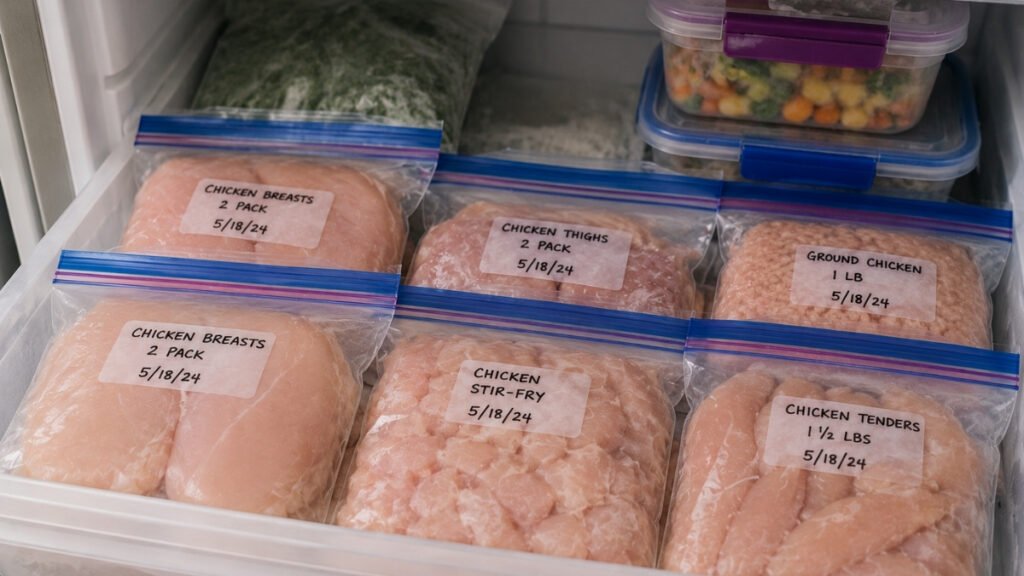
- Divide chicken into portions sized for a single meal before freezing, rather than freezing one large block.
- Press out as much air as possible from freezer bags, or use a vacuum sealer for longer storage.
- Label each portion with the date it was frozen.
- Thaw in the fridge overnight, or use the cold-water method if you’re short on time.
Bulk Chicken Storage Checklist
- [ ] Portion chicken into meal-sized amounts immediately after buying
- [ ] Remove excess air before freezing
- [ ] Label with the freeze date
- [ ] Store raw chicken on the bottom shelf, never in the door
- [ ] Thaw in the fridge, not on the counter
- [ ] Cook or freeze discounted chicken the same day
A family-sized value pack of chicken thighs can look like a great deal per pound — and it usually is, but only if it actually gets used. Portioning and freezing it the same day you bring it home is what turns that bulk discount into real savings instead of eventual freezer waste. This is one of the simplest ways to save money on groceries without changing what you’re actually buying — just how you handle it once you’re home.
Frequently Asked Questions
What is raw chicken supposed to smell like when it is fresh? Fresh raw chicken has little to no smell, or at most a very mild, faintly meaty odor. It should never smell sour, sharp, or unpleasant. Any strong odor that lingers after airing the chicken out for a minute or two is worth taking seriously.
Why does fresh raw chicken smell weird right after opening the package? This is usually just packaging odor from the vacuum-sealing process, not spoilage. Let the chicken sit uncovered for a minute or two — if the smell fades, it was very likely harmless. If it persists or gets stronger, treat it as a warning sign.
How can you tell the difference between normal wet chicken and slimy spoiled chicken? Normal chicken feels slightly moist or tacky, while spoiled chicken feels distinctly slimy or sticky, with a film that clings to your fingers and doesn’t rinse off easily. If it feels notably different from what you’re used to, trust that instinct.
Does thoroughly cooking spoiled chicken kill the bacteria and make it safe to eat? No. Cooking to 165°F kills many bacteria in fresh chicken, but it doesn’t reverse spoilage or eliminate certain heat-resistant toxins that spoiled chicken may already contain. Never cook chicken you already suspect is spoiled.
What color changes indicate that raw chicken has gone bad? Watch for gray, greenish, or notably dull coloring — not the normal range of pink to pale pink that raw chicken naturally has. Color changes combined with a bad smell or slimy texture are the clearest signs of spoilage.
How long can raw chicken stay in the fridge before it goes bad? Raw chicken is generally safe for 1 to 2 days in the refrigerator. If you won’t cook it within that window, freezing it right away is the better option rather than letting it sit longer.
What should you do if raw chicken still smells slightly off after airing it out? If the smell doesn’t improve after a couple of minutes of air exposure, it’s best to treat that as a genuine warning sign rather than assuming it’s just packaging odor. Combine it with a check of texture and color before deciding, and when in doubt, discard it.
Is raw chicken still good to eat a day or two past the sell-by date? It can be, if it’s been stored properly and passes the smell, texture, and color checks — sell-by dates are about store inventory, not a strict safety cutoff. That said, chicken spoils relatively quickly, so treat any date that’s passed as a signal to check more carefully, not to assume it’s fine automatically.
Final Thoughts
Learning how to tell if chicken is bad gets much easier once you stop relying on a single clue. Instead of focusing only on the smell or the date on the package, look at the whole picture—smell, texture, color, and how long the chicken has been stored. Taking those signs together gives you a much more confident answer.
I’ve also learned that not every piece of chicken that seems a little questionable needs to be thrown away. A temporary packaging odor, a sell-by date that’s just passed, or a bit of freezer burn doesn’t always mean the chicken has spoiled. Knowing what to look for can help you stay safe while avoiding unnecessary food waste.
The next time you’re standing in front of the fridge wondering whether to keep or toss a package of chicken, you’ll have a simple checklist instead of a guess. That’s good for your family’s safety, your confidence in the kitchen, and your grocery budget.
🏠 Editorial Note Behind This Guide
If you’ve ever stood in front of the fridge wondering whether a package of chicken was still safe to cook, you’re not alone. Small questions about smell, color, texture, or expiration dates lead many people to throw away perfectly good food—or, sometimes, keep chicken they shouldn’t.
We created this guide to make those decisions easier. Instead of relying on a single warning sign, it brings together practical food safety advice and everyday kitchen habits into a simple process that’s easy to remember and use at home.
Because the goal isn’t just to learn how to tell if chicken is bad—it’s to waste less food, shop with more confidence, and keep every meal as safe as possible.

🥩 Continue Building Your Food Storage Skills
Knowing how to tell if chicken is bad is just one part of keeping your food fresh and reducing waste. These practical guides can help you store groceries safely, plan meals with confidence, and make the most of every shopping trip.
- How Long Does Cooked Chicken Last in the Fridge? — Learn exactly how long cooked chicken stays safe, the best storage methods, and the warning signs that it’s time to throw it away.
- How Long Does Food Last in the Fridge? — Use this complete refrigerator storage guide to compare shelf life for meat, dairy, produce, leftovers, and more.
- How to Save Money on Groceries — Discover simple shopping and food storage habits that help you waste less food and stretch your grocery budget further.
- How Long Does Ground Beef Last in the Fridge? — Compare ground beef storage times, spoilage signs, and safe handling tips before you cook.
- How Long Do Leftovers Last in the Fridge? — Find out how long common leftovers stay safe and how to organize your refrigerator to avoid unnecessary waste.
- How to Freeze Chicken Properly — Learn the best way to portion, wrap, label, and freeze chicken so it stays fresh and avoids freezer burn.
❤️ A Final Note
Making the most of your groceries isn’t about being perfect—it’s about making small, informed choices every day.
At Pantryva, we create practical food storage, grocery, and kitchen guides that help everyday households waste less, spend smarter, and feel more confident about the food they bring home. Every article is built around clear, reliable advice you can trust in real life.
Our goal is simple: helping you make smarter food decisions, save more on every grocery trip, and get the most from every item in your pantry.