
Every fridge seems to have one carton of milk that makes you stop and think: How long does milk last? Maybe it’s two days past the sell-by date, maybe it’s been open all week, or maybe you’re wondering if freezing the extra half-gallon will save it from going to waste.
The answer isn’t as simple as the date printed on the carton. Different types of milk, how they’re processed, where they’re stored, and how long they’ve been open all affect how long they stay fresh.
In this guide, you’ll learn how long milk lasts in the fridge and freezer, how to tell when it’s actually gone bad, and how to store and buy milk in a way that helps your household waste less and save more.
Overview: The Quick Answer
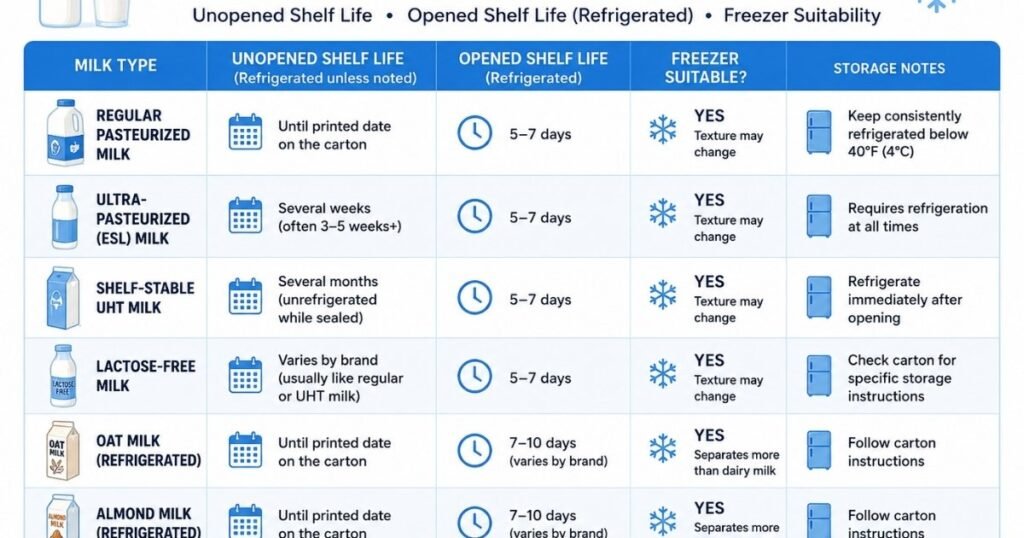
Regular pasteurized milk is generally good until the printed date while unopened, and should be used within about 5–7 days once opened. Ultra-pasteurized and ESL (extended shelf life) milk can last several weeks unopened but still needs refrigeration and prompt use after opening. Shelf-stable UHT milk can sit unrefrigerated for months while sealed, but must go in the fridge once opened, and behaves similarly to regular milk from that point on. Plant-based milk varies quite a bit by brand, so it’s worth checking the carton’s specific after-opening guidance.
Milk can also be frozen for later use — it won’t spoil in the freezer, but expect some separation or a slightly grainier texture once thawed, which is generally fine for cooking and baking but noticeable if you’re drinking it plain.
Regardless of type, discard milk that has a persistent sour or rancid smell, unexpected curdling or lumps, unusual discoloration, or a swollen, leaking, or damaged package. And one important rule: never taste-test milk that already looks or smells questionable — trust the signs you can see and smell instead.
Milk Shelf-Life Quick Reference
| Milk Type | Unopened Storage | Opened (Fridge) | Freezer Suitable? | Main Storage Note |
|---|---|---|---|---|
| Regular pasteurized milk | Until printed date, fridge | 5–7 days | Yes, texture changes | Keep consistently cold |
| Ultra-pasteurized / ESL | Several weeks, fridge | 5–7 days after opening | Yes | Still requires refrigeration |
| Shelf-stable UHT | Months, unrefrigerated (sealed) | 5–7 days after opening | Yes | Refrigerate immediately once opened |
| Lactose-free milk | Similar to regular or UHT | 5–7 days | Yes | Check carton — often UHT-processed |
| Plant-based (refrigerated) | Until printed date | 7–10 days (varies) | Yes, separates more | Follow carton instructions |
| Plant-based (shelf-stable) | Months, unrefrigerated (sealed) | 7–10 days after opening | Yes | Refrigerate after opening |
30-Second Milk Freshness Check
- [ ] Check the date — but don’t treat it as an automatic deadline
- [ ] Give it a quick smell — sour or “off” means discard
- [ ] Pour a small amount and look for lumps or separation
- [ ] Check the package for swelling, leaks, or a damaged seal
- [ ] When two or more signs point to spoilage, don’t risk it
How Long Does Milk Last After Opening? (And What About Unopened Milk?)
You’re not alone. A lot of people assume the printed date tells the whole story, but that’s only one piece of the puzzle. Whether milk is opened or unopened, how it’s processed, stored, and handled has a much bigger impact on how long it actually stays fresh.
A few key factors affect every timeline in this section:
- Processing method — regular pasteurization, ultra-pasteurization, or UHT treatment all reduce microorganisms to different degrees
- Opened vs. unopened status — opening introduces air and bacteria, starting a shorter countdown regardless of the original shelf life
- Refrigerator temperature — consistently below 40°F (4°C) matters more than almost anything else
- Time spent outside refrigeration — even short stretches on the counter add up
- Package integrity — a damaged seal shortens shelf life immediately
Regular Pasteurized Milk
This is the most common milk found in grocery store refrigerated sections. Unopened, it’s good until the printed date as long as it’s been kept cold. Once opened, plan to use it within 5 to 7 days, even if the date on the carton is further out.
Ultra-Pasteurized and ESL Milk
Ultra-pasteurized and extended-shelf-life (ESL) milk go through a higher-heat process that extends unopened shelf life to several weeks — sometimes over a month — while still requiring refrigeration the entire time. Once opened, though, it behaves much like regular milk: use it within about a week.
Shelf-Stable UHT Milk
UHT (ultra-high temperature) milk is processed and packaged so it can sit unrefrigerated on a pantry shelf for several months while sealed. This is genuinely useful for stocking up during a sale or keeping a backup carton on hand. Once opened, though, it needs to go straight into the fridge and gets used within roughly the same 5–7 day window as regular milk.
Lactose-Free Milk
Lactose-free milk is often UHT-processed to help offset the shorter shelf life that can come from the lactase enzyme added to break down lactose. Timelines are generally similar to regular or shelf-stable milk, but it’s worth checking the specific carton, since processing methods vary between brands.
Plant-Based Milk
Plant-based milks — almond, oat, soy, and others — vary the most from brand to brand. Refrigerated cartons typically follow dates similar to regular milk, while shelf-stable versions behave like UHT milk before opening. After opening, many plant-based milks last 7 to 10 days, sometimes a bit longer, but this really does depend on the specific product, so the carton’s instructions should take priority over general rules.
If your household goes through more than one type of milk, it’s worth checking specifics like how long almond milk lasts or how long oat milk lasts separately, since they don’t always follow dairy milk’s timelines.
Milk Shelf Life by Type: Unopened vs. Opened
| Milk Type | Unopened | Opened |
|---|---|---|
| Regular pasteurized | Until date, refrigerated | 5–7 days |
| Ultra-pasteurized / ESL | Several weeks, refrigerated | 5–7 days |
| Shelf-stable UHT | Months, unrefrigerated | 5–7 days (refrigerate) |
| Lactose-free | Varies, often UHT-based | 5–7 days |
| Plant-based (refrigerated) | Until date | 7–10 days |
| Plant-based (shelf-stable) | Months, unrefrigerated | 7–10 days (refrigerate) |
It’s worth comparing this to a broader sense of dairy shelf life — for instance, how long cheese lasts in the fridge follows very different rules, since aging and moisture content change things considerably.
A household that buys a gallon of regular milk and finishes it within a few days is in a completely different situation than one that buys a small long-life carton because milk gets used slowly — and that difference matters more for choosing what to buy than most people realize. We’ll come back to that later in this guide.
Milk type determines the expected timeline, while temperature and handling determine whether that timeline is realistic.
Can You Still Drink Milk After the Sell-By or Best-By Date?
The date is only part of the story. How the milk has been stored, whether it’s still sealed, and whether it shows any signs of spoilage matter much more than the calendar.
What Sell-By Means
The Sell-By date is guidance for the store, telling staff how long to display the product — it’s inventory management, not a safety cutoff for the consumer.
What Best-By Means
Best-By (or Best-Before) reflects the manufacturer’s estimate of peak quality — flavor and freshness — rather than a hard safety deadline.
What Use-By Means
Use-By is the closest of the three to an actual usage recommendation from the manufacturer, though it still isn’t a guaranteed safety line the way something like a medication expiration date would be.
How to Check Milk Past the Printed Date
Ask yourself:
- Was it continuously refrigerated, without extended time on the counter?
- Is the package still unopened and undamaged?
- Has it spent meaningful time above safe refrigerator temperatures (above 40°F)?
- Does it show any spoilage signs on smell, appearance, or texture?
If the answers are reassuring across the board, the milk is often still usable. If even one answer raises concern, lean toward discarding it.
Sell-By vs. Best-By vs. Use-By
| Date Type | What It Tells You | Safety Deadline? |
|---|---|---|
| Sell-By | When the store should stop displaying it | No |
| Best-By | Estimated peak quality/flavor | No |
| Use-By | Manufacturer’s usage guidance | Closer, but not absolute |
Milk can sometimes spoil before its date if it wasn’t kept consistently cold — a warm car ride home on a summer day can do more damage than a week sitting properly refrigerated. On the other hand, properly stored milk may remain perfectly fine for several days past a Best-By date, since that date is about quality, not an on/off safety switch.
Past-the-Date Milk Decision Checklist
- [ ] Package is unopened and undamaged
- [ ] Was refrigerated consistently since purchase
- [ ] No swelling, leaking, or damaged seal
- [ ] Passes the smell test
- [ ] No lumps, curdling, or separation when poured
- [ ] If all checks pass, it’s likely still fine to use
You find an unopened carton several days past its Sell-By date at the back of the fridge. Rather than assuming the worst, walk through the checklist above — more often than not, if it’s been consistently cold and the seal is intact, it’s still perfectly good.
This same logic applies to discounted, near-date milk at the store: if the package is cold, sealed, and undamaged, and you have a clear plan to use or freeze it soon, it’s often a legitimate deal rather than a risk. But if the discount is deep because the date is very close and your household goes through milk slowly, the likely waste can outweigh the savings.
The printed date guides the decision, but storage history and spoilage signs determine the final action.
How Can You Tell if Milk Has Gone Bad?
Before you throw away a carton of milk—or risk taking a sip—take a closer look.The smell, appearance, texture, and even the condition of the carton usually tell the story long before you ever taste it.
Check the Smell
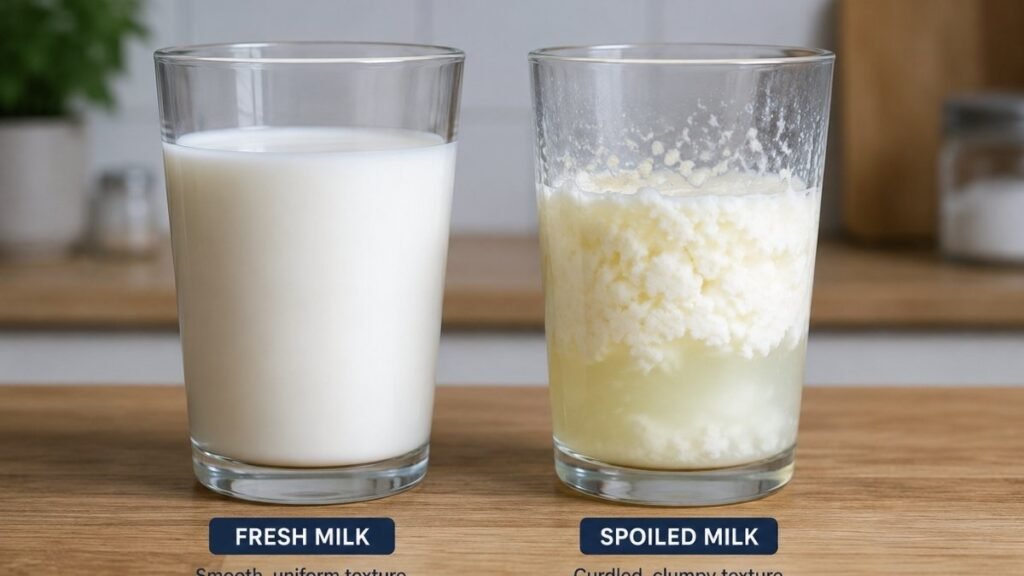
Fresh milk has a mild, faintly sweet smell, or barely any smell at all. Spoiled milk develops a distinctly sour, sharp, or rancid odor that’s usually unmistakable the moment you open the carton.
Check the Appearance
Fresh milk looks smooth and evenly colored. Spoiled milk may show visible lumps, curdling, or an unusual off-white, yellowish tint that wasn’t there before.
Check the Texture
Normal milk pours in a smooth, even stream. Spoiled milk can turn thick, ropey, grainy, or chunky — a texture change that’s usually obvious once you pour a small amount out.
Inspect the Package
Beyond the milk itself, check the carton or jug for:
- Swelling or bulging (a sign of gas-producing bacteria)
- Leaks around the seams or cap
- A damaged or loose cap or seal
- Dried, crusty residue around the opening
One important distinction: plant-based milks often separate naturally, especially after sitting for a while — this is usually just settling and resolves with a good shake, unlike true spoilage, which involves an actual off odor or curdled texture that a shake won’t fix.
Fresh Milk vs. Spoiled Milk
| Sign | Fresh Milk | Spoiled Milk |
|---|---|---|
| Smell | Mild, faintly sweet | Sour, sharp, rancid |
| Appearance | Smooth, even color | Lumps, curdling, discoloration |
| Texture | Smooth, even pour | Thick, ropey, grainy |
| Package | Sealed, flat, dry | Swollen, leaking, damaged |
Smell, Look, Texture, and Package Check
- [ ] Smell it directly from the opening
- [ ] Pour a small amount into a glass to check appearance
- [ ] Note the texture as it pours
- [ ] Inspect the package for swelling or leaks
- [ ] If two or more signs are off, discard it
Pouring milk into a clean glass, rather than judging it straight from the carton, makes subtle separation, lumps, or off-color much easier to spot. It only takes a few seconds and removes a lot of the guesswork.
Persistent bad odor, abnormal texture, curdling, or damaged packaging means the milk should be discarded.
Where Should You Store Milk in the Fridge?
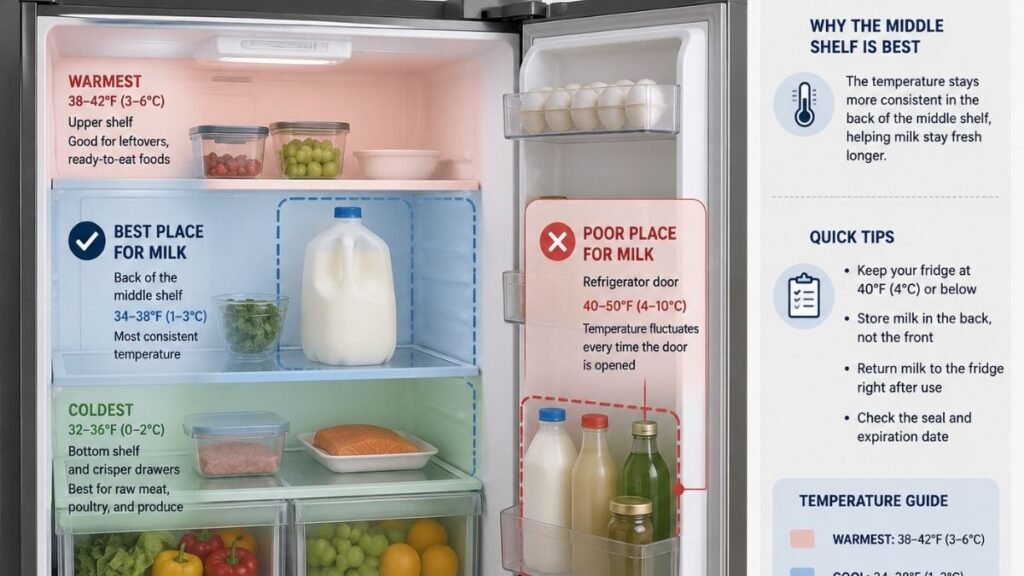
A lot of people keep milk in the refrigerator door because that’s where the built-in shelf is—but it’s not the best place for it. The door warms up every time it’s opened, while an interior shelf stays at a more consistent temperature, helping milk stay fresh for longer.
Keep Milk Off the Refrigerator Door
The door is the warmest and least stable part of the fridge, since it’s exposed to room temperature air every time it’s opened. Even though most refrigerators are designed with a milk shelf built into the door, a stable interior shelf actually keeps milk fresher for longer.
Maintain a Safe Refrigerator Temperature
Keep your fridge at or below 40°F (4°C). A refrigerator thermometer is a more reliable way to confirm this than trusting the dial alone, since the number on the dial doesn’t always reflect the actual internal temperature — especially in an older or heavily packed fridge. Just be careful not to store milk directly against the back wall of the fridge, where it can occasionally freeze if the appliance runs cold.
Limit Warming and Contamination
- Return milk to the fridge immediately after pouring — don’t leave it out for the whole meal
- Keep the cap or lid tightly closed between uses
- Avoid drinking directly from the container
- Use clean utensils or glasses, never one that’s already been in someone’s mouth
- Never pour unused milk back into the original carton
- Minimize unnecessary transfers between containers
Milk Refrigerator Storage Checklist
- [ ] Store on an interior shelf, not the door
- [ ] Keep the fridge at or below 40°F
- [ ] Use a fridge thermometer to confirm actual temperature
- [ ] Return milk to the fridge right after pouring
- [ ] Keep the cap sealed tightly between uses
- [ ] Never drink straight from the carton
It’s an extremely common habit at breakfast — the milk carton sits out on the table for the entire meal, sometimes 20–30 minutes, while everyone eats. That’s usually not long enough to cause real harm on its own, but doing it repeatedly, meal after meal, day after day, adds up and can meaningfully shorten how long the carton stays fresh overall.
Why Does Organic or Ultra-Pasteurized Milk Last Longer?
Organic milk can stay fresh for weeks longer than regular milk, and that’s one of the questions shoppers ask most often. The longer shelf life usually isn’t due to added preservatives. Instead, it comes from the way the milk is processed and packaged before it reaches the store.
Pasteurized vs. Ultra-Pasteurized Milk
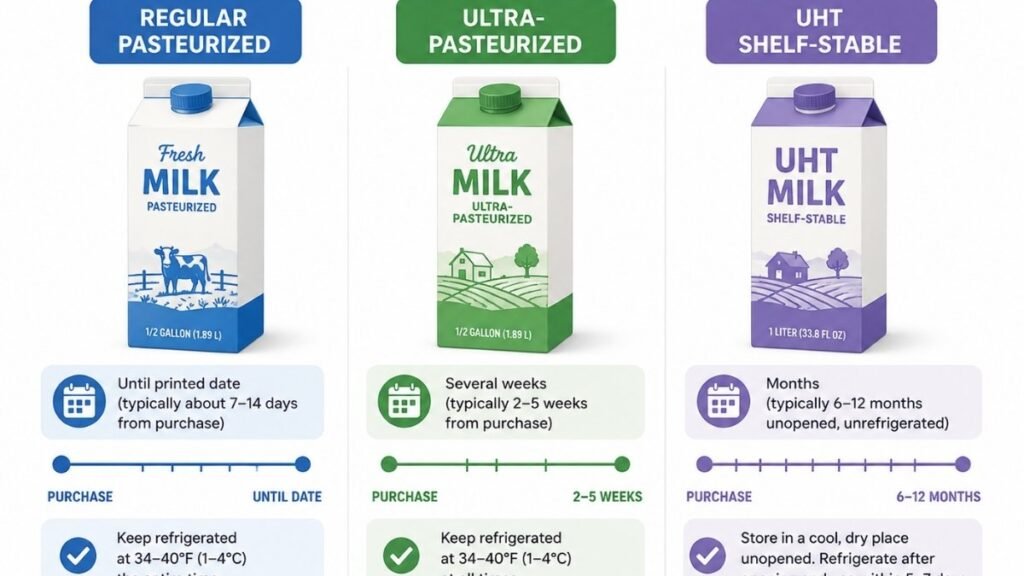
Standard pasteurization heats milk enough to make it safe while preserving flavor and nutritional qualities familiar to most shoppers. Ultra-pasteurization uses a higher temperature for a short time, which extends unopened shelf life considerably — often to several weeks — while still requiring refrigeration throughout.
Ultra-Pasteurized vs. Shelf-Stable UHT Milk
UHT (ultra-high temperature) processing goes a step further, combined with sterile packaging, allowing the sealed carton to sit unrefrigerated on a shelf for months. The key difference from ultra-pasteurized milk is the packaging and storage requirement before opening — UHT doesn’t need refrigeration until it’s opened, while ultra-pasteurized milk does.
Does Long-Life Milk Contain Preservatives?
Generally, no — the extended shelf life comes from the heat treatment and the sterile, sealed packaging, not from added chemical preservatives. This is a common misconception worth clearing up, since “lasts longer” doesn’t automatically mean “processed with additives.”
Is Longer-Lasting Milk Worth the Price?
This depends heavily on your household’s consumption rate. Organic milk is often ultra-pasteurized as a side effect of how it’s typically processed and distributed, which is part of why it tends to last noticeably longer than a standard carton — not necessarily because it’s organic itself.
Regular vs. Ultra-Pasteurized vs. UHT Milk
| Processing Method | Refrigeration Before Opening | Unopened Shelf Life | After Opening | Best Household Fit |
|---|---|---|---|---|
| Regular pasteurized | Required | Days to ~2 weeks | 5–7 days | Households that finish milk quickly |
| Ultra-pasteurized/ESL | Required | Several weeks | 5–7 days | Moderate-use households wanting a buffer |
| UHT (shelf-stable) | Not required (sealed) | Months | 5–7 days | Backup stock, low-use households, stockpiling on sale |
A household that goes through a gallon of regular milk in a few days doesn’t gain much by paying more for ultra-pasteurized or organic milk — the extended shelf life mostly benefits it while unopened, and that advantage disappears once the carton is opened either way. A single adult who only uses a splash of milk in coffee each morning, on the other hand, often sees real value in a smaller, longer-life carton, since regular milk in that situation is more likely to spoil before it’s finished.
Can You Freeze Milk?
Yes, most dairy and many plant-based milks can be frozen — it won’t make milk unsafe, but expect some fat separation and a slightly grainier texture once thawed, which works better for cooking and baking than for drinking plain.
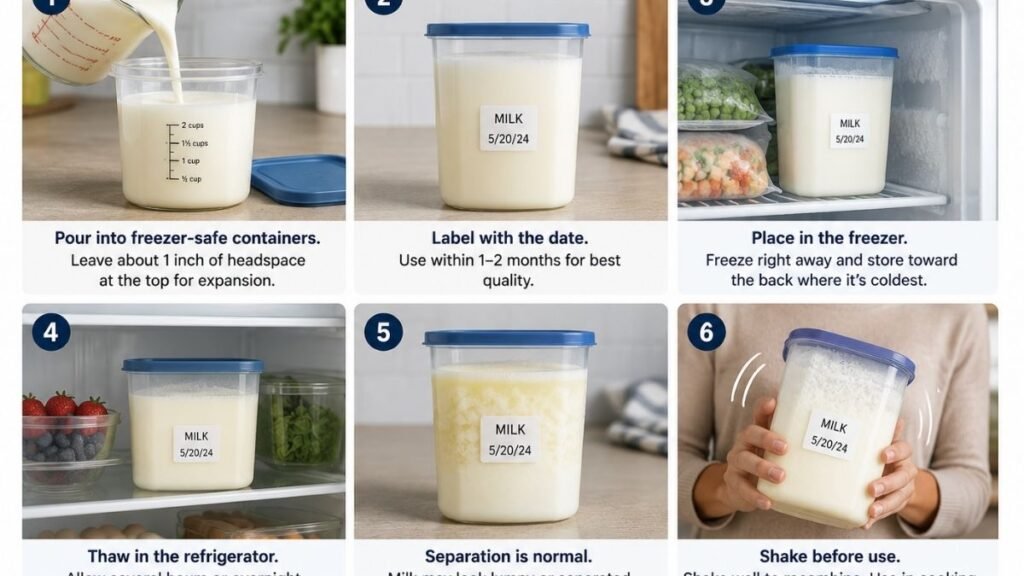
How to Freeze Milk Safely
- Freeze milk while it’s still fresh, not as a last-minute rescue for milk that’s close to its date.
- Use freezer-safe containers, and leave some expansion space at the top since liquids expand as they freeze.
- Portion milk based on how you’ll actually use it later — small portions for coffee, larger ones for baking or recipes.
- Seal containers tightly and label each with the date frozen.
- Avoid glass containers unless they’re specifically freezer-safe, since regular glass can crack under the pressure of expanding liquid.
How to Thaw Frozen Milk
Thaw frozen milk in the refrigerator rather than at room temperature. Once thawed, shake or stir well before using, since separation is normal and usually resolves with a good shake.
What Texture Changes to Expect
Freezing can cause the fat in milk to separate, which sometimes results in a slightly grainy or watery texture after thawing. This is a quality change, not a safety issue, and it’s most noticeable when drinking the milk plain.
Best Uses for Thawed Milk
Thawed milk works especially well in:
- Cooking and sauces
- Baking (muffins, pancakes, breads)
- Smoothies, where texture changes go largely unnoticed
- Soups and creamy dishes
Milk Freezing Checklist
- [ ] Freeze while milk is still fresh
- [ ] Use freezer-safe containers with expansion space
- [ ] Portion based on planned use
- [ ] Label with the date frozen
- [ ] Thaw in the fridge, not at room temperature
- [ ] Shake or stir well before using
If milk mainly goes into coffee, pancakes, or sauces in your household, freezing it in small, recipe-sized portions — think ice cube trays or small containers — means you can grab exactly what you need without thawing a whole carton at once.
One important caution: freezing does not rescue milk that’s already spoiled, and repeatedly freezing and thawing the same portion isn’t a good idea either — freeze once, in the portion size you’ll actually use.
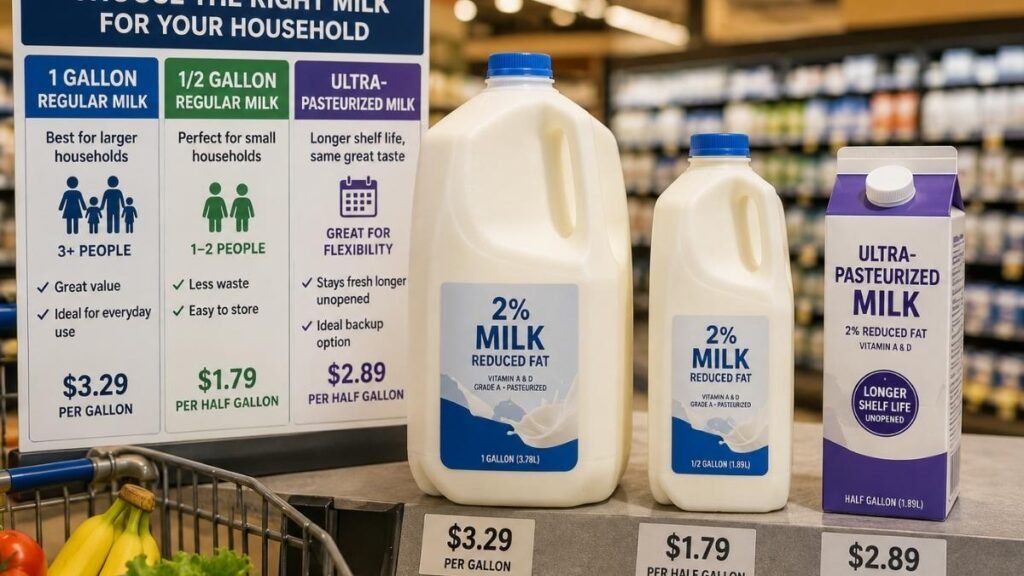
Is Buying Milk in Bulk Really the Best Deal?
I used to assume the biggest carton was always the cheapest option. After throwing away more unfinished milk than I’d like to admit, I realized the better deal isn’t always the one with the lowest price per gallon. What really matters is how much your household finishes before the milk goes bad.
Compare Cost Per Amount Used
A gallon priced lower per ounce than a half-gallon looks like the better deal on paper, but if a third of it ends up down the drain because it wasn’t finished in time, the effective cost per ounce actually used can end up higher than the smaller carton.
Choose the Right Package Size
Think through:
- How many people in your household actually drink milk
- Roughly how much gets used per week
- Available fridge (and freezer) space
- Whether milk is mostly a drink, a coffee addition, or a cooking ingredient
A family that goes through milk quickly for cereal, drinking, and cooking is well-suited to gallon sizes. A smaller household, or one that only uses milk occasionally, is often better off with a half-gallon or quart — or a shelf-stable UHT carton that doesn’t need to be rushed once it’s home.
When Long-Life Milk Saves Money
If your household regularly ends up tossing out unused milk, a longer-lasting ultra-pasteurized or UHT option — even at a slightly higher shelf price — can end up cheaper overall once waste is factored in.
When Discounted Milk Is Worth Buying
Discounted, near-date milk is worth buying when:
- The package is cold, sealed, and undamaged
- There’s enough time left to use it or freeze it promptly
- Your household can realistically finish it (or freeze it) before quality declines
Gallon vs. Half-Gallon vs. Long-Life Milk
| Factor | Gallon | Half-Gallon | Long-Life (UHT/Ultra-Pasteurized) |
|---|---|---|---|
| Upfront cost | Lowest per ounce | Moderate | Often higher per ounce |
| Best for | High-use households | Moderate-use households | Low-use households, backup stock |
| Likely waste | Higher if under-consumed | Lower | Lowest, if opened portion is used |
| Effective cost | Can be higher if wasted | Usually balanced | Can be lower for slow users |
Bulk Milk Buying Checklist
- [ ] Estimate realistic weekly consumption before buying
- [ ] Check that discounted milk is cold and sealed
- [ ] Have a plan to freeze any milk you won’t finish in time
- [ ] Compare unit price against your household’s actual use, not just the sticker price
- [ ] Consider a smaller or long-life carton if waste has been a recurring issue
A family that reliably finishes a gallon within four or five days is getting genuine value from the lower unit price. A single adult who only splashes milk into coffee each morning is often better served by a smaller carton or a shelf-stable option — buying the “cheaper” gallon in that situation often just means throwing part of it away later, which isn’t actually a deal at all.
How to Use Milk Before It Spoils
The best way to avoid wasting milk is to use it deliberately before quality starts to decline — not to try to rescue milk that’s already spoiled by cooking or baking with it, which never works and isn’t safe.
There’s an important distinction here: milk that’s simply nearing its quality date but shows no spoilage signs is completely fine to cook with. Milk that’s already sour, curdled, or otherwise showing spoilage signs should be discarded, never repurposed.
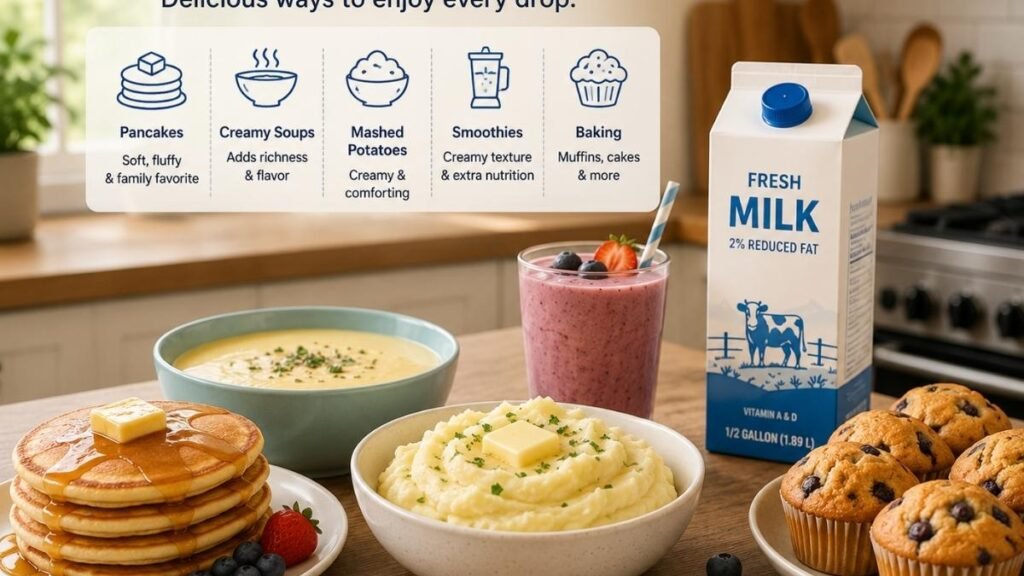
Use It in Breakfast Recipes
- Pancakes and waffles
- Muffins and biscuits
- Oatmeal or overnight oats
Add It to Savory Meals
- Mashed potatoes
- Cream-based soups
- Sauces and gravies
Plan a Use-First Day
If leftover milk near the end of the week is a recurring issue in your household, plan one milk-heavy meal — a creamy soup, a batch of pancakes, or a smoothie night — specifically to use it up before it turns.
Discard Milk That Shows Spoilage Signs
Never treat spoiled milk as an ingredient, even for something like baking. Sour, curdled, off-smelling milk should be discarded, not repurposed — that’s different from intentionally soured buttermilk, which is a separate, controlled process.
Use-It-Before-It-Spoils Plan
- [ ] Check dates and freshness at the start of the week
- [ ] Plan at least one milk-heavy recipe for milk that’s nearing its window
- [ ] Keep a visible “use first” spot in the fridge for items closer to their date
- [ ] Freeze any extra milk you won’t get to in time
- [ ] Discard, don’t cook with, milk that already shows spoilage signs
A “use-first” shelf or bin — even just a designated spot at the front of the fridge — makes a noticeable difference. It’s a small system, but it means milk (and other perishables) actually get seen and used instead of quietly pushed to the back until it’s too late.
Frequently Asked Questions
How long does opened milk actually last in the fridge past the 7-day rule? Most opened milk is good for about 5 to 7 days, and that’s a reasonable general guideline rather than a strict cutoff. If it’s been kept consistently cold and passes the smell, appearance, and texture check, it may be fine for a day or two beyond that — but always rely on those checks rather than the day count alone.
Is unopened milk still safe to drink past its sell-by or best-by date? Often, yes — if it’s been continuously refrigerated, the package is undamaged, and it shows no spoilage signs. Sell-by and best-by dates are about inventory and quality, not a strict safety deadline, so check the milk itself before deciding.
Why does organic or ultra-pasteurized milk last so much longer than regular milk? It’s processed at a higher temperature, which reduces more microorganisms than standard pasteurization. This is a processing difference, not typically the result of added preservatives, and organic milk is often ultra-pasteurized as part of standard distribution practices.
Where is the best place in the refrigerator to store milk so it lasts longer? An interior shelf, not the refrigerator door. The door experiences far more temperature fluctuation every time it’s opened, which shortens milk’s usable life more than most people expect.
How can you tell if milk has gone bad without drinking it? Check the smell (sour or rancid means spoiled), the appearance (lumps or curdling when poured into a glass), the texture (thick or grainy instead of smooth), and the package (swelling, leaks, or a damaged seal). Never taste-test milk that already shows any of these signs.
Can you freeze milk to extend its shelf life, and how do you thaw it properly? Yes, freeze it while it’s still fresh, in a freezer-safe container with room for expansion. Thaw it in the refrigerator, not at room temperature, and shake or stir well before use, since some separation is normal.
Is organic milk actually more cost-effective for small households due to its longer shelf life? It can be, particularly for households that use milk slowly and often end up throwing part of it away. For high-use households that finish milk quickly, the extended unopened shelf life doesn’t add much practical value, since it disappears once the carton is opened either way.
What can you safely cook or bake with milk that is slightly sour or just past its prime? Milk that’s simply near its quality date but shows no actual spoilage signs is fine to use in pancakes, muffins, mashed potatoes, or cream-based soups. Milk that’s already sour, curdled, or off-smelling should be discarded — cooking or baking doesn’t reverse spoilage or make it safe.
Final Thoughts
Whether you’re wondering how long does milk last or simply trying to avoid pouring another half-full carton down the drain, the answer is usually simpler than it seems. I’ve found that paying attention to how milk is stored—and trusting its smell, appearance, and texture instead of relying only on the printed date—makes shopping and meal planning much less stressful.
A few small habits can make a surprisingly big difference: keep milk on an interior refrigerator shelf, return it to the fridge as soon as you’re done using it, and buy only the amount your household is likely to finish before it spoils. Those simple changes can help you waste less food, save a little more on groceries, and feel more confident every time you reach for the milk.
🏠 Behind This Guide
Knowing how long milk lasts isn’t just about the date on the carton—it’s about storing it well, wasting less, and getting the most from every grocery trip.
That’s why this guide focuses on the practical questions people ask every day, from understanding expiration dates to storing milk properly and deciding when it’s still safe to use.
This guide is built around three essentials:
- 🥛 Milk Storage — Where to keep milk, how cold your fridge should be, and common storage mistakes.
- 📅 Shelf Life — How long different types of milk stay fresh after opening, freezing, or passing the printed date.
- 💰 Smarter Grocery Habits — Buying the right amount, reducing food waste, and saving money over time.
Because the goal isn’t just to answer how long does milk last.
It’s to help every carton last a little longer—and every grocery dollar go a little further.
🥛 Continue Building Smarter Grocery Habits
Keeping milk fresh is just one way to reduce food waste and save money. These practical guides can help you store everyday groceries properly, stretch your food budget, and make the most of every shopping trip.
- How Long Does Food Last in the Fridge? — Learn how long common foods stay fresh and when it’s time to use or discard them.
- How Long Does Cheese Last in the Fridge? — Discover the storage timelines for different cheeses and the signs they may have spoiled.
- How to Save Money on Groceries — Simple shopping habits that help your household spend less without sacrificing quality.
- How Long Do Leftovers Last in the Fridge? — Store leftovers safely and know exactly when they’re still good to eat.
- Pantry Staples List — Build a well-stocked pantry with everyday essentials that save time, money, and unnecessary grocery trips.
❤️ A Final Note
Making the most of your groceries isn’t about being perfect—it’s about making small, informed choices every day.
At Pantryva, we create practical food storage, grocery, and kitchen guides that help everyday households waste less, spend smarter, and feel more confident about the food they bring home. Every article is built around clear, reliable advice you can trust in real life.
Our goal is simple: helping you make smarter food decisions, save more on every grocery trip, and get the most from every item in your pantry.